
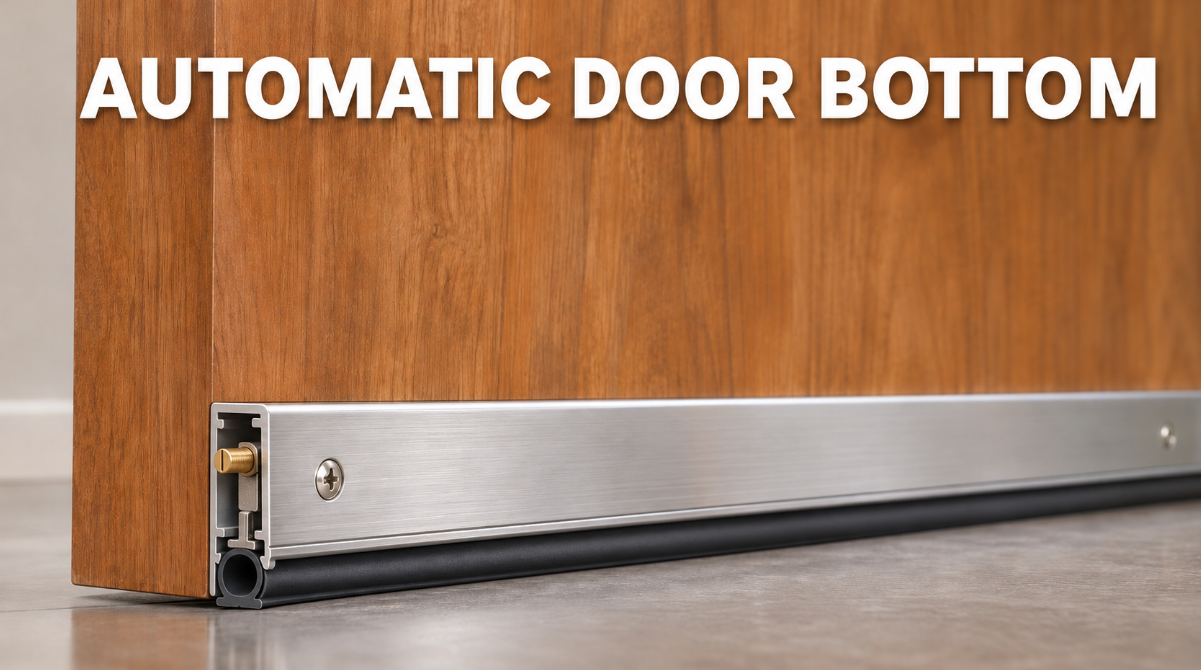
The answer to what is an automatic door bottom fits in one line. It's a concealed or surface-mounted seal at the base of a door that drops to the floor when the door closes and retracts when it opens. A spring and a small plunger operate it, with no electrical power or wiring, and it stays clear of the floor while the door swings.
Manufacturers also sell this hardware as an automatic door seal, door drop seal, drop down door seal, or automatic door sweep. Whatever the label, it blocks sound, drafts, light, and insects at the bottom of a door.
How Does an Automatic Door Bottom Work?
An automatic door bottom uses the closing motion of the door to operate the seal. A housing contains a spring-loaded bar with a rubber or neoprene strip, and a plunger protrudes from the hinge end of the housing. The sequence runs as follows:
- As the door closes, the plunger meets the door frame and gets pushed in.
- That movement drives the spring mechanism inside the housing.
- The seal drops, touching down at the hinge side first and then along the rest of the door.
- When the door opens, the plunger springs back and the seal lifts.
The hinge-side touchdown matters more than it sounds. Because that end lands first, the seal comes straight down instead of skidding across the floor, so the door doesn't hang up and the strip wears slowly.
Most models also allow adjustment, since turning a nut or screw at the plunger changes how far the seal drops and how much pressure reaches the floor. Too little pressure leaves a gap, and too much can make the door difficult to latch.
Types of Automatic Door Bottoms
Automatic door bottoms come in three mounting styles, and the choice depends mostly on whether the door is already hanging. Drop distance varies by model, so the figures below are examples from one manufacturer's data sheet.
| Type | Where it sits | Installation | Example maximum drop | Best fit |
| Surface mounted | On the door face | Drill and screws, door stays on its hinges | Up to 1/2" | Retrofits |
| Semi-mortised | In a notch cut into the door face | Routing, partly recessed | Up to 1" | Doors where a slimmer profile matters |
| Mortised | Inside a channel in the door bottom | Door comes off and gets routed | Up to 1/2" | New construction and doors where hardware should stay hidden |
A surface-mounted automatic door bottom suits most existing doors, since it goes on with basic tools. A mortise automatic door bottom looks cleaner, but it needs a door thick enough to take the channel and someone equipped to cut it accurately.
Automatic Door Bottom vs Door Sweep
The main difference is contact with the floor. A fixed door sweep stays in the same position, so it rubs the floor or threshold on every swing. An automatic door bottom touches down only when the door is closed.
As a result, sweeps wear faster and can drag on carpet, while a drop seal lifts clear of both surfaces. Sweeps remain simpler and less expensive, which makes them a sensible choice for a back door where drafts matter more than noise. For sound control, the firm, even pressure of a drop seal gives it the advantage.
How Much Sound Does an Automatic Door Bottom Block?
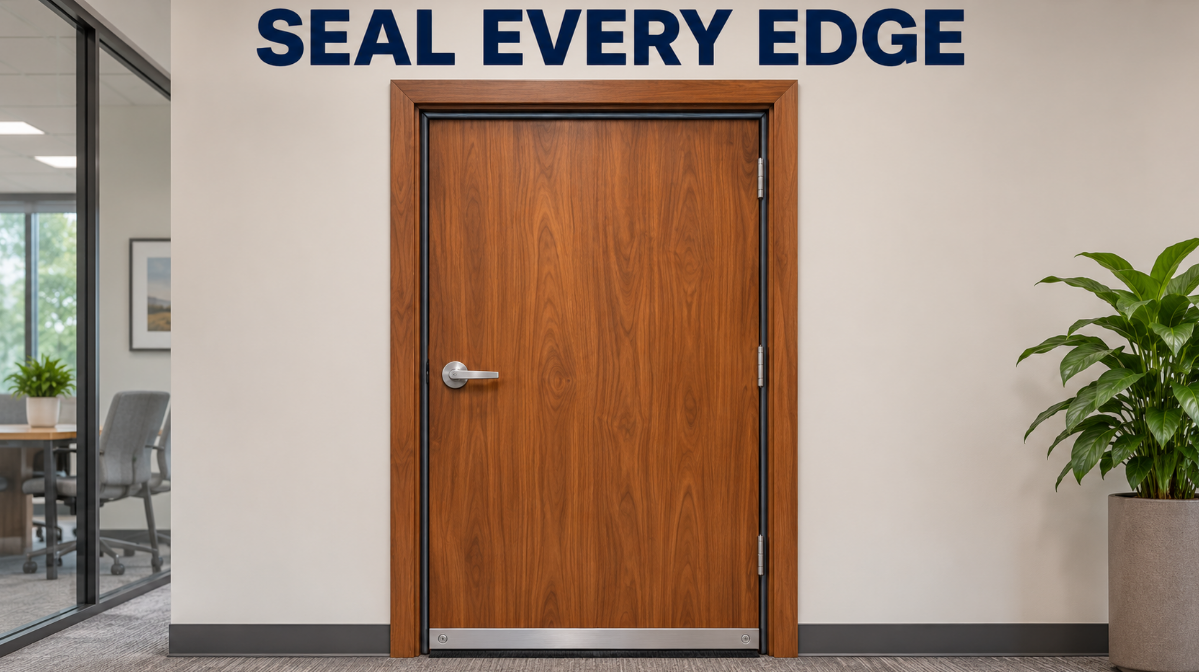
An automatic door bottom doesn't have a sound rating of its own, because an STC rating belongs to the complete door assembly. The seal's contribution depends on the door slab, the frame, and every other gap around it. Any figure you see quoted should come with a description of the full system tested.
Research shows how much the gaps matter. J.D. Quirt of National Research Council Canada tested a solid-core wood door under ASTM E90. With no seals it rated STC 22, weatherstripping lifted it to between STC 26 and 30, and fully sealing the gaps took it to STC 31. A hollow metal door in the same series went from STC 17 to STC 35.
Those tests sealed all four edges, so they show the value of a complete seal instead of a bottom seal alone. An open gap at the floor can undo the work on the other three sides, and the reverse is also true. A door with a good drop seal and open gaps along the jambs still leaks sound.
Where an Automatic Door Bottom Works Best
These seals suit interior doors where sound, light, or air needs to stay on one side: offices, bedrooms, studios, conference rooms, and exam rooms. Performance depends on the surface below the door and on any accessibility or fire requirements that apply.
Floors and Thresholds
A drop seal door needs a smooth, flat surface for the strip to press against, such as a threshold or hard flooring. A slightly uneven floor is manageable, since the strip has some give and the drop adjusts. On carpet, the seal can't close the gap through the pile as well, so a threshold under the door usually gives a tighter result.
Check the gap before you buy. Published seal ranges run from about 0.3 inch to 1 inch, and a door cut higher than the unit can reach will need a threshold or a different model.
Accessible Doors
The 2010 ADA Standards limit thresholds to 1/2 inch in new construction, and they cap the opening force for interior hinged doors at 5 pounds. Every drop seal adds some resistance as the plunger compresses, so some manufacturers offer light-spring models for accessible openings.
The standards also require a smooth surface on the push side of the door, up to at least 10 inches from the bottom. Check how a surface-mounted unit affects that side before you specify one for an accessible door.
Fire and Smoke Doors
Seals and thresholds on a fire door have to be listed for that use, so a standard door bottom can't simply be added to a rated opening. Some automatic door bottoms carry UL 10C fire listings and UL 1784 smoke testing, and the listing should match the door you have. Codes rarely call for a bottom seal on fire doors or smoke doors, though a few elevator lobby conditions do. Confirm the requirement with your local authority. The surface-mounted model we carry doesn't list a fire or smoke rating.
How to Size an Automatic Door Bottom
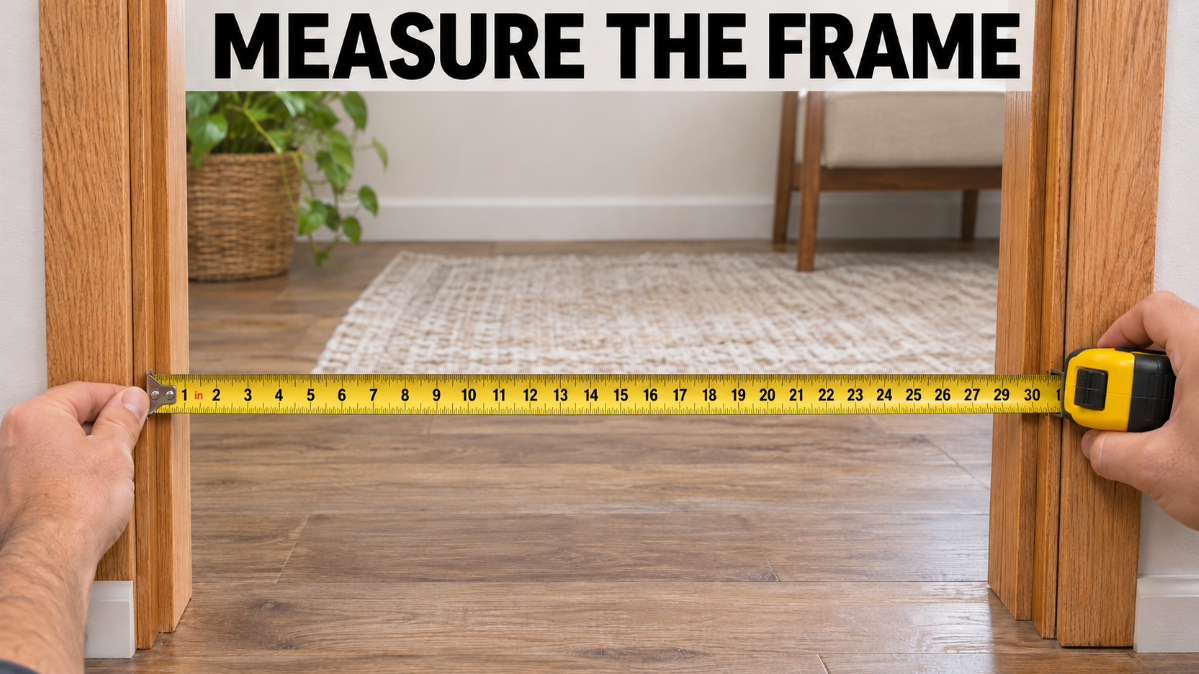
To size an automatic door bottom, measure the distance between the frame stops at the bottom of the door. For a single door, the unit should be 1/8 inch shorter than that distance. For double doors, measure from the frame stop to the meeting edge of the door and go 1/16 inch shorter.
Next, measure the gap under the closed door at the hinge side, the center, and the latch side. Our automatic door bottom seal comes in standard lengths from 24 to 48 inches and can be made from 12 to 96 inches. It suits an undercut of up to 3/4 inch with a drop of up to 7/8 inch. Made-to-order items are final sale, so double-check your measurements first.
A drop seal handles only the bottom edge. For sound, pair it with perimeter door seals along the head and jambs, or look through our heavy-duty door seals for busy openings. If noise is also coming through the wall, our sound isolation range covers the rest of the assembly.
Send us your door size, gap, and floor type, and we'll help you choose the right combination.
Recent posts


