
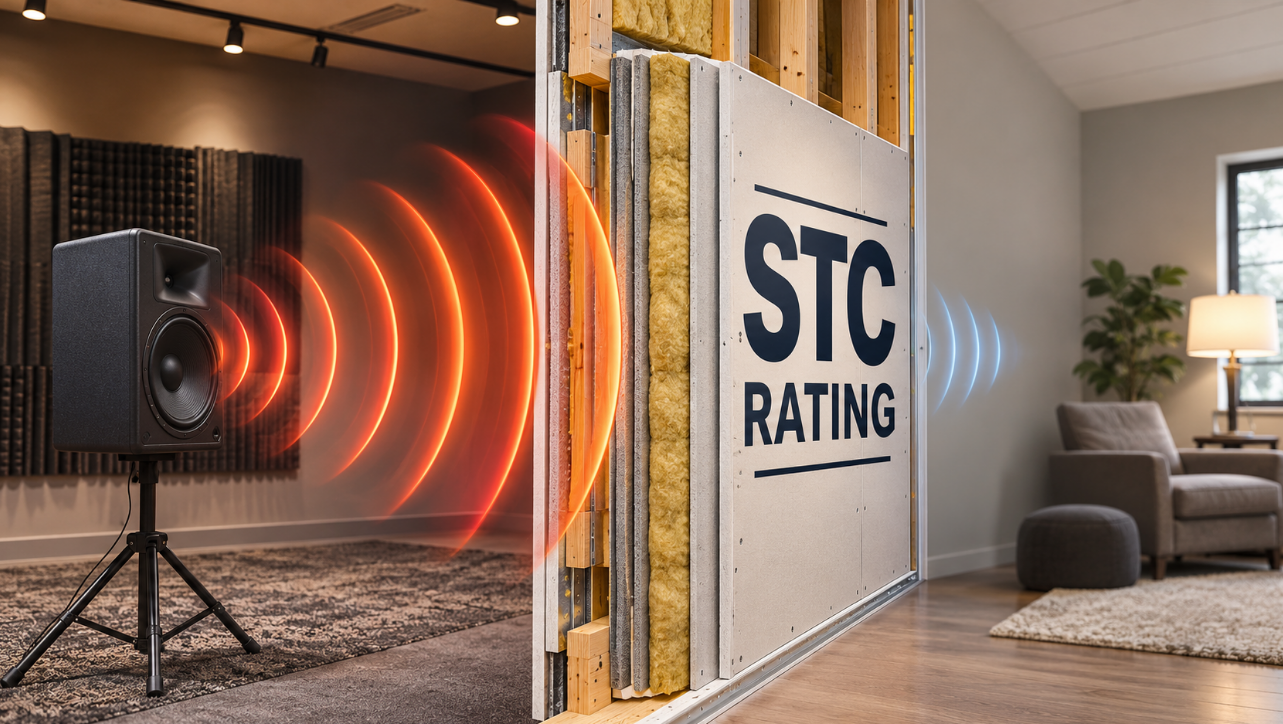
The short answer to what is an STC rating: it's a single number showing how well a wall, floor, door, or window blocks airborne sound between two spaces. STC stands for sound transmission class, and a higher number means less sound gets through. A wood stud wall with one layer of drywall per side tests around STC 33, while the International Building Code asks for STC 50 between apartments.
If you're looking up the STC rating meaning because of a noisy neighbor or a new build, keep one limit in mind from the start. The rating describes sound moving between rooms, while echo inside a room falls under a different measurement entirely.
What an STC Rating Measures
An STC sound rating measures how much airborne sound a finished construction stops on its way from one space to the next. Voices, television, and similar everyday noise fall in its range, which runs across 16 frequency bands from 125 Hz to 4,000 Hz. Anything lower sits outside the test.
The formal STC rating definition comes from ASTM E413, which ties the number to speech, radio, television, and similar noise in offices and buildings. Two details cause most of the confusion when people read sound transmission class ratings on a specification sheet.
Why STC Is Not a Decibel Number
An STC rating of 50 doesn't mean a wall removes 50 decibels. Every wall stops a different amount at each frequency, usually far less in the bass range than in the treble. The rating squeezes that whole curve into one value, so it works well for comparing two walls and poorly for predicting what a single sound will do.
Why the Rating Belongs to the Assembly
The number describes a complete build tested as a unit, including the framing, insulation, board, and everything between them. A tube of compound or a roll of vinyl can't carry a meaningful STC on its own, because the result depends on what surrounds it.
STC ratings don't add up, either. In one National Research Council Canada series, a second layer of board on one side of an STC 32 wall raised it to STC 37. Anyone who assumes the extra layer brings its own rating along will overestimate the result.
How STC Is Tested and Calculated
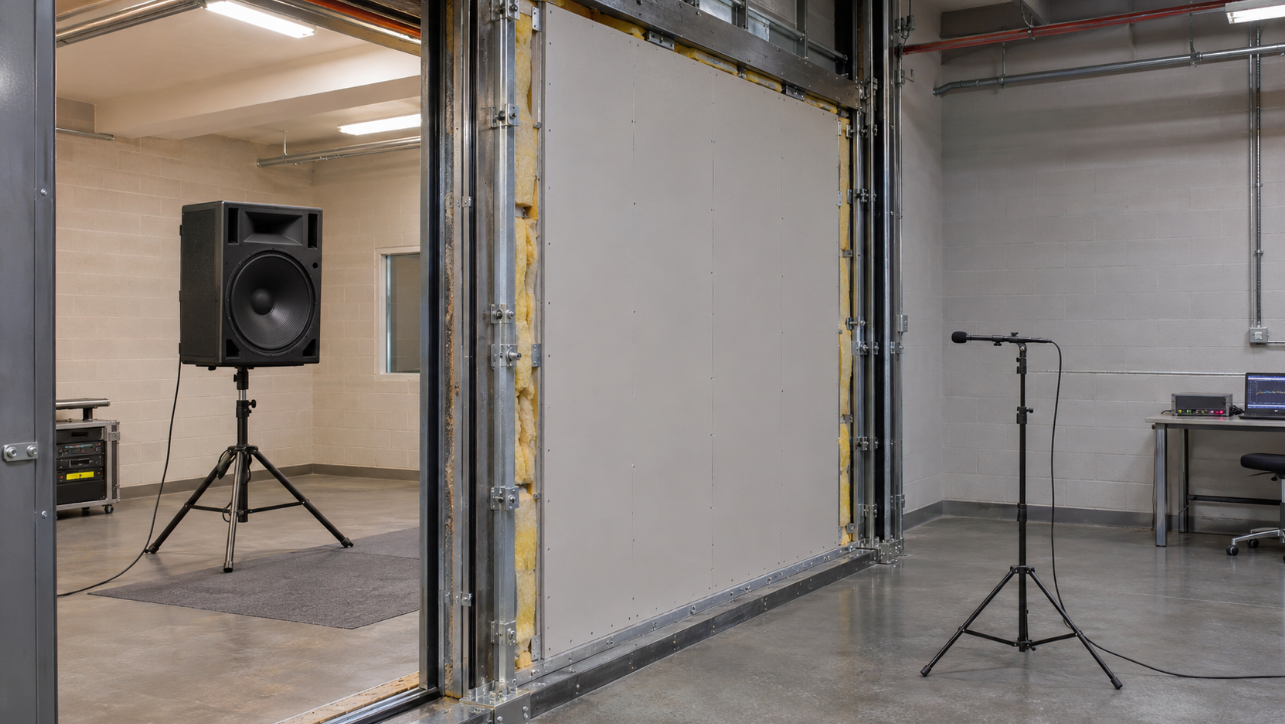
STC testing takes place in a laboratory under ASTM E90, and the math follows ASTM E413. The sample fills an opening between two test rooms that are isolated from each other, which forces sound through the sample and keeps other routes out of the measurement. The process has five steps:
- A loudspeaker in the source room plays broadband noise.
- Microphones record sound levels in the source room and the receiving room.
- The lab turns the difference into transmission loss for each of the 16 frequency bands.
- A fixed reference curve moves against that data until it reaches one of two limits: a combined shortfall of 32 dB across all bands, or a shortfall of 8 dB in any one band.
- The curve's value at 500 Hz becomes the STC rating.
Step 4 explains why one weak frequency band can hold down an entire rating. ASTM has an open work item on removing the 8 dB limit, so the method may change, though the rule remains part of the standard today.
STC Rating Chart – What You Can Hear at Each Level
This STC rating chart pairs each level with what a listener typically hears through a partition. Versions differ slightly from one source to the next, and this one follows the descriptions commonly traced to a 1967 U.S. Department of Housing and Urban Development guide.
| STC | What you hear through the partition |
| 25 | Normal speech can be understood |
| 30 | Loud speech can be understood |
| 35 | Loud speech is audible but not intelligible |
| 40 | Loud speech comes through as a murmur |
| 45 | Loud speech is barely audible |
| 50 | Loud sounds are faintly heard |
| 60+ | Most sounds don't disturb neighbors |
Background noise changes these results. A quiet bedroom at night exposes sounds that a busy office hides, so the same wall can seem stronger or weaker depending on the room that receives the noise.
How Many Points Make a Real Difference
A gap of one or two points between similar walls is usually too small to hear, and laboratory results vary by about that much anyway. When National Research Council Canada rebuilt one wall six times with new materials, the results ranged from STC 56 to 59.
Differences become clearly noticeable at around five points, while a ten-point change is generally described as making sound seem twice or half as loud.
What Is a Good STC Rating?
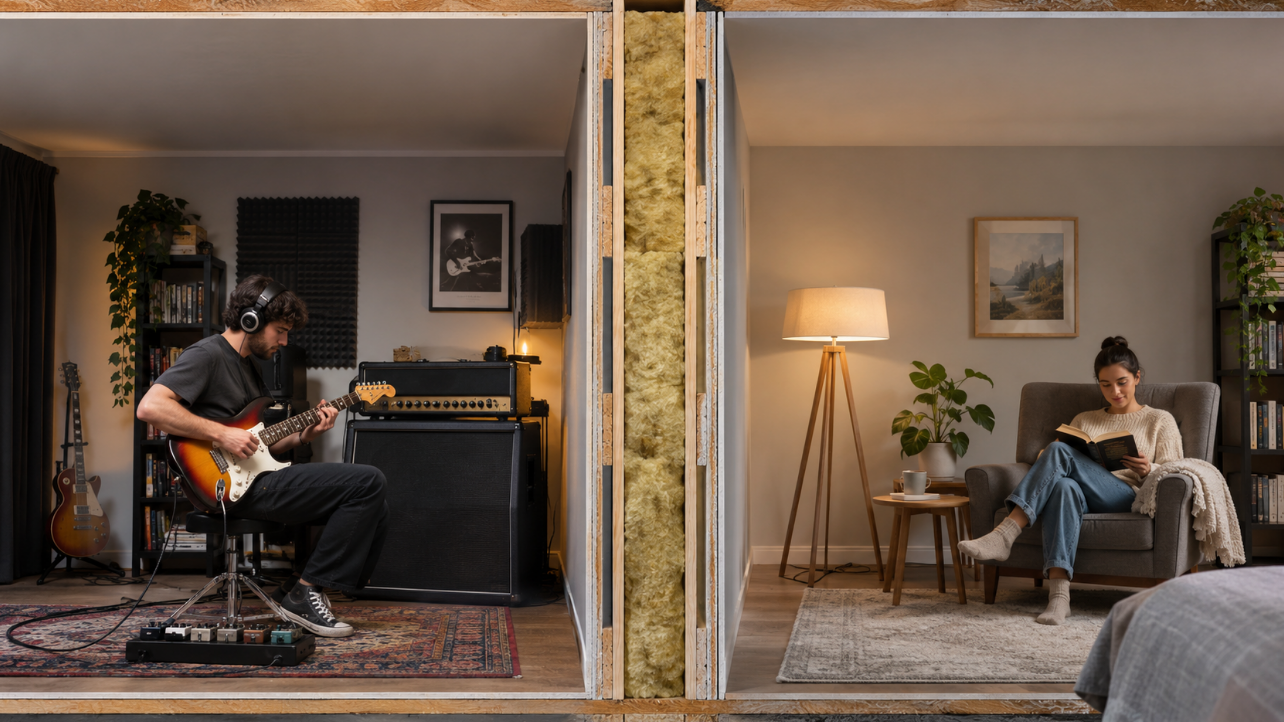
A good STC rating depends on the sound you need to contain and who's listening on the other side. For confidential speech in an office, the usual target is around STC 45. Between homes, STC 50 is the common code minimum, and research points to STC 55 or 60 for residents who want real privacy.
Building Code Minimums
Section 1206 of the 2021 International Building Code sets STC 50 for walls, partitions, and floor-ceiling assemblies between dwelling or sleeping units. The same minimum covers separations from public or service areas, and it applies to laboratory testing under ASTM E90. A field test can satisfy the section instead with a Normalized Noise Isolation Class of at least 45.
Not every jurisdiction uses the same edition or wording, so check the code that governs your project.
What Occupants Actually Notice
The code minimum and everyday comfort sit some distance apart. J.S. Bradley of National Research Council Canada surveyed 600 residents of multi-unit housing in Toronto, Vancouver, and Montreal, then compared their answers with measurements of their shared walls.
Reports of hearing and being bothered by neighbors only began to fall steadily at around STC 50. Music needed more than STC 55 before residents noticed a benefit. Bradley's recommendation was STC 55 as a realistic goal and STC 60 as the ideal for shared walls.
STC Ratings of Common Walls and Doors
The figures below come from laboratory tests, and they show how far construction can move the number. Results shift with stud spacing, board type, and workmanship, so use them to compare approaches and ask for the test report before you specify an assembly.
Walls
The STC rating of drywall by itself tells you little, because the connection between layers matters as much as the board. National Research Council Canada tested 350 gypsum board walls under ASTM E90, and this STC wall rating chart draws on that report, IRC-IR-761. Every wall listed uses wood studs spaced 16 inches on center.
| Wall assembly | Cavity insulation | STC |
| Single studs, one layer of 1/2" board per side | Mineral fiber or cellulose | 32–34 |
| Single studs, two layers of 1/2" Type X per side | Blown cellulose | 38 |
| Single studs, resilient channels on one side, one layer of 5/8" Type X per side | Glass fiber | 46 |
| Single studs, resilient channels on one side, two layers of 5/8" Type X per side | Glass fiber | 57 |
| Staggered studs, one layer of 1/2" Type X per side | Glass fiber | 45 |
| Staggered studs, two layers of 1/2" Type X per side | Glass fiber | 55 |
| Double studs with a 1" gap, one layer of 1/2" Type X per side | Glass fiber in both cavities | 58 |
Doubling the board on a rigid single stud wall added only about six points. Resilient channels, which separate the board from the studs, did far more with the same stud frame. The double stud wall scored highest of the group with just one layer of board per side, so separation clearly outperformed added weight in these tests.
Some published charts list higher figures for similar single stud walls, which is one more reason to request the test report behind any number you're quoted.
Doors
STC ratings for doors depend heavily on the seal around the slab. In tests by J.D. Quirt of National Research Council Canada, a solid-core wood door with no perimeter seals rated STC 22. Weatherstripping lifted it to between STC 26 and 30, and fully sealing the gaps took it to STC 31.
A hollow metal door in the same series climbed from STC 17 to STC 35. The door panels stayed the same throughout, so the entire gain came from closing the gaps around them.
Why a High STC Rating Can Still Disappoint
A laboratory rating describes a carefully built sample under controlled conditions, and finished rooms rarely match that. Three gaps between the rating and the result explain most disappointing projects.
Low Frequencies
The test stops at 125 Hz, so deep bass below that line doesn't count toward the rating. ASTM E413 itself says the classification doesn't suit sources such as machinery, musical instruments, many music systems, motor vehicles, aircraft, and trains.
For those sources, a strong score can still let a kick drum or truck traffic through. Ask for transmission loss data across the frequency bands, which shows what the single number hides.
Laboratory Results Versus Finished Rooms
Sound in a real building also travels around a wall through floors, ceilings, ducts, and framing, an indirect route called flanking that laboratory setups are designed to suppress. Building codes acknowledge the drop by accepting a field result five points below the laboratory target.
That five-point allowance is only a rule of thumb, since the actual difference depends on the assembly. Field ratings such as Normalized Noise Isolation Class and Apparent Sound Transmission Class report what the finished room really does.
Gaps and Weak Elements
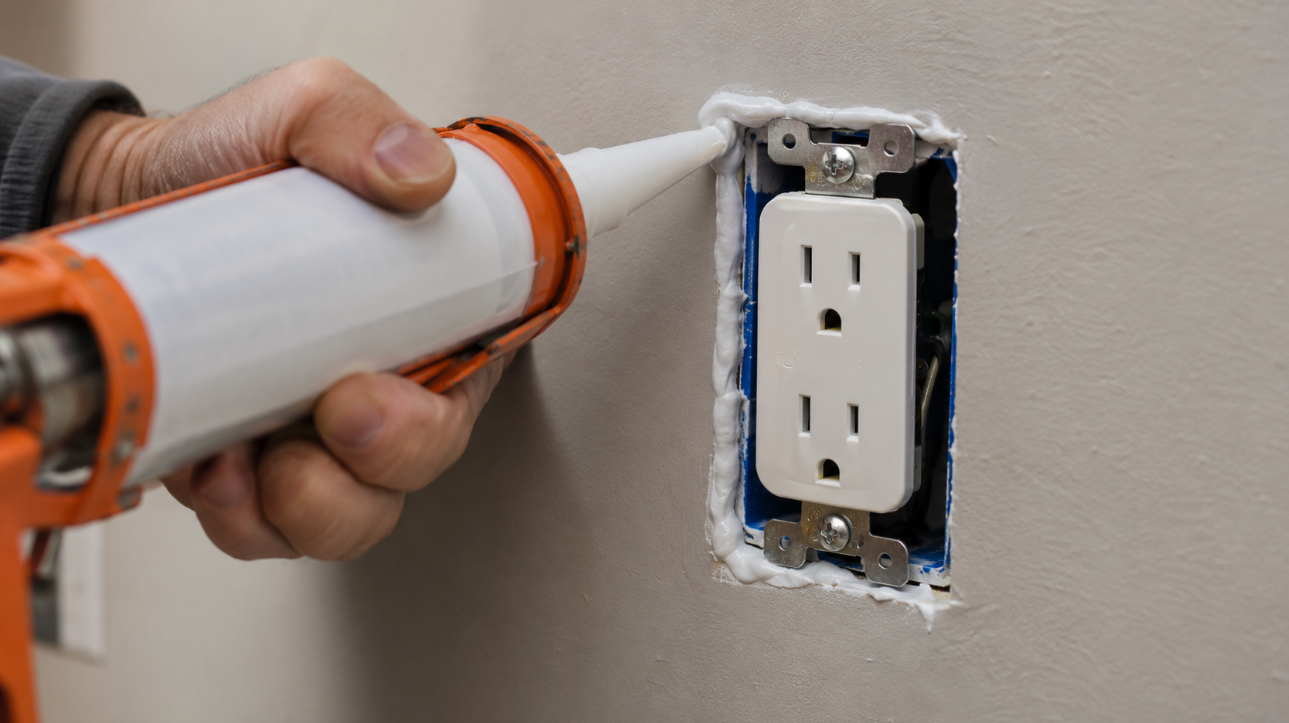
Small openings do disproportionate damage. Figures in the Handbook for Sound Engineers show a partition capable of 40 dB falling to 30 dB with just 0.1% of its area open. Back-to-back outlet boxes, unsealed pipes, and recessed lights create exactly this kind of leak.
A door or window also caps what the whole wall can do. Take a 96-square-foot wall rated STC 50 with a 21-square-foot door in it. With the unsealed STC 22 door from the tests above, the combined wall works out to roughly STC 29. Fully sealing that door at STC 31 lifts the result to roughly STC 37.
That example uses a simplified calculation by area, meant to show the scale of the effect. A true composite rating is worked out band by band.
STC vs NRC, OITC, and IIC
Four ratings often get mixed up on specification sheets, and each one answers a different question.
| Rating | What it measures | Test standard | Use it for |
| STC | Airborne sound blocked between spaces | ASTM E90, E413 | Speech and TV through walls |
| NRC | Sound absorbed by a surface | ASTM C423 | Echo and reverberation inside a room |
| OITC | Outdoor noise blocked, down to 80 Hz | ASTM E1332 | Exterior walls, windows, traffic |
| IIC | Impact sound through floors | ASTM E492, E989 | Footsteps and dropped objects |
The STC and NRC mix-up tends to cost people the most money. Fabric-wrapped acoustic panels have high NRC values and improve how a room sounds, yet research going back to 1978 found that absorptive facings do not significantly raise a partition's STC. A panel on your side of the wall won't quiet the neighbor's TV.
How to Raise an STC Rating
Raising an STC rating comes down to four moves: sealing gaps, adding mass, adding damping, and decoupling the two sides of the wall. A project aiming for STC 50 or higher usually needs several of them working together.
Sealing comes first, because leaks undo everything else. Acoustical sealants close perimeter joints, outlet boxes, and floor tracks, and door seals deal with the weakest point in most rooms.
Mass makes a surface harder to set in motion. Most assemblies get it from extra board, and mass-loaded vinyl adds weight where depth is tight. Damping works differently: a compound such as Green Glue sits between two rigid layers and turns vibration into a small amount of heat.
Decoupling produced the largest gains in the laboratory data above, because it breaks the rigid connection between the two faces of the wall. Isolation clips with hat channel do this on an existing frame, while staggered or double studs do it in new construction. Cavity insulation pays off well once the faces are separated. In the same report, a staggered stud wall with 5/8" board went from STC 41 with an empty cavity to STC 47 with glass fiber batts.
The right combination depends on the noise and the depth you can give up. You can browse the full range of sound isolation products, or narrow it down with our sound isolation options for walls. If your problem turned out to be echo, start with sound absorption instead.
Send us the room dimensions, the existing construction, and a description of the noise, and we'll help you put a materials list in the right order. Sound Pro Solutions supplies materials and consultation, and we don't perform installation work.
Recent posts


