
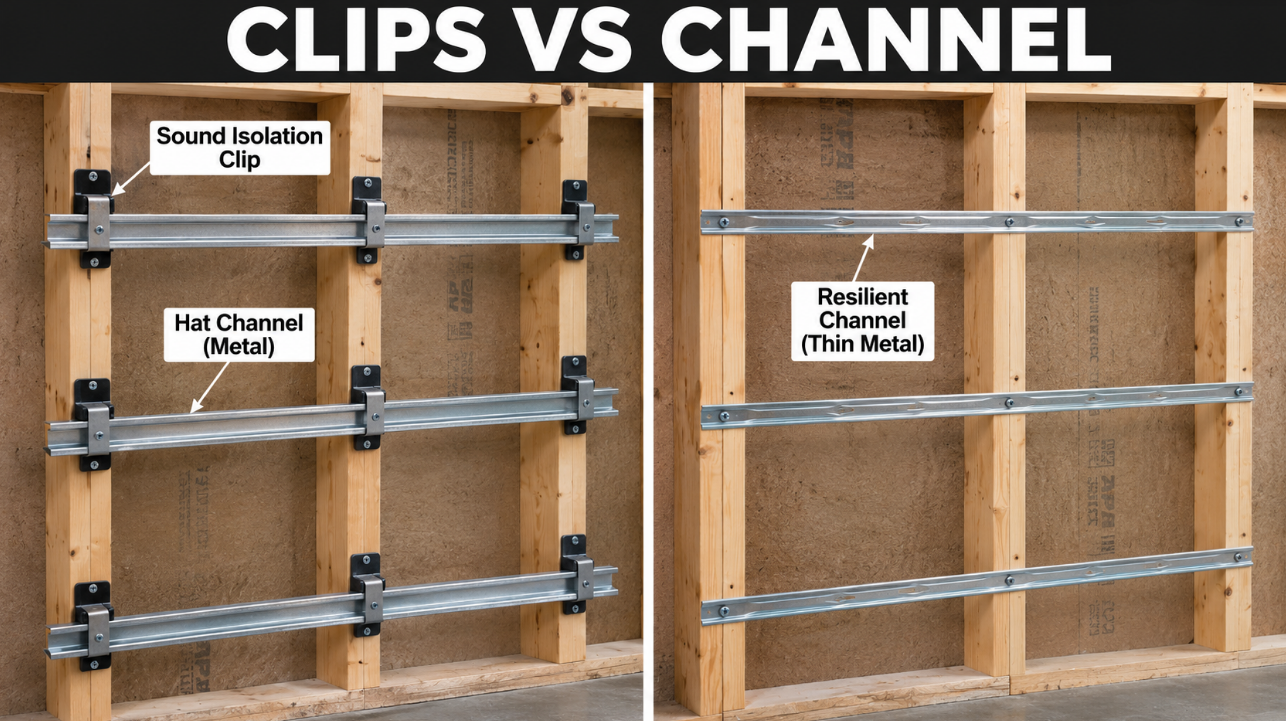
When the question is sound isolation clips vs resilient channel, the lab data favors clips. On identical wood stud walls tested in one laboratory, clips reached STC 57 with one layer of drywall per side, while resilient channel reached STC 50. With two layers, the scores were STC 64 and STC 60. Clips also tolerate installation mistakes better, and that's where many resilient channel jobs lose their rating.
Resilient channel still has a place. It costs less, takes up about a third of the depth, and can reach STC 50 when the right product goes in correctly. Anyone weighing sound clips vs resilient channel should start with three things: the target rating, the depth available, and who's doing the work.
How Each Method Decouples Drywall
Both products keep drywall from screwing directly into the framing, so vibration loses its rigid path from one side of the wall to the other. They differ in which part does the flexing.
Sound Isolation Clips
A clip screws to the stud or joist and holds a length of hat channel, also sold as drywall furring channel. The drywall then screws to that channel, which stays clear of the framing while a resilient isolator in the clip takes up the movement.
The system has two parts, so both have to match. The Resilmount A237R fits 7/8" and 1 1/2" furring channel, for example, while the Kinetics IsoMax accepts channel widths from 2.38" to 2.75".
Resilient Channel
Resilient channel skips the clip and puts the spring in the steel itself. One flange screws to the stud, and the drywall screws to a thin leg that hangs free of the framing. Installation guides for single-leg RC-1 call for the attachment flange facing down and channels no more than 24 inches on center. The weight of the board then pulls the leg away from the structure.
Quality varies from one product to the next, because no single manufacturing standard sets gauge or flexibility. The Steel Stud Manufacturers Association doesn't specify resilient channel, and one manufacturer notes that its two-leg RC-2 has no STC rating or test data.
Resilient Channel vs Hat Channel
Hat channel fastened straight to studs has very little flex, so it can't stand in for resilient channel. John LoVerde and Wayland Dong tested both on a wood stud wall with one layer of board per side. They reported results as Rw, an international rating that usually lands within a point or two of STC.
The wall scored Rw 35 with no channel, Rw 43 with hat channel, and Rw 53 with the best resilient channel in the series. Hat channel reaches its potential only when it rides in clips.
Sound Isolation Clips vs Resilient Channel – Side by Side
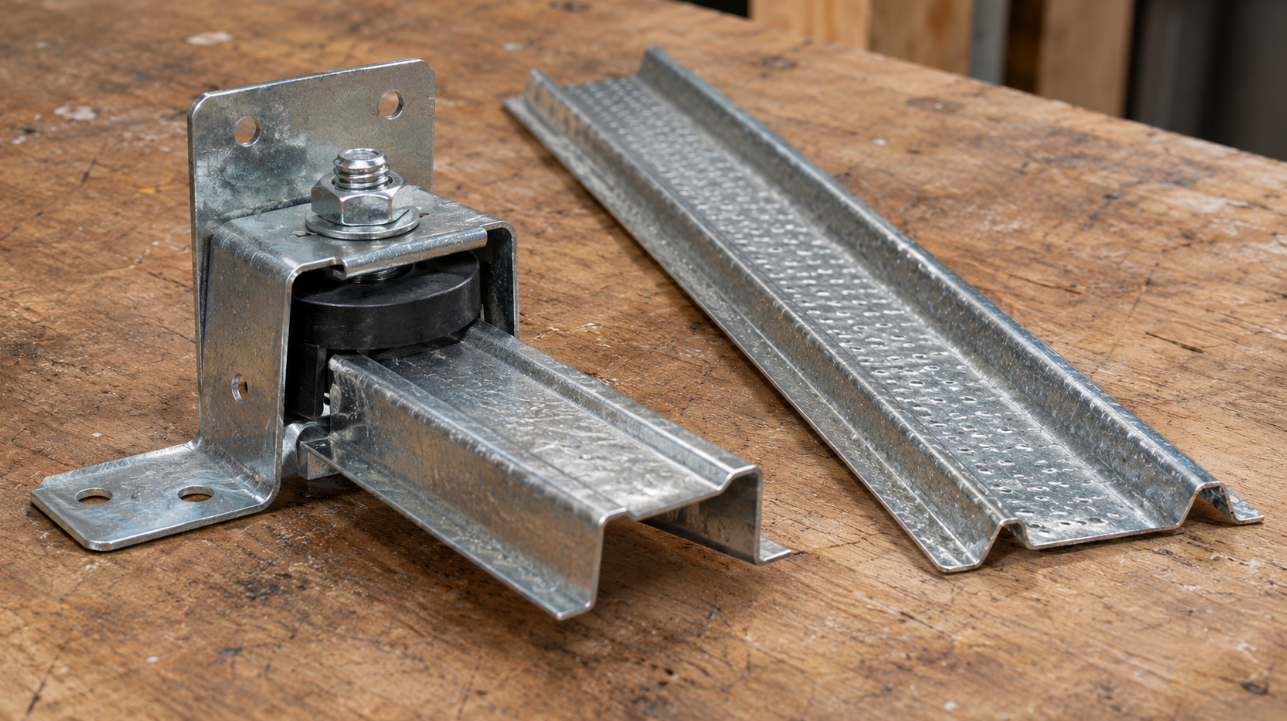
The biggest differences come down to rating, depth, and how easily one misplaced screw can undo the work. The STC figures in this table come from a single wall series, covered in the next section.
| Factor | Sound isolation clips | Resilient channel |
| What flexes | Isolator in the clip | Thin steel leg |
| STC, one layer per side | 57 | 50 |
| STC, two layers per side | 64 | 60 |
| Added depth | About 1 1/2" with channel | About 1/2" |
| Short-circuit risk | Low, unless screws run too long | High, since a screw into a stud bridges it |
| Product standard | Furring channel follows an industry standard | No single standard |
| Parts to buy | Clips and channel | Channel only |
| Material cost | Higher | Lower |
Depth often settles the choice in basements and apartment ceilings, where every inch of headroom counts. Material cost usually pushes builders the other way, because clips add a second component across the whole surface.
What the Lab Tests Show
An STC rating lets you compare how much airborne sound two assemblies block, though the comparison only holds when the walls and the lab match. Published results for these products often fail that test, so the most useful data changes one thing at a time.
Same Wall, Same Lab
Wilson Byrick compared both methods in a 2011 Canadian Acoustics paper. Every wall used 2x4 studs at 16 inches on center, R-13 batts, and 5/8" Type X gypsum board. The clips carried 7/8" furring channel on a 24-by-48-inch grid, and the resilient channel ran at 24 inches on center.
| Wall | One layer per side | Two layers per side |
| Single stud, no decoupling | STC 37 | STC 41 |
| Resilient channel | STC 50 | STC 60 |
| Isolation clips | STC 57 | STC 64 |
Clips led by seven points with one layer of board and by four points with two. Byrick worked for Pliteq, which makes the GenieClip used in this test, so read the size of that gap with the manufacturer link in mind. Kinetics reports a similar range for its IsoMax clips, with laboratory results from STC 57 to STC 64.
Why Resilient Channel Results Vary
Brand and lab both move the number. In the LoVerde and Dong series, resilient channels on the same one-layer wall ranged from Rw 49 to Rw 53. A National Research Council Canada wall with one layer of 5/8" board per side and channel on one side averaged STC 46. That's four points below Byrick's result for a similar build.
That spread matters most on rated work. A substituted channel can drop an assembly by several points, so install the exact product named in the test report.
Low Frequencies
Byrick found the clip wall 2 to 3 dB better than the resilient channel wall from 63 Hz upward. Some suppliers cite gaps near 10 dB in the bass range, but those claims compare reports from different laboratories.
Neither method tops the low-frequency results in that paper. A double stud wall in the same series ran 3 to 4 dB ahead of every other partition, so home theaters and drum rooms may need more than new hardware.
Why Installation Decides the Result
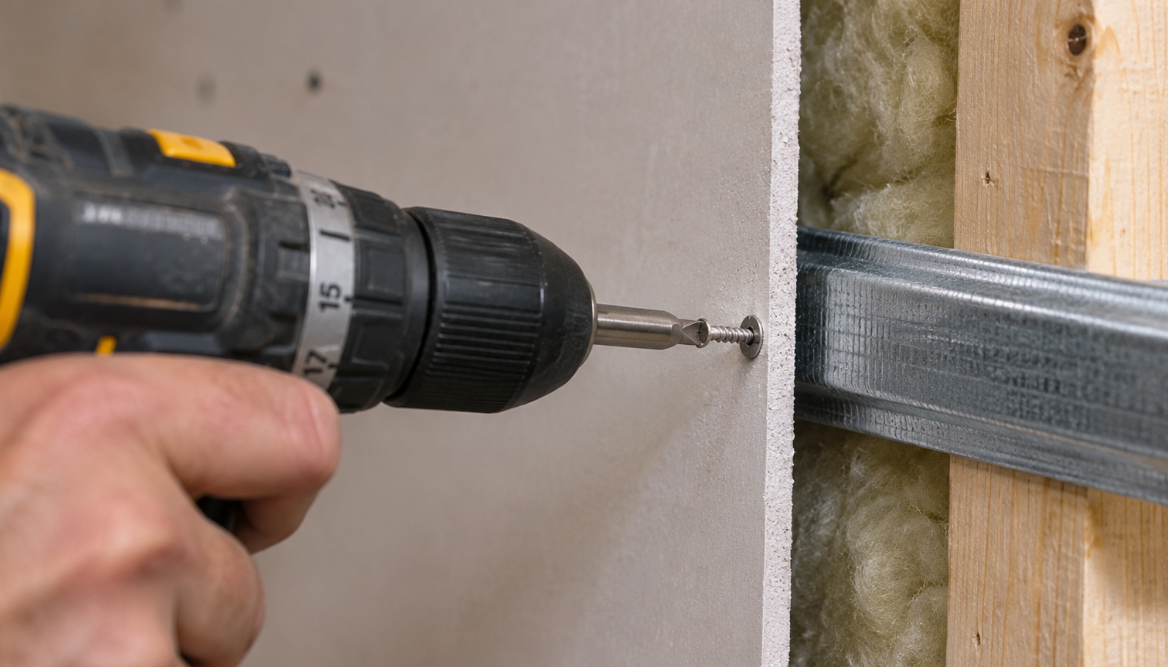
A decoupling system works only while nothing rigid crosses the gap, and this is where the two methods separate most clearly. Lab walls get careful attention that job sites don't always match.
Short Circuits
A screw that passes through resilient channel into a stud locks that spot to the framing. LoVerde and Dong measured the effect on a four-layer, 8-by-8-foot wall. The best channel scored Rw 60 with no short circuits, Rw 58 with five, and Rw 51 with 35. A fully short-circuited channel performed about like plain hat channel.
Other errors do even more damage. Fastening channel between two layers of drywall took a three-layer wall from Rw 55 or 56 down to Rw 40, which nearly erased the benefit. Byrick also lists channel hung upside down as a common fault, because it removes the pull that keeps the leg clear of the structure. Extra screws into the channel itself barely changed the rating, so the danger lies in screws that reach the stud.
Mistakes Clips Don't Prevent
Clips make these errors harder to commit, though they can't rule them out. Byrick's paper says the clip system can't be short-circuited unless 2.5" screws go into the board. A screw that long can reach past the channel into the framing.
Rigid contact elsewhere undoes the work in the same way. Wood blocking behind baseboards and cabinets anchored to studs both rebuild the bridge you paid to remove.
When Each Method Makes Sense
The right choice depends on the rating you need and how much risk you can accept on site. A wall built to the common STC 50 code minimum has little margin, and resilient channel reached exactly that figure in Byrick's one-layer test.
Are sound isolation clips worth it? The test data says yes whenever a project needs to clear STC 50 comfortably, or when you can't watch every screw go in. Clips make the stronger case for:
- Targets of STC 55 or higher, including bedrooms beside noisy neighbors
- Ceilings under footfall noise, where one manufacturer-published field test on a floor system with IsoMax clips went from a field impact rating of 45 to 62
- Crews without decoupling experience
- Assemblies that need a tested, UL-listed design using clips, since each product lists its own designs
Resilient channel does work when the conditions suit it. It fits projects with a target near STC 50, an experienced crew, and a tight budget, or ceilings where the extra inch of clip depth can't be spared. Both systems need access to the framing, so existing drywall has to come off first. Light-gauge steel studs already flex, which leaves resilient channel with less to add on those walls.
Planning a Clip System
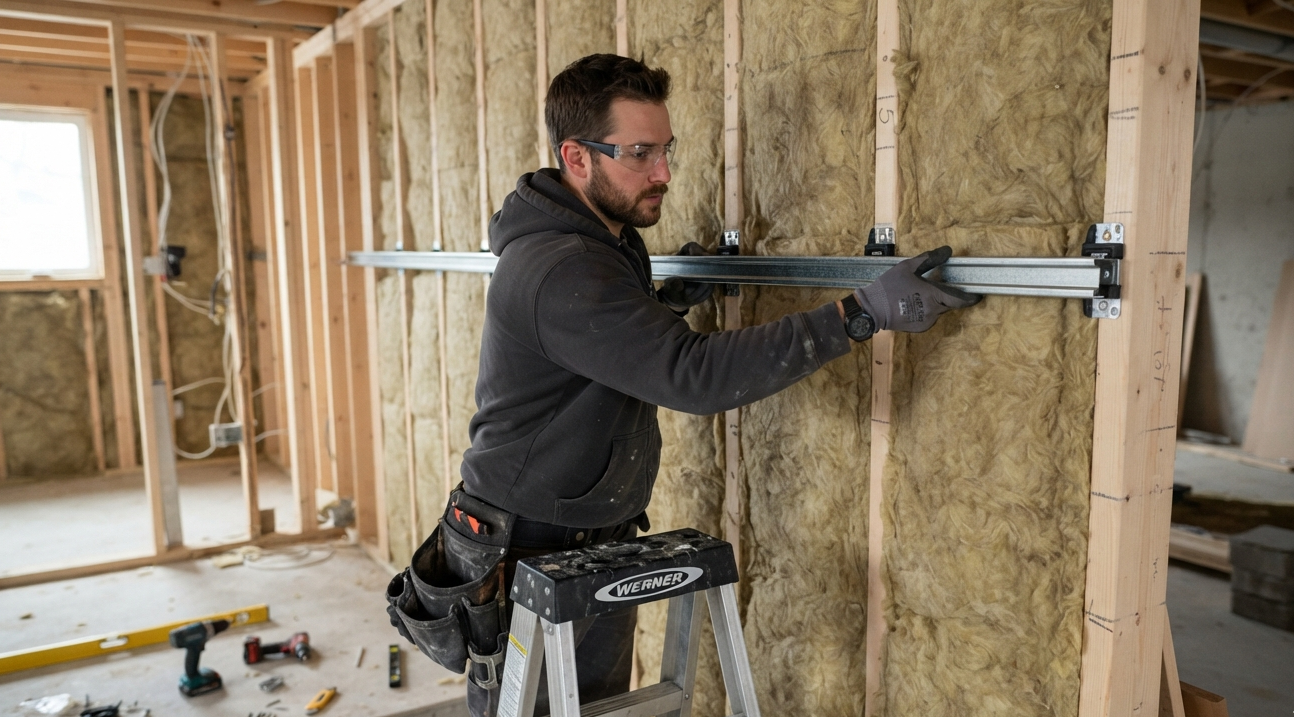
Clip count comes from the grid. The A237R allows clips up to 48 inches apart along the channel and channels up to 24 inches apart. That works out to about one clip per 8 square feet, or roughly 13 clips for a 100-square-foot wall. A case of 72 IsoMax clips is rated to cover about 400 square feet. Heavier assemblies may need tighter spacing, so check the manufacturer's load data first.
To work out how many sound isolation clips you need, start with the surface area and the weight of the finished board. Then compare both against the options in our isolation clips range. The channel itself is standard drywall furring channel, and it has to match the clip you choose.
Decoupling also needs the rest of the assembly around it. Cavity insulation adds to the result; a second layer of board with Green Glue adds mass and damping, and acoustical sealants close the perimeter and outlet boxes. You can see how these pieces fit together on our sound isolation for walls page, or browse all sound isolation products.
None of this treats echo inside a room, which calls for sound absorption instead. Send us the room dimensions, the existing construction, and a description of the noise, and we'll help you put together a materials list. Sound Pro Solutions supplies materials and consultation, and we don't perform installation work.
Recent posts


