
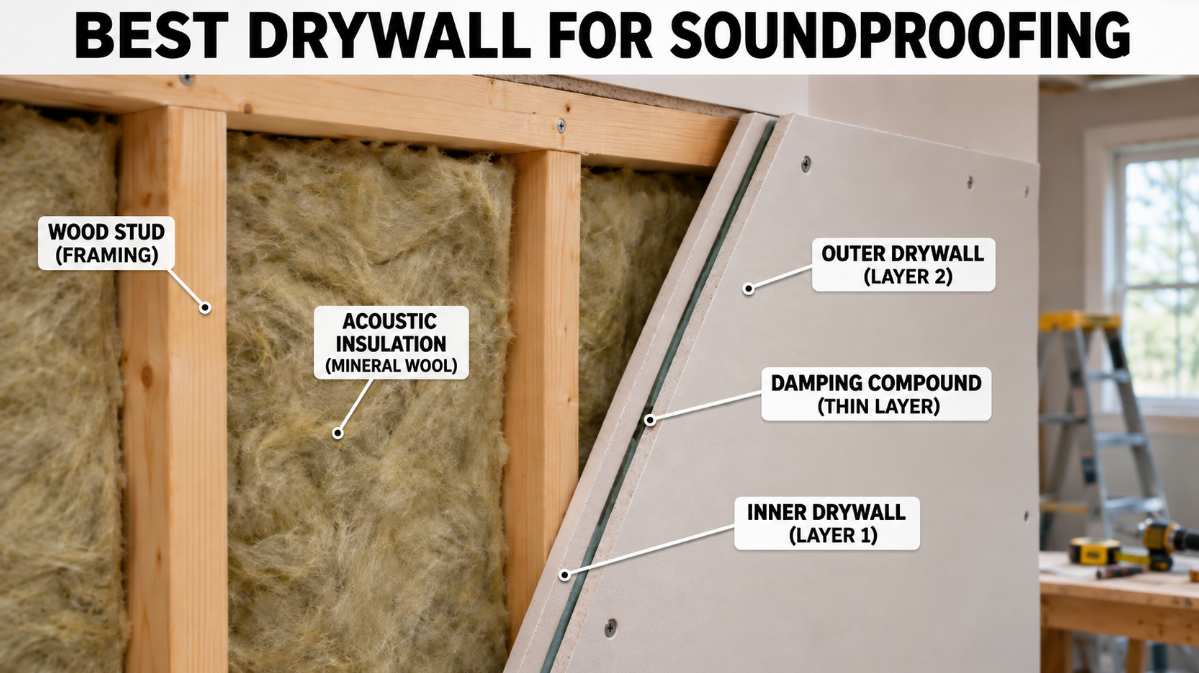
The best drywall for soundproofing, for most projects, turns out to be two layers of ordinary 5/8-inch board with a damping compound between them. Factory-damped panels such as QuietRock and SoundBreak XP earn their place when wall depth is tight or labor costs more than materials. Plain thicker board, on its own, changes very little.
Drywall also has a ceiling of its own. On a standard stud wall, the framing carries vibration straight through whatever board you hang, so the panel only tells part of the story.
Best Drywall for Soundproofing – Options Compared
Soundproofing drywall falls into four groups, from plain board to factory-laminated panels. The table below compares published results, and stud spacing appears beside each one because it moves the rating by itself.
| Option | Stud spacing | STC | Source |
| One layer of 1/2" per side, insulated | 16" | 32–34 | National Research Council Canada lab tests |
| One layer of 5/8" Type X per side, insulated | 16" | 34–35 | National Research Council Canada, National Gypsum |
| Two layers of 1/2" Type X per side, insulated | 16" | 38 | National Research Council Canada lab tests |
| QuietRock 510, 1/2" damped board | 24" | 47–52, by layout | PABCO data sheet |
| QuietRock 530, 5/8" damped board | 24" | About 52 | PABCO data sheet |
These are wood stud walls. Read the top three rows and the bottom two as separate groups. Wider stud spacing helps on its own, and manufacturers' ratings depend on the exact layout.
Standard 1/2-Inch Drywall
Standard 1/2-inch board is the usual starting point for interior walls, and it offers little privacy. Laboratory tests put a wood stud wall with one layer per side and cavity insulation at STC 32 to 34, a level where loud speech comes through clearly.
5/8-Inch Type X
Type X is a heavier board used in many fire-rated designs. On the same kind of wall it tested at STC 34 to 35, so the sound benefit is small. Its real value comes as the base for a stronger assembly, where its extra mass adds to the result.
Two Layers With Damping Compound
Double drywall soundproofing works much better when a viscoelastic compound such as Green Glue sits between the sheets. The compound stays flexible, so the two rigid layers can't move as one, and vibration turns into a small amount of heat. Published Green Glue results for similar walls land in the same range as factory-damped panels. The figures we found didn't name a laboratory, so ask for the test report behind any number.
This option makes sense for most buyers because it uses standard board and common tools. Coverage matters: plan on two tubes per 4-by-8 sheet.
Factory-Damped Board – QuietRock and SoundBreak XP
These panels build the damping layer into the sheet. QuietRock drywall comes in several versions, including the 1/2-inch 510 at about 2.1 pounds per square foot. The 5/8-inch 530 weighs about 2.9 pounds, adds a thin steel layer, and needs a saw for cutting. SoundBreak XP joins two gypsum layers with a viscoelastic polymer, comes in 1/2-, 5/8-, and 3/4-inch thicknesses, and can be finished like regular paper-faced board.
Either route saves a step on site and adds less depth than a double layer. The trade-off comes in cost per sheet, and QuietRock's steel-core versions take more effort to cut.
Does Soundproof Drywall Work?
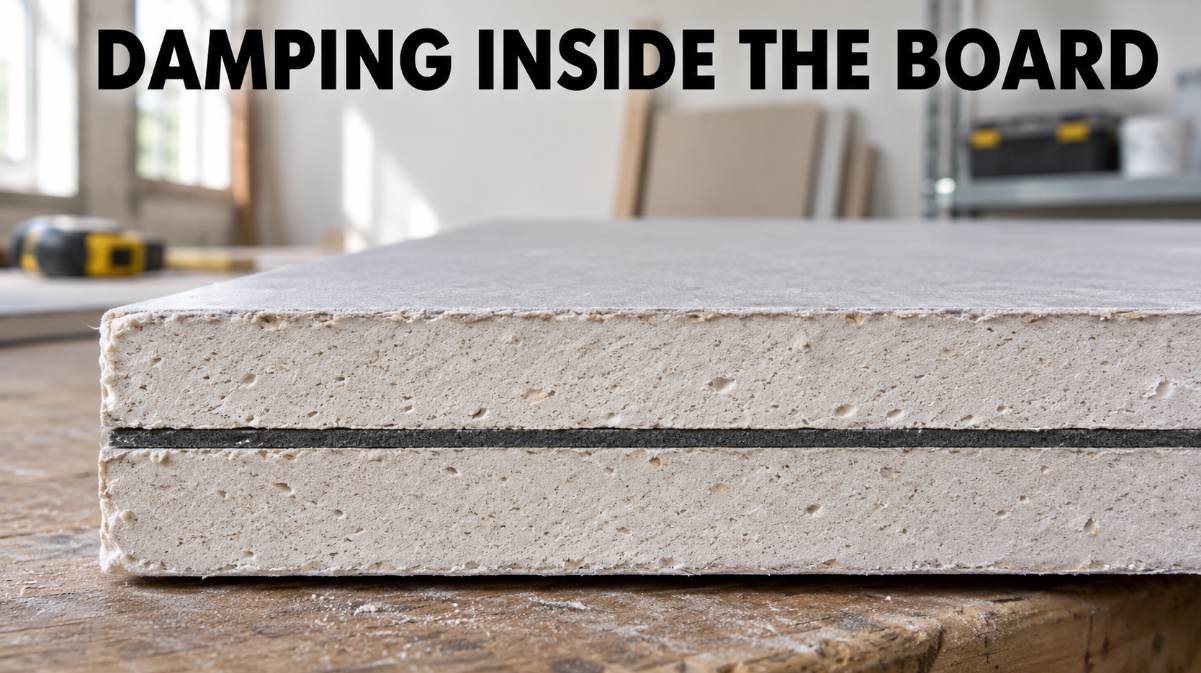
Soundproof drywall does work, particularly when it goes on one side of a wall that already has some separation in the framing. Sold as soundproof drywall, acoustic drywall, sound-deadening drywall, or sound-dampening drywall, these are laminated panels with a damping layer inside.
National Gypsum's own example shows the scale. A staggered stud wall with 5/8-inch Type X tested at STC 45, and one added layer of SoundBreak XP on one side raised it to STC 53. The company also says that using damped board on both sides doesn't raise the rating enough to justify the extra cost.
Two limits apply. Manufacturers note that framing, flanking paths, and workmanship all affect the final rating, and they won't guarantee a result on site. Damping also does most of its work in the mid and upper frequencies, so deep bass from a subwoofer or drum kit needs decoupling as well.
Cost decides the rest. Soundproof drywall runs well above standard board per sheet, while a double layer with compound uses cheaper materials and takes more labor. So the best soundproof drywall for a given wall is the panel that suits its depth, its fire rating, and the crew hanging it.
Does Thicker Drywall Block More Sound?
Thicker drywall blocks a little more sound, but less than most people expect. For 5/8 drywall soundproofing on a rigid wood stud wall, the gain over 1/2-inch board amounted to a point or two in laboratory tests. Both sheets stay screwed to the same studs, so the extra mass has little effect.
Adding a whole layer helps more. In one National Research Council Canada series with cellulose insulation, one layer of 1/2-inch Type X per side tested at STC 32. Two layers per side tested at STC 38. Those six points are useful, yet they fall far short of doubling the rating. Claims that a double layer scores twice as high don't hold up.
Why Drywall Alone Hits a Limit
Every sheet screwed to a stud shares that stud with the sheet on the other side, so vibration crosses the wall through the framing. An STC rating reflects that whole path, and changing the board only addresses one part of it.
Changing the framing often does more than changing the panel. National Gypsum's test wall went from STC 35 on single studs to STC 45 on staggered studs with the same 5/8-inch board. In the National Research Council Canada series, a double stud wall with a 1-inch gap reached STC 58 with just one layer of 1/2-inch Type X per side.
Resilient channel makes a similar point. On one single stud wall, adding channel on one side lifted a one-layer build with 5/8-inch Type X to an average of STC 46. With two layers per side, the average reached STC 57.
How to Choose Drywall for Your Project
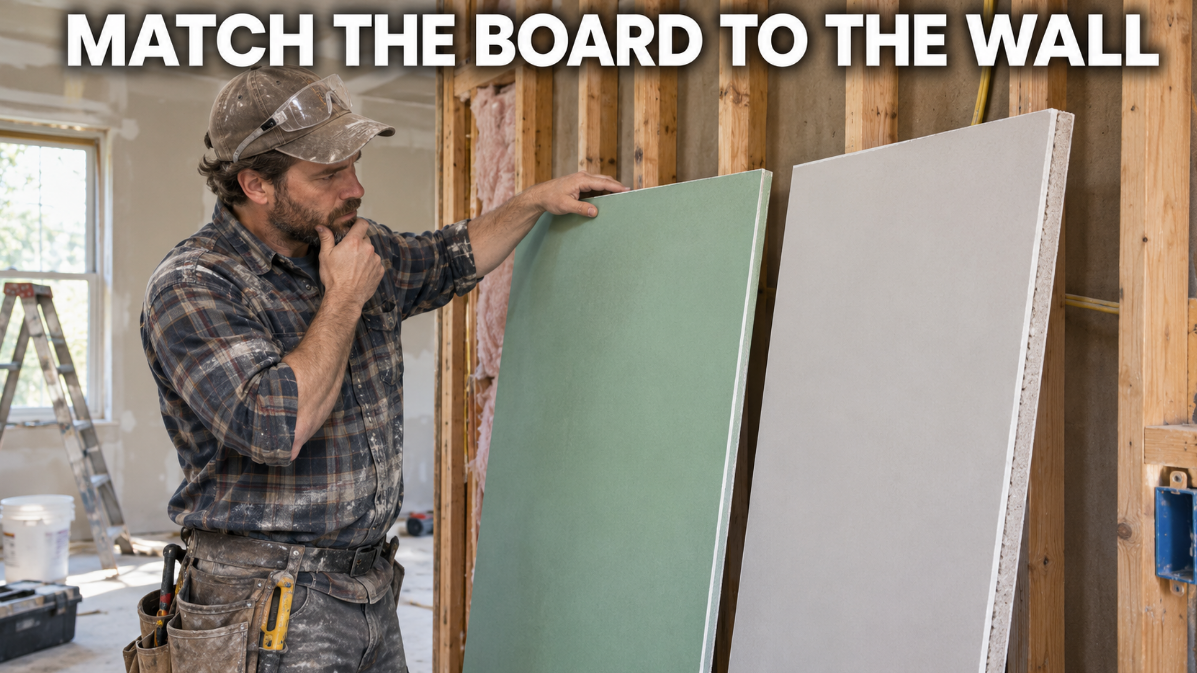
The right board depends on what's already in place and how much depth you can give up. Five common situations cover most projects.
Existing Wall You Want to Keep
Add a second layer of 5/8-inch board over the old surface with Green Glue between them. Treat one side of the wall if the other isn't yours to touch.
New Wall
Sort out the framing first with staggered or double studs, or add isolation clips. Then hang 5/8-inch Type X in one or two layers.
Ceiling Below Noisy Neighbors
Decouple with clips and channel before you choose a panel, since footfall travels through the structure. PABCO doesn't recommend QuietRock 510 as a ceiling face layer, so check the data sheet for the panel you pick.
Very Little Depth to Spare
Factory-damped board is the better fit here, and SoundBreak XP Retrofit Board comes in a 5/16-inch thickness. Where you need more mass behind the finish layer, mass-loaded vinyl adds weight without much depth.
Fire-Rated Assembly
Confirm the listing first. Damped panels are approved in many UL designs, though they aren't a direct substitute for classified gypsum board in all of them.
Installation Details That Protect the Rating
A well-chosen board can still lose points to small gaps and rigid connections. Sealing comes first, so run acoustical sealants around the perimeter of each layer and around outlet boxes. National Gypsum notes that some sealants harden over time and can compromise the rating, so use an acoustical product that stays flexible.
Offset the seams between layers so that no joint runs straight through the wall, and use screws long enough for the double thickness. Apply damping compound at the full rate, because a thin coat won't deliver the result. Green Glue also needs time to reach peak performance, which takes about 30 days.
Avoid fixing cabinets or shelves through a decoupled wall into the studs, since that reconnects the layers you separated. A strong wall also won't help much with a hollow-core door in it, so look at door seals as part of the same project.
You can see how these materials fit together on our sound isolation for walls page. Send us the room dimensions, the existing construction, and a description of the noise, and we'll help you put a materials list in the right order. Sound Pro Solutions supplies materials and consultation, and we don't perform installation work.
Recent posts


