
Automatic Door Bottom Seal
$149.00
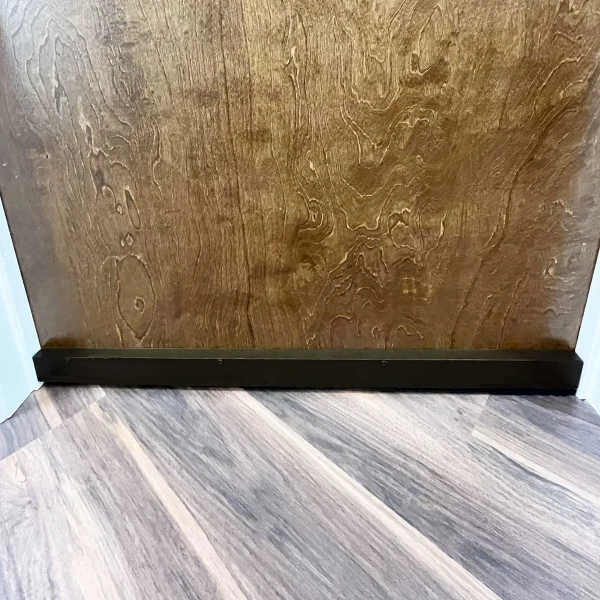
An automatic door bottom seal closes the gap at the bottom of a door only when the door is shut. It's an aluminum housing screwed to the face of the door, with a neoprene bulb seal inside. The seal drops to the floor as the door closes and lifts as it opens. With it in place, the door blocks noise, drafts, and pests without dragging across the floor every time someone walks through.
The same device is also sold as an automatic door seal, an automatic door sweep, or a drop seal. Our surface-mount model comes in standard lengths from 24 to 48 inches and can be made to any length from 12 to 96 inches. It's available in White, Chrome, Gold, Dark Bronze, and Black.
How an Automatic Door Bottom Works
An automatic door bottom is a mechanical door sweep with no power, wiring, or batteries. The unit mounts with its brass adjusting nut at the hinge end of the door. When the door swings shut, that end meets the frame, and a spring mechanism inside the housing pushes the seal down until it touches the floor.
Opening the door releases the pressure, and the seal pulls back up into the housing. Because the seal stays retracted while the door moves, carpet, hardwood, and tile see no wear, and the door swings as freely as it did before. That retract-and-drop action is why an auto door sweep is often called a retractable or self-adjusting door sweep. Automatic door sweeps stay out of the way until the door is fully closed.
The seal on our model drops up to 7/8 inch and levels itself as it comes down, so it follows a floor that isn't perfectly flat. Turning the brass nut by hand changes how far the seal drops, which makes it an adjustable door bottom you can fine-tune after installation. A strip of noise-reduction rubber lines the inside of the housing between the mechanism and the door.
Automatic Door Bottom vs Door Sweep vs Mortised Models
Three types of hardware can seal the bottom of a door, and they differ mainly in how they mount and whether they touch the floor while the door moves. The table compares a surface-mounted automatic door bottom with a standard fixed sweep and a mortised automatic door bottom.
|
Surface-mounted automatic door bottom |
Fixed door sweep |
Mortised automatic door bottom |
|
|
Where it mounts |
Screwed to the face of the door at the bottom edge |
Screwed to the face of the door at the bottom edge |
Inside a channel routed into the bottom edge of the door |
|
Floor contact while the door moves |
None, the seal retracts |
Constant, the sweep brushes the floor |
None, the seal retracts |
|
Door preparation |
Drill and screw, door stays on its hinges |
Drill and screw |
Door comes off and gets routed |
|
Visibility |
Housing visible on one face |
Strip visible on one face |
Hidden inside the door |
|
Adjustment after installation |
Brass nut sets the seal drop |
None, the sweep is reset by moving it |
Depends on the model |
|
Typical use |
Retrofitting existing doors |
Basic draft control where light drag is acceptable |
New doors machined for it at the factory or by a carpenter |
The fixed sweep, the simplest of the three, rubs the floor on every swing and wears both the sweep and the flooring over time. It works for a back door where drafts matter more than sound.
A mortised model hides the mechanism inside the door, which suits new construction where the door can be machined before it's hung. For an existing door, it means taking the door off its hinges and cutting into it.
Surface-mounted auto door bottoms sit between the two. A surface-mount automatic door bottom retracts like a mortised unit, installs with a drill and screws, and can be removed later without damaging the door. That combination makes it the practical choice for most homes and offices that want to quiet a door they already have.
Some people look for this product as an automatic door threshold. A threshold is a strip fixed to the floor, while an automatic door bottom attaches to the door itself. The two can work together, since a threshold gives the seal a flat, solid surface to close against.
How to Choose Length and Finish
Choosing an automatic door bottom seal comes down to two decisions: the length that fits your door frame and the finish that matches your hardware. Every auto door bottom we sell is made to the length you order and ships with mounting screws and instructions.
Measuring Your Door
The length of the unit depends on the door frame, not on the door alone. Measure the distance between the stops on each side of the frame. For a single door, the automatic door bottom should be 1/8 inch shorter than that distance.
Double doors need a slightly different measurement. Measure from the stop on the frame to the stop on the meeting edge of the door, and make the unit 1/16 inch shorter than that distance. The door bottom can be cut to length before mounting if it arrives a little long.
Check the gap under the door as well. The unit is designed for doors with a standard undercut of up to 3/4 inch, and the seal drops up to 7/8 inch. If your gap is wider, or if you need a length outside the standard 24 to 48 inches, contact us before ordering.
Choosing a Finish
The housing comes in White, Chrome, Gold, Dark Bronze, and Black. Most people match it to the door hardware. Chrome sits well next to polished or satin metal handles, dark bronze or black suits darker hardware, and white works on a painted door where the housing should disappear.
How to Install an Automatic Door Bottom Seal
A surface-mount automatic door bottom installs on the door you already have, with no routing, no kerf cuts, and no need to remove the door. It fits wood, metal, and fiberglass doors, and one door usually takes a homeowner an afternoon.
Before You Start
You'll need a tape measure, a pencil, a drill with a bit sized for the supplied #8 x 1-1/2" sheet metal screws, and a screwdriver. If the unit needs cutting, cut it to the length you measured before mounting. The door bottom goes on the push side of the door, with the brass adjusting nut facing the hinge side.
Mounting Steps
- Close and latch the door, and keep it latched while you mount the unit.
- Hold the door bottom on the push side, flush with the bottom edge of the door, with up to 1/16 inch of clearance at each end.
- Mark the screw hole locations and drill the pilot holes.
- Fasten the unit with the supplied screws, taking care not to overtighten them.
- Turn the brass nut in either direction to set the spring tension until the seal meets the floor evenly.
Never pull on the seal insert or any of the rubber parts. Forcing the insert lower than it's designed to go can bind the unit and stop the seal from retracting into the housing.
Sealing the Whole Door
An automatic door bottom only closes the gap at the bottom of the door. The sides and top of the opening still leak sound through the space between the door and the frame. Sealing three edges while leaving one open gives up most of the benefit. For any door that needs to block noise, plan the door bottom and a perimeter seal together.
When you install both, run the perimeter seals from the top of the door down to the floor or threshold. The automatic door bottom then sits between the two side seals, so the four edges close as one continuous line.
Home offices and bedrooms off a busy hallway, conference rooms, and recording studios all get this pairing as a baseline. Hotels, apartment buildings, schools, and hospitals use the same combination on doors where privacy and quiet matter. The retracting seal also keeps those doors easy to open for anyone who uses them all day.
Perimeter options are collected in our perimeter door seals. For high-traffic openings, our heavy-duty door seals and commercial door seals group the door bottom with matching perimeter seals, and the full range lives in acoustic door seals.
Door seals belong to sound isolation, which keeps noise from passing between rooms. Acoustic panels do a different job: they absorb echo inside a room and won't stop sound coming under a door. If you're working on a full room, browse the rest of our sound isolation products.
Ordering, Shipping, and Returns
Each automatic door bottom is made to order and ships within 3 to 4 business days. Orders ship via FedEx anywhere in the contiguous United States, with shipping calculated at checkout from weight, dimensions, and address.
Every package is insured for the full order value, and that coverage is built into the shipping charge. If something arrives damaged, email us within 5 days of delivery with photos, and we'll send a free replacement once the insurance review is done.
Made-to-order items are final sale, so it pays to double-check the frame measurements before you order. In New York City, pickup and delivery are free on orders over $150.
If you're sealing several doors or aren't sure which length or finish to pick, send us the frame measurements and a photo, and we'll help you put the order together.
FAQs
Frequently Asked Questions. Here are some common questions about Acoustic panels.
/01Will an automatic door bottom drag on the floor?
The seal drops only after the door closes and retracts as soon as it opens, so it never drags while the door moves. Carpet, hardwood, and tile stay untouched during normal use.
/01How big a gap under the door can it seal?
The unit is designed for doors with a standard undercut of up to 3/4 inch, and its seal drops up to 7/8 inch. Because the seal levels itself as it drops, it also handles a floor that runs slightly out of level.
/01Do I need a perimeter seal as well as an automatic door bottom?
For a door that has to block sound, yes. The door bottom seals the floor gap, and a perimeter seal closes the gaps along the sides and top of the frame.
/01What doors can I install it on?
The surface-mount unit attaches with screws to wood, metal, and fiberglass doors, on single or double doors. It goes on the push side of the door and doesn't require taking the door off its hinges.
/01Can I order a length that isn't listed?
Standard lengths run from 24 to 48 inches, and the door bottom can be made to any length from 12 to 96 inches. Contact us with your frame measurements, and we'll confirm the right length before the order goes into production.
/01Can I return an automatic door bottom seal?
Automatic door bottoms are made to the length you order, and made-to-order items can't be returned. Confirm your measurements before placing the order, and contact us if you're unsure which length fits.