
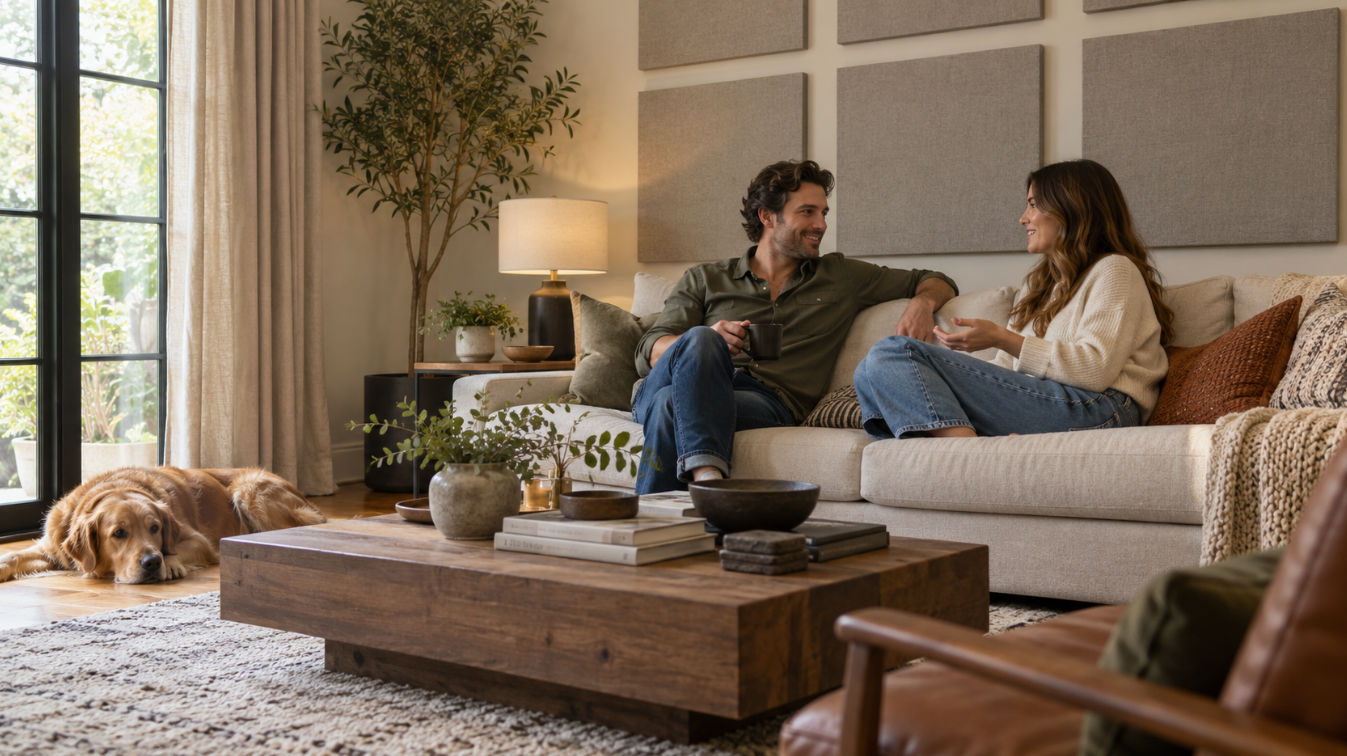
To reduce echo in a room, add soft, porous surfaces where sound bounces the most. A rug on hard floors, heavy curtains over windows, upholstered furniture, and acoustic panels on the walls and ceiling all take reflected energy out of the room.
Start with free fixes using what you already own, test the room, and then place acoustic panels where reflections are strongest. Most rooms improve long before every wall is covered.
Why Does My Room Echo?
A room echoes when sound hits hard, smooth surfaces and bounces back toward you before it fades. Drywall, glass, tile, concrete, and hardwood or laminate floors reflect most of the sound that reaches them, and many American homes are finished almost entirely in these materials.
Several conditions make echo worse:
- Parallel walls that send sound back and forth between them
- An empty or sparsely furnished room, such as a new home or an apartment before move-in
- Large windows and glass doors
- High, vaulted, or cathedral ceilings that add volume and a long reflective surface overhead
- Open-concept layouts where the kitchen, dining, and living areas share one large space
Knowing what kind of echo you hear, and where it comes from, tells you which fix to try first.
Echo, Reverberation, and Flutter Echo
A true echo is a distinct repeat of a sound, like a shout coming back from a canyon wall. It needs a long travel path, so in an ordinary room you rarely hear one.
What people call room echo usually turns out to be reverberation. Hundreds of overlapping reflections keep the sound hanging in the air after the source stops. Speech gets blurry, and a video call picks up a hollow, roomy tone.
Flutter echo has its own signature. Two bare parallel surfaces bounce sound between them quickly, and you hear a metallic ringing or buzz after a sharp sound such as a clap.
The Clap Test
Stand in the middle of the room and clap once, sharply. A long, smooth tail points to general reverberation, while a fluttery ring points to parallel walls facing each other with nothing on them.
To find first reflection points, sit where you usually talk or listen and ask someone to slide a mirror along the side walls at ear level. Any spot where you can see the sound source in the mirror reflects sound straight toward you. Mark those spots with painter's tape, because treatment goes there first.
Reducing Echo vs. Soundproofing
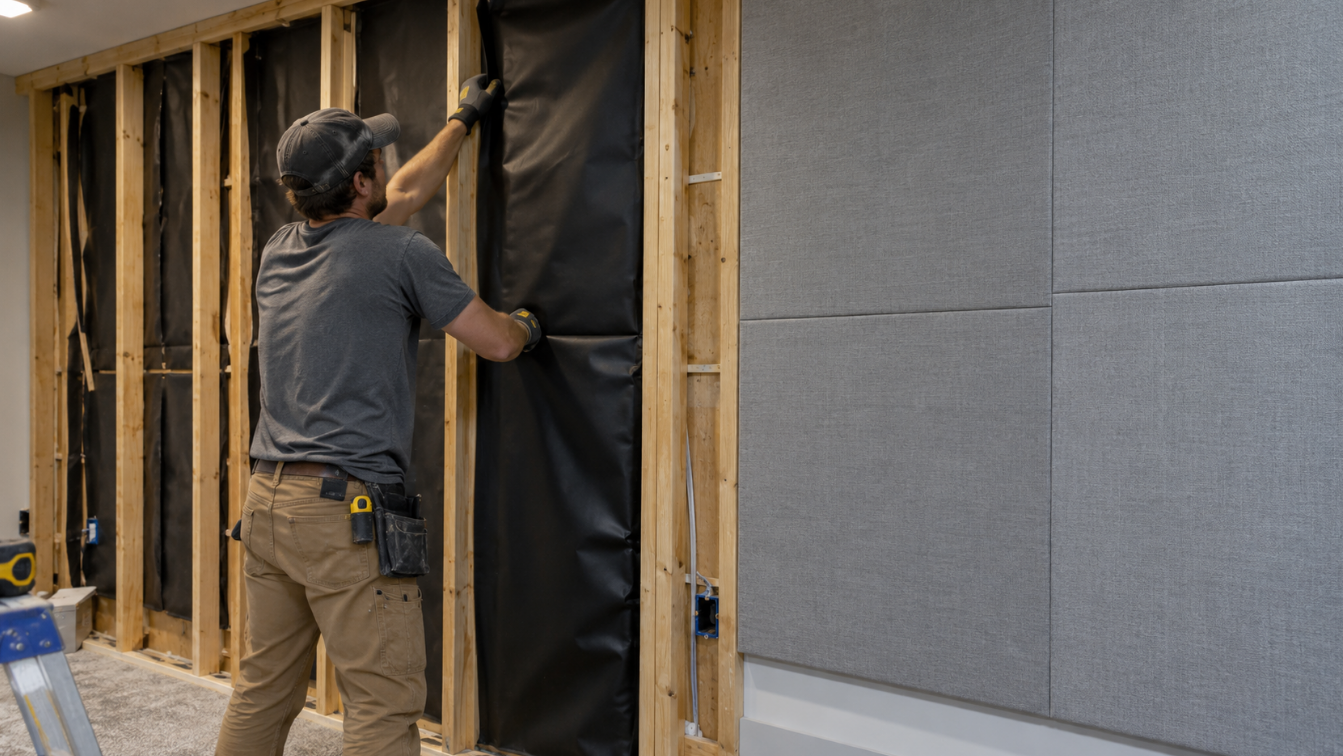
Reducing echo and soundproofing solve two separate problems. Echo control absorbs sound inside a room so it sounds clearer, while soundproofing blocks sound from passing through walls, floors, and ceilings into another space.
The materials work in opposite ways. Absorbers are soft, light, and porous, so sound enters them and loses energy. Soundproofing depends on mass, airtight sealing, and decoupling, which is why it relies on dense products like mass-loaded vinyl and damping compounds.
This affects what you buy. Acoustic panels will make your home office sound cleaner on calls, yet they won't stop a neighbor's TV from coming through the wall.
How to Reduce Echo in a Room Cheaply
The cheapest way to reduce echo is to cover the largest bare surfaces with soft things you may already own. Floors and windows usually come first because they are the biggest reflective areas in most rooms.
After each change, clap again and listen. The tail gets shorter as each surface stops reflecting.
Cover Hard Floors With a Rug
Hardwood, laminate, vinyl plank, and tile floors reflect sound up to the ceiling, which sends it back down. A large area rug breaks that floor-to-ceiling path, and a dense felt pad underneath adds absorption for very little cost. Put the rug where people sit and talk, under the coffee table, the bed, or the desk chair.
Hang Heavy Curtains
Glass reflects sound about as well as any surface in a home. Floor-length curtains made of heavy, tightly woven fabric absorb part of what would otherwise bounce off the window. Hang them wider than the frame and let the fabric fall in deep folds, since folds put more material in the path of the sound.
Add Upholstered Furniture and Soft Textiles
A fabric sofa, padded armchairs, throw pillows, and an upholstered headboard all soak up sound, while leather and molded plastic help much less. On bare walls, a tapestry or canvas print adds some absorption, though thin textiles mainly affect higher frequencies.
Fill Bookshelves
A bookshelf loaded with books of different depths turns a flat wall into an uneven surface. Sound striking it scatters in many directions, so less of it comes back to you as one strong reflection. Shelves work best on a bare wall opposite another bare wall, where they also break up flutter echo.
Acoustic Panels - The Most Effective Way to Get Rid of Echo
Acoustic panels are built for one job: absorbing sound. Each one has a dense, porous fill wrapped in acoustically transparent fabric. Sound passes through the fabric, enters the fill, and loses energy as friction in the fibers turns it into a tiny amount of heat.
You can't move a sofa to wherever a reflection lands. Panels go exactly where the mirror test pointed, so a handful of them often changes a room more than a houseful of soft decor.
Where to Put Acoustic Panels First
Placement matters more than quantity. Treat these spots in order:
- First reflection points on the side walls, found with the mirror test
- The wall you face when you talk or listen, such as the wall behind a desk monitor
- The wall behind you, which sends sound back toward a microphone or your ears
- The ceiling directly above the area where people sit and talk
Center wall panels near ear height for a seated person, since that's where the strongest reflections arrive.
How Many Panels Do You Need?
The right number depends on room size, furnishings, and use, so no single count fits every space. Cover the first reflection points, run the clap test again, and then add panels in pairs on opposite walls until speech sounds clear.
Adding panels gradually also protects you from over-treating the room. Too much thin absorption removes the highs and leaves the lows, so the room turns dull and boomy at once. Panels spread across several walls give a more even result than one fully covered wall.
Panel Thickness and What It Absorbs
Thickness decides which frequencies a panel can absorb. Short, high-frequency sound waves lose energy in thin material, while long, low-frequency waves need more depth.
- 1 inch - speech and higher frequencies; the usual choice for walls in offices, bedrooms, and living rooms
- 2 inches - wider absorption that reaches lower into the midrange; a common choice for ceilings
- 3 to 4 inches - broadband absorption that includes more of the bass range, for recording studios and home theaters
Panels are often compared by NRC, the noise reduction coefficient, which averages how much sound a material absorbs across the main speech frequencies. A higher value means more absorption. Trust ratings that name a laboratory test standard, usually ASTM C423.
Fiberglass Panels vs. Acoustic Foam
Most professional acoustic panels use rigid fiberglass board, such as Owens Corning 703, as their fill. Its density stays consistent across the whole board, so it absorbs predictably and keeps its shape for years.
Acoustic foam costs less and sticks to a wall in minutes, which explains its popularity. Most foam sold for home use is thin, though, so it mostly takes out high frequencies and leaves the mids and lows untouched. Cheap foam can also sag, fade, and crumble over time.
How to Reduce Echo in a Large Room or a Room With High Ceilings

Large rooms and rooms with high ceilings echo longer because sound travels farther between reflections, and the time it takes to die away grows with the room's volume. Wall treatment alone often falls short here, since many of the reflections come from the ceiling and the upper walls.
Ceiling clouds handle this most directly. These acoustic panels hang horizontally below the ceiling on chain or wire, usually over a seating area or a dining table. A panel with an open back absorbs sound from both faces when it hangs in the air, so each cloud works harder than the same panel mounted flat.
Under vaulted ceilings, panels can go on the upper parts of the walls to catch reflections coming down from the slopes. Open-concept homes need a zone-by-zone approach: a rug and wall panels around the living area, a cloud over the dining table, and soft seating near the kitchen.
Echo Reduction Methods Compared
Each method absorbs a different part of the sound and suits a different situation, as the table shows.
|
Method |
Effort |
What it absorbs |
Best for |
Renter-friendly |
|
Area rug with pad |
Low |
Mid and high frequencies from the floor |
Rooms with hard floors |
Yes |
|
Acoustic curtains or heavy drapes |
Low |
Mid and high frequencies from windows |
Rooms with large windows |
Yes |
|
Upholstered furniture |
Low |
Broad, uneven absorption |
Living rooms, bedrooms |
Yes |
|
Filled bookshelves |
Low |
Scatters reflections |
Bare walls facing each other |
Yes |
|
Wall textiles and canvas art |
Low |
Mostly high frequencies |
Mild echo |
Yes |
|
1" to 2" sound-absorbing wall panels |
Medium |
Speech and midrange |
Offices, living rooms, bedrooms |
Yes, with clips (small screw holes) |
|
Suspended ceiling clouds |
Medium |
Speech and midrange, from both faces |
High ceilings, open layouts |
Needs ceiling anchors |
|
3" to 4" panels in corners |
Medium |
Broadband, including more bass |
Studios, home theaters |
Yes, with clips |
How to Fix Echo in Specific Rooms

The method stays the same everywhere: find the strongest reflections, cover them, and test again. What changes from room to room is which surfaces matter most.
Living Rooms and Open-Concept Spaces
Start with a large rug and floor-length curtains, then treat the wall behind the sofa and the wall facing it. If you'd like treatment that reads as interior design, wood slat acoustic panels pair natural wood slats with a sound-absorbing backing. In open layouts, a ceiling cloud over the dining area handles reflections the walls can't reach.
Home Offices and Video Calls
A microphone picks up the wall in front of you and the wall behind you more than any other surface. Put one or two panels behind your monitor and one or two behind your chair, then add a rug if the floor is bare. For software settings and microphone fixes, see our guide on how to fix echo on Zoom.
Home Theaters
A home theater needs control at the first reflection points between the front speakers and the main seat, plus treatment on the rear wall behind the seating. Acoustic panels with an inner frame keep straight, crisp edges and hold their shape over time, which suits a room where the treatment stays in full view.
Recording and Podcast Rooms
Recording rooms need the most absorption across the widest frequency range, because a microphone captures every reflection. Use thicker panels around the recording position, place thick panels in the corners where low frequencies build up, and treat the ceiling above the mic. Frameless acoustic panels have an open back and fabric wrapped to the edges, so they work both on walls and as suspended ceiling panels.
Bathrooms and Empty Homes
Bathrooms pack tile, glass, and porcelain into a small space, and our article on why bathrooms echo covers that room in detail. A new or empty house echoes because nothing inside it absorbs sound yet; see why your house echoes and how to fix it.
Planning Acoustic Treatment for Your Space
A treatment plan starts with three things: the room's dimensions, photos of each wall and the ceiling, and a note on how you use the room. That's enough to work out how many panels the space needs, which thickness fits, and where each one goes.
Sound Pro Solutions works with homeowners, architects, and contractors from Long Island City, New York. Orders ship by FedEx across the contiguous United States, and customers in New York City get free pickup and delivery on orders over $150. Send your room details to requests@soundprosolutions.com for help choosing panels for your space.
Recent posts


