
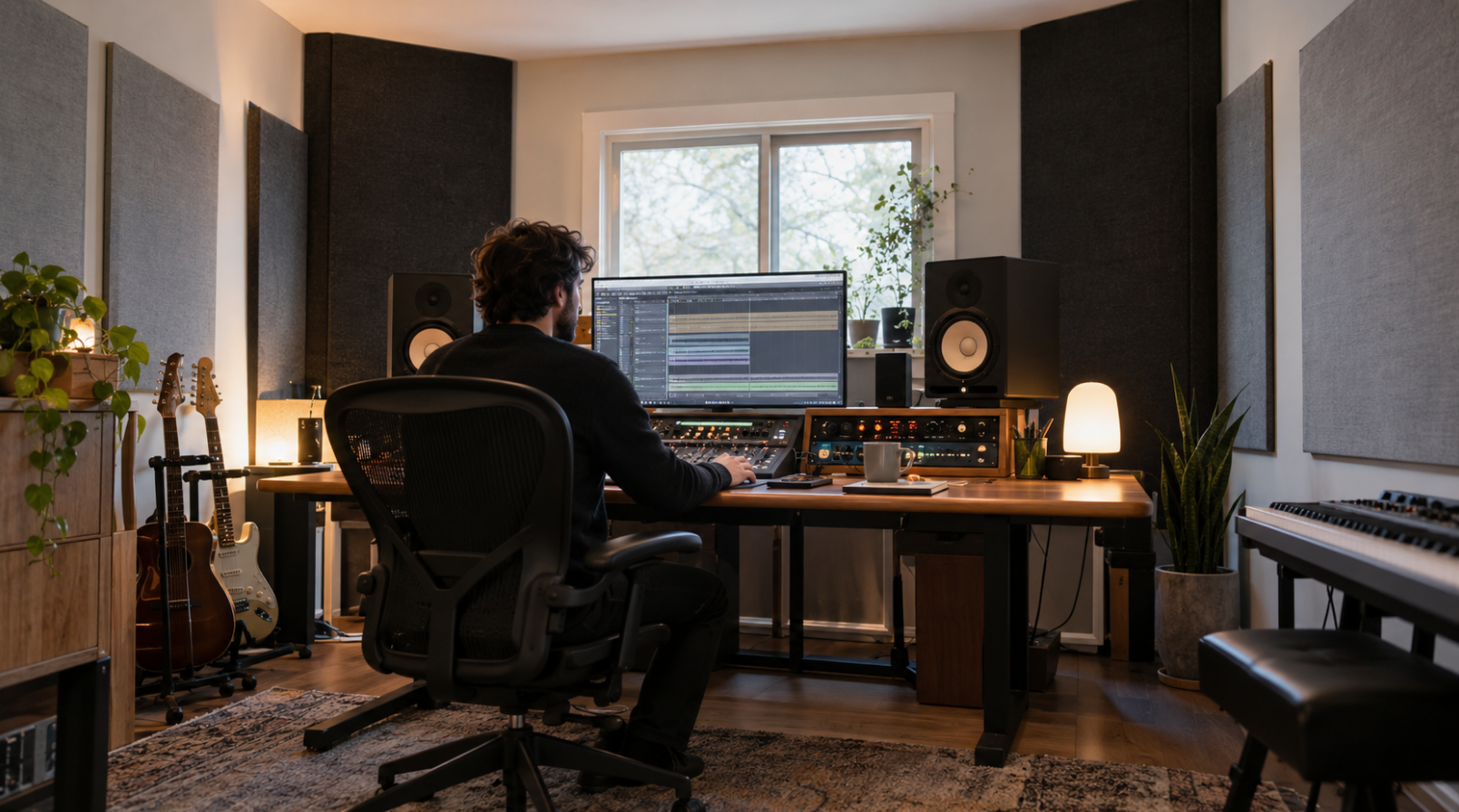
Bass traps and acoustic panels both absorb sound, but they work on different parts of it. Standard acoustic panels, usually 1 to 2 inches thick, control reflections in the mid and high frequencies where speech and most instruments live. Bass traps are thicker absorbers placed in corners, where low frequencies pile up and make a room sound boomy.
Rooms used mainly for talking, such as offices and living rooms, usually need only panels. Recording studios, mixing rooms, and home theaters need both, because they have to sound accurate across the whole frequency range.
What Bass Traps and Acoustic Panels Do
A bass trap absorbs low-frequency sound that ordinary wall panels can't catch. Low notes bounce between parallel walls and form standing waves, so some bass notes ring loudly while others almost disappear depending on where you sit. Corners collect the most of this energy, since three surfaces meet there and the pressure of those standing waves peaks at room boundaries.
Bass traps come in two main types. Porous traps use thick blocks of fiberglass or mineral wool and absorb a broad range of low frequencies. Membrane traps use a sealed panel that flexes at a specific frequency, which makes them effective on one problem note and weaker everywhere else.
Acoustic panels handle the reflections you hear as echo and harshness. Mounted on walls and ceilings, they absorb the sound bouncing off flat surfaces, which shortens the room's ringing tail, removes flutter echo, and makes speech easier to understand.
A thin panel leaves most bass untouched for a simple physical reason. Low-frequency sound waves are long, and a deep bass note can stretch longer than the room itself. A 1-inch panel gives a wave that size almost no material to pass through. Absorbing bass takes depth, either from a thicker absorber or from an air gap behind it.
Bass Traps vs Acoustic Panels - Key Differences
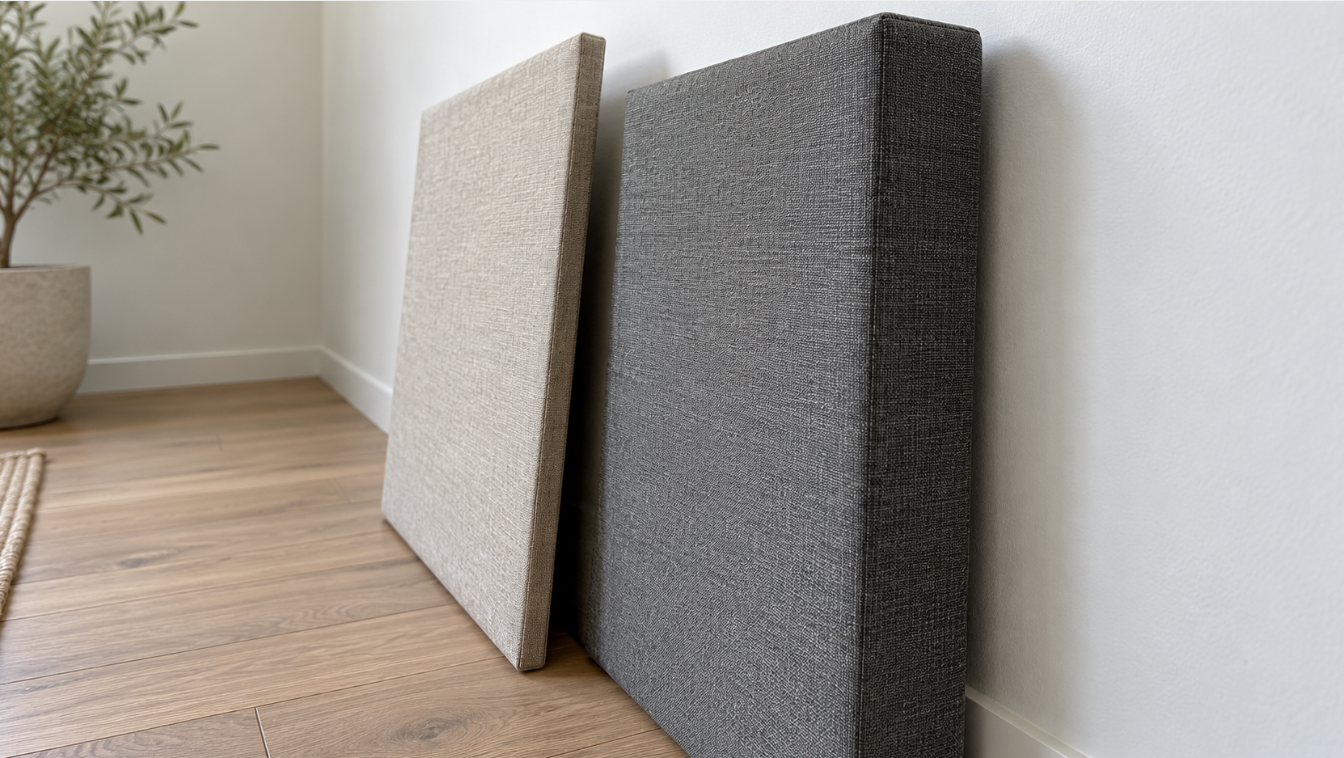
The real difference comes down to depth and placement. A panel only needs enough thickness to catch short, high-frequency waves, so it can sit almost flat on any wall. A bass trap needs much more depth and works best where low frequencies concentrate, which means corners.
Many people ask whether acoustic panels and bass traps are the same thing. They overlap more than the names suggest. A fiberglass panel 3 to 4 inches thick, placed across a corner with air space behind it, works as a broadband bass trap. A 1-inch panel on a flat wall stays a reflection absorber, whatever it is called.
|
Acoustic panels |
Bass traps |
|
|
Frequencies absorbed |
Mid and high frequencies |
Low frequencies, plus mids for porous traps |
|
Typical depth |
1 to 2 inches |
3 to 4 inches or more, or a thinner panel with a deep air gap |
|
Where they go |
First reflection points, rear wall, ceiling |
Wall-to-wall and wall-to-ceiling corners |
|
What you hear without them |
Echo, flutter, harsh or hollow sound |
Boomy, uneven bass, notes that ring or vanish |
|
Typical rooms |
Offices, living rooms, podcast rooms, studios |
Recording studios, mixing rooms, home theaters |
|
Mounting |
Clips or adhesive on walls, suspension on ceilings |
Corner mounting, freestanding, or straddling a corner |
Space is the practical trade-off. Panels sit almost flush and fit any room, while bass traps stick out from the corners and take up floor or ceiling space. In a small room, that depth is still worth giving up, because small rooms tend to have the strongest bass problems.
Do You Need Bass Traps, Acoustic Panels, or Both?
The answer depends on what the room is for and how much bass it has to handle. Speech-focused rooms rarely need dedicated bass treatment, while any room built around music or movie soundtracks does.
Home Studios and Mixing Rooms
A mixing room needs both, and bass traps usually come first. Uneven bass in the room leads straight to a bad mix. You end up cutting low notes that are really just ringing in your corner, or boosting notes the room happens to swallow. Treat the corners first, then add panels at the first reflection points around the mixing position.
Home Theaters
Home theaters need both as well, since subwoofers push a lot of low-frequency energy into the room. Bass traps in the front and rear corners even out the low end. Panels at the side-wall reflection points between the front speakers and the main seat keep dialogue clear.
Before buying treatment, try moving the subwoofer and the main seat. Small changes in either position can shift which bass notes boom and which ones drop out, and corner traps then have less to correct.
Podcast and Vocal Rooms
Most podcast and vocal rooms can start with acoustic panels alone. The microphone picks up reflections from the walls around it, and panels near the recording position fix most of what you hear on a voice track. Small rooms that still sound boxy or boomy after panels go up benefit from adding thick panels in the corners.
Offices and Living Rooms
Offices, conference rooms, and living rooms usually need only acoustic panels. Their main problem is echo that blurs speech, and that sits in the mid and high frequencies. A living room that doubles as a listening space for music is the exception, and corner treatment helps there too.
Where to Put Bass Traps and Acoustic Panels
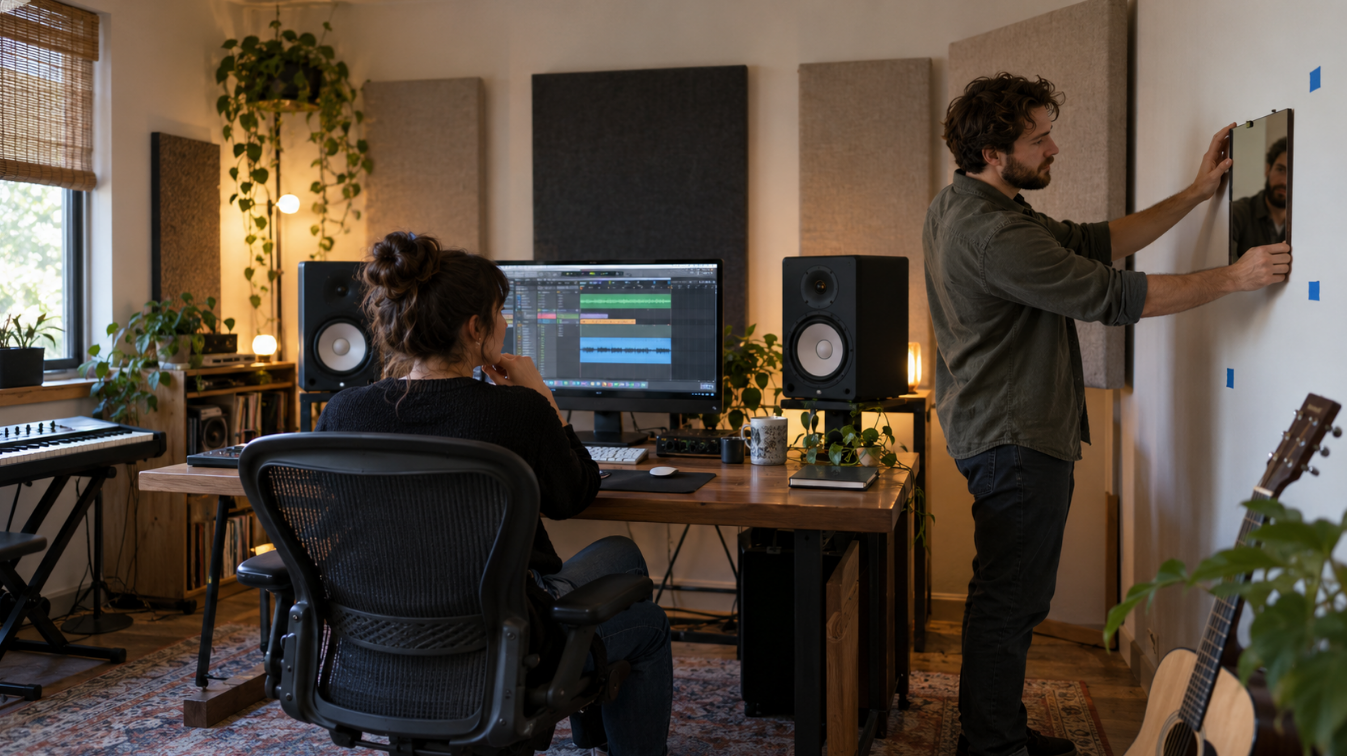
Placement decides how much each piece of treatment does, so start with the spots that carry the most energy. The usual order is corners first, then reflection points, then the rear wall and ceiling.
Vertical corners, where two walls meet, take priority for bass traps. Floor-to-ceiling traps in the front corners help most in a studio or theater, followed by the rear corners. Corners where the walls meet the ceiling come next. A flat panel mounted diagonally across a corner leaves an air pocket behind it. That pocket extends its absorption lower than the same panel mounted flush on a wall.
Acoustic panels go where sound reflects straight toward the listener. To find first reflection points, sit in your listening or recording position while someone slides a mirror along the side walls. Anywhere you can see a speaker or the sound source in the mirror needs a panel. The wall behind you and the ceiling above the listening position come after that.
No fixed number of bass traps fits every room. A practical sequence is to treat the two front vertical corners, listen, then add the rear corners, and only then move to the wall-to-ceiling corners. Small rooms usually need all four vertical corners treated before extra panels make a noticeable difference.
To judge whether the bass is under control, play a slow scale of low notes and listen from your main position, then walk around the room. If some notes still boom while others fade, add more corner treatment. A measurement microphone with room analysis software makes the same check more precise.
Choosing Acoustic Panels That Work as Bass Traps
Thick fiberglass panels can do the job of broadband bass traps when they go into corners. Acoustic panels with an inner frame come in 3- and 4-inch thicknesses, which absorb more of the low-frequency range than standard 1- and 2-inch panels. Mounted across a corner, they handle bass buildup and still look like the rest of the room's treatment. Taller sizes such as 2'x4' and larger cover more of a corner's height, which matters because bass collects along the whole corner, from floor to ceiling.
For first reflection points, the rear wall, and the ceiling, 1- and 2-inch panels are usually enough. Frameless acoustic panels mount flat on walls or hang from the ceiling on chain or wire. If you are planning a theater, our acoustic panels for home theaters page covers that room in more detail.
Keep in mind what both kinds of treatment can't do. Bass traps and acoustic panels change how sound behaves inside the room, and neither one stops sound from traveling through walls to the neighbors. Blocking it calls for sound isolation built from mass, decoupling, and sealed gaps. Our guide on how to block out low-frequency noise explains that side of the problem.
To plan treatment for a specific room, start with its dimensions, photos of each wall, and a note on how you use it. That's enough to work out how many corner panels and reflection panels the space needs and what thickness each one should be.
Recent posts


