
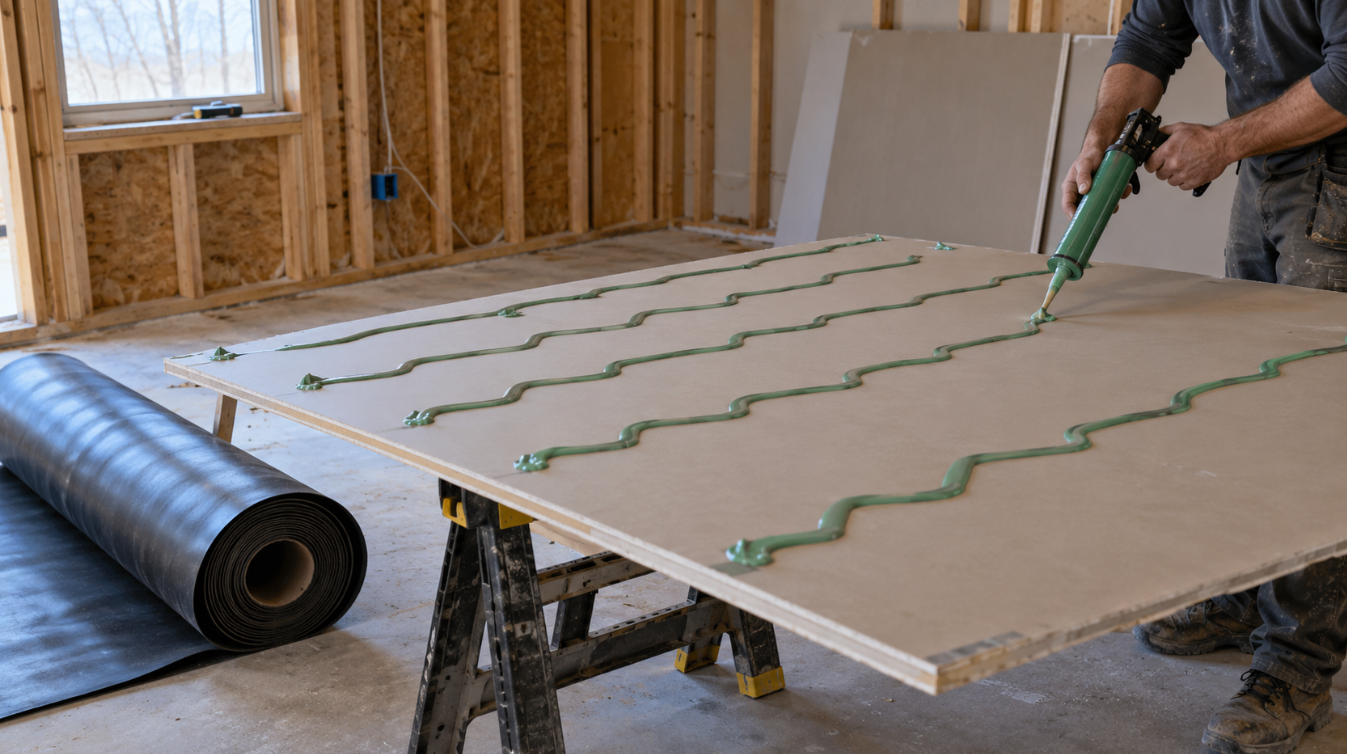
Mass-loaded vinyl and Green Glue both reduce the sound that passes between rooms, and they do it in different ways. Mass-loaded vinyl adds weight to a wall, floor, or ceiling through a thin, flexible sheet. Green Glue Noiseproofing Compound goes between two rigid layers, such as two sheets of drywall. There, it turns vibration into a small amount of heat before it can travel through.
That difference decides where each one fits. Green Glue makes the most sense when you're adding a second layer of drywall or plywood. Mass-loaded vinyl works where a second rigid layer won't fit, such as around ducts and pipes. Home theaters and music rooms often use both.
How Mass-Loaded Vinyl and Green Glue Work
Mass-loaded vinyl blocks sound with weight. Heavy materials are harder for sound waves to set in motion, so a dense layer lets less energy through to the other side. The vinyl version packs that weight into a thin, flexible sheet. It rolls out, cuts with a utility knife, and wraps around shapes a rigid board can't follow.
Green Glue works through damping. When sound hits a wall, the drywall vibrates and passes that vibration on. A layer of viscoelastic compound sandwiched between two rigid sheets flexes as the sheets move against each other, and that motion turns part of the vibration into heat. The compound adds very little weight, and its effect depends on being trapped between two layers.
Both materials belong to soundproofing, the work of stopping sound from traveling from one space to another. Neither one changes how a room sounds inside. Echo and reverberation call for absorption, which uses soft, porous materials on the room's surfaces.
Mass-Loaded Vinyl vs Green Glue - Key Differences
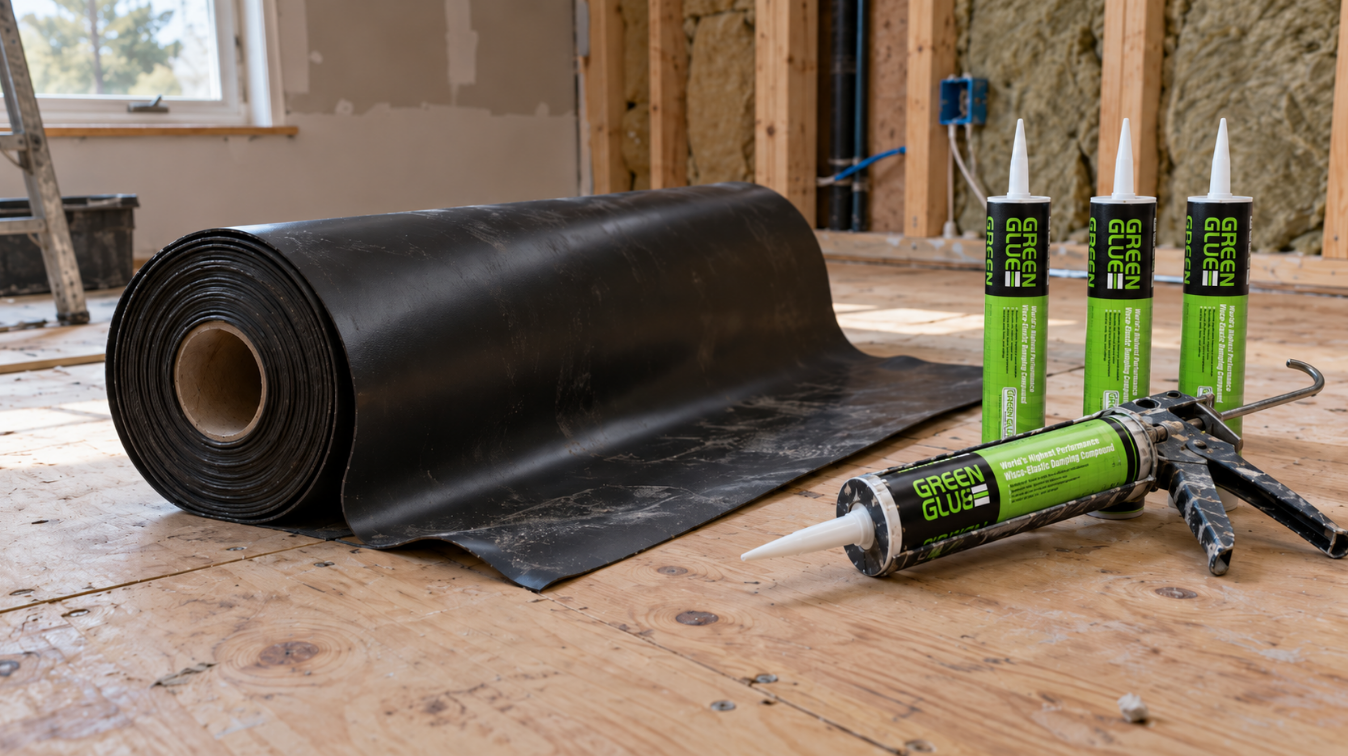
The two products solve the same problem from opposite directions. Mass-loaded vinyl adds mass with minimal thickness, while Green Glue adds damping to an assembly that already has two rigid layers. One goes on as a sheet; the other comes out of a caulk gun.
Installation needs differ just as much. Mass-loaded vinyl has to be fastened, and every seam and edge has to be sealed for it to work. Green Glue needs a second sheet of drywall or plywood screwed on while the compound is still wet, and it reaches full performance only after it cures.
|
Mass-loaded vinyl |
Green Glue Noiseproofing Compound |
|
|
How it works |
Adds mass |
Damps vibration between rigid layers |
|
Form |
Flexible sheet on a roll |
Compound in tubes, applied with a caulk gun |
|
What it needs |
Fastening plus sealed seams and edges |
Two rigid layers, such as drywall over drywall |
|
Added thickness |
About 1/8 inch for a 1 lb per sq ft sheet |
Almost none beyond the second layer of drywall |
|
Best fit |
Ducts, pipes, floors, ceilings, curved or tight spaces |
Adding drywall to existing walls and ceilings |
|
Time to full effect |
Immediate once installed |
About 30 days of curing |
|
Tools |
Utility knife, fasteners, sealant or tape |
Caulk gun, screws, second layer of board |
Which One Blocks More Sound?
Neither material wins on its own. The result depends on the whole wall or ceiling: the studs, the cavity insulation, the number of drywall layers, and how well the gaps are sealed. A strong product in a leaky assembly will lose to a modest product in a sealed one.
Green Glue tends to suit walls and ceilings where you're already adding drywall. The second sheet brings its own mass, and the compound between the sheets adds damping, so one job delivers both effects. Damping also targets the low-frequency vibration behind bass and footsteps, which tends to pass through walls most easily.
Mass-loaded vinyl does work, but its weight per square foot is modest, so it rarely transforms a wall by itself. Its strength lies in flexibility. It can line a duct, wrap a drain pipe, go under a floor, or fill a spot where a second sheet of drywall won't fit. In those places Green Glue has no rigid layer to work between, and the vinyl becomes the practical choice.
Both materials share the same weak point. Sound slips through any gap. An unsealed outlet box, a gap at the floor line, or an open seam in the vinyl can cancel much of what either product adds.
When to Use Mass-Loaded Vinyl, Green Glue, or Both
The best choice follows the surface you're treating and what you can add to it. Each material fits most naturally in one of the following situations.
Adding Drywall to an Existing Wall
Green Glue fits this job best. Apply it to the back of a new drywall sheet in a random pattern. Screw the sheet over the existing wall while the compound is still wet, then seal the perimeter. The wall gains both mass from the new sheet and damping from the compound, without opening it up.
Ducts, Pipes, and Tight Spaces
Only mass-loaded vinyl works here. It wraps around HVAC ducts and drain pipes, which carry noise between rooms and floors, and it fits into cavities too tight for an extra sheet of drywall. Seal every seam so the wrap stays continuous.
Floors and Ceilings
Both can help. Mass-loaded vinyl can go under flooring or above a ceiling to add mass without much height. Green Glue fits a ceiling where you're adding a second layer of drywall, and the same approach works between two layers of subfloor. Ceilings below a noisy floor usually benefit most when the new layer is also decoupled from the joists with isolation clips.
Home Theaters and Music Rooms
Rooms that need serious isolation often combine both materials with decoupling. A typical approach pairs isolation clips and channel with two drywall layers and Green Glue between them. Mass-loaded vinyl then handles ducts and other spots the drywall can't cover. Sealing every gap with acoustical sealant ties the system together.
Installation Mistakes That Waste Both Materials
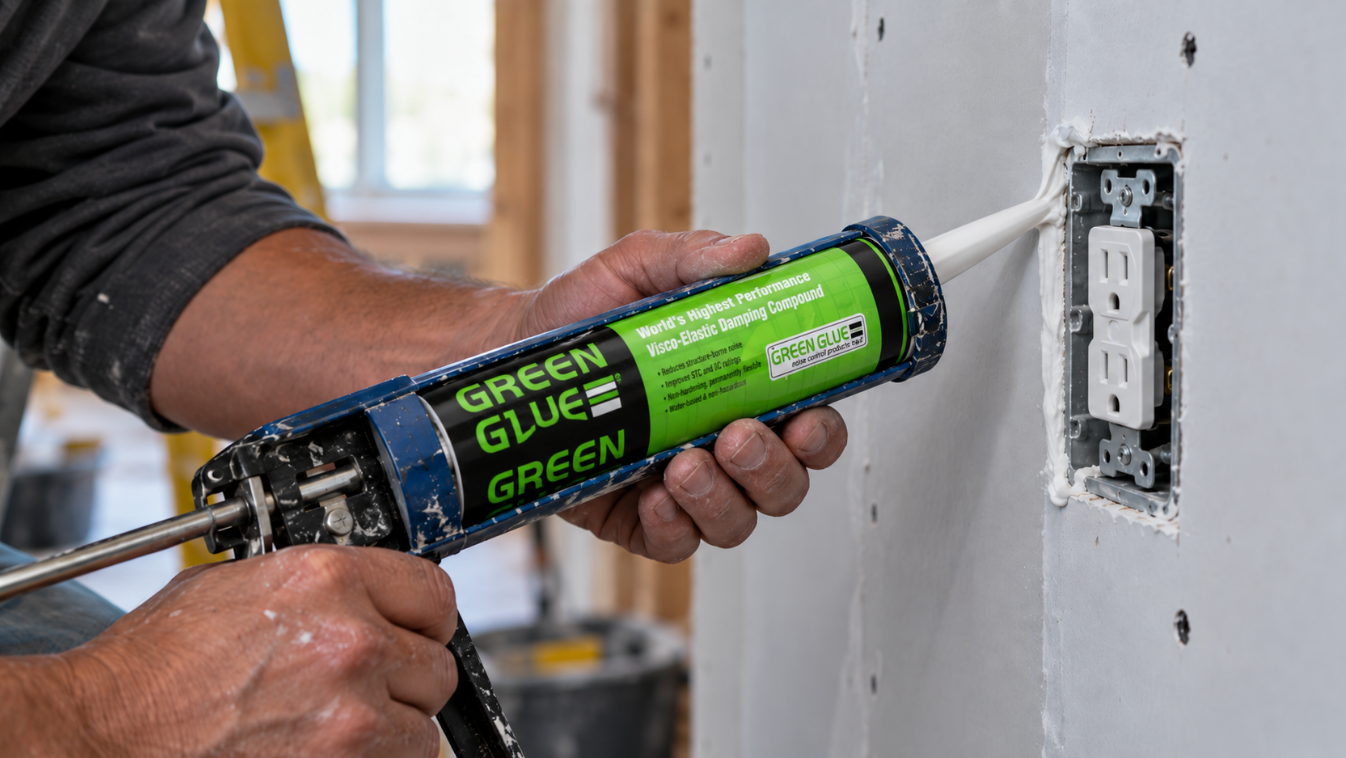
Installation causes more disappointing results than product choice does. Leaving seams, edges, and penetrations open is the biggest one. Mass-loaded vinyl seams need sealing or taping, and drywall edges, outlet boxes, and gaps around pipes need acoustical sealant, or sound simply goes around the treatment.
Green Glue loses performance when it is used like an adhesive. It belongs in a random pattern between two sheets, at two tubes per 4x8 sheet. The second sheet has to go on before the compound dries. Applying it to a single layer, or spreading it on a wall with nothing screwed over it, gives it nothing to work between.
Stretching mass-loaded vinyl tight against framing is another common error. It works better hanging limp or sandwiched loosely, so it can't easily pass vibration along.
Expecting the full result on day one leads to false conclusions. Green Glue reaches its peak after about 30 days of curing, so a wall tested right after installation won't show the final improvement yet.
Buying either material to fix echo inside a room wastes money. Echo needs absorption, such as sound-absorbing panels on the walls and ceiling, which change how the room sounds without affecting what passes through to the neighbors.
Choosing Materials for Your Project
Start with the surface and the type of noise. For walls and ceilings, getting an extra layer of drywall, plan on Green Glue Noiseproofing Compound at two tubes per 4x8 sheet. For ducts, pipes, floors, and tight cavities, use mass-loaded vinyl. The 1/8-inch, 1 lb per square foot sheet comes in 4' x 25' rolls and cuts with a utility knife.
Whichever material you choose, budget for sealing. Acoustical sealants close the seams, edges, and penetrations that would otherwise leak sound. When a project needs more than mass and damping can provide, isolation clips decouple new drywall from the framing. The full range of options is in our sound isolation section.
To plan a specific room, gather the wall and ceiling dimensions, a description of how the walls are built, and what kind of noise you need to stop. With that, it's straightforward to work out how much compound, vinyl, and sealant the project needs.
Recent posts


