
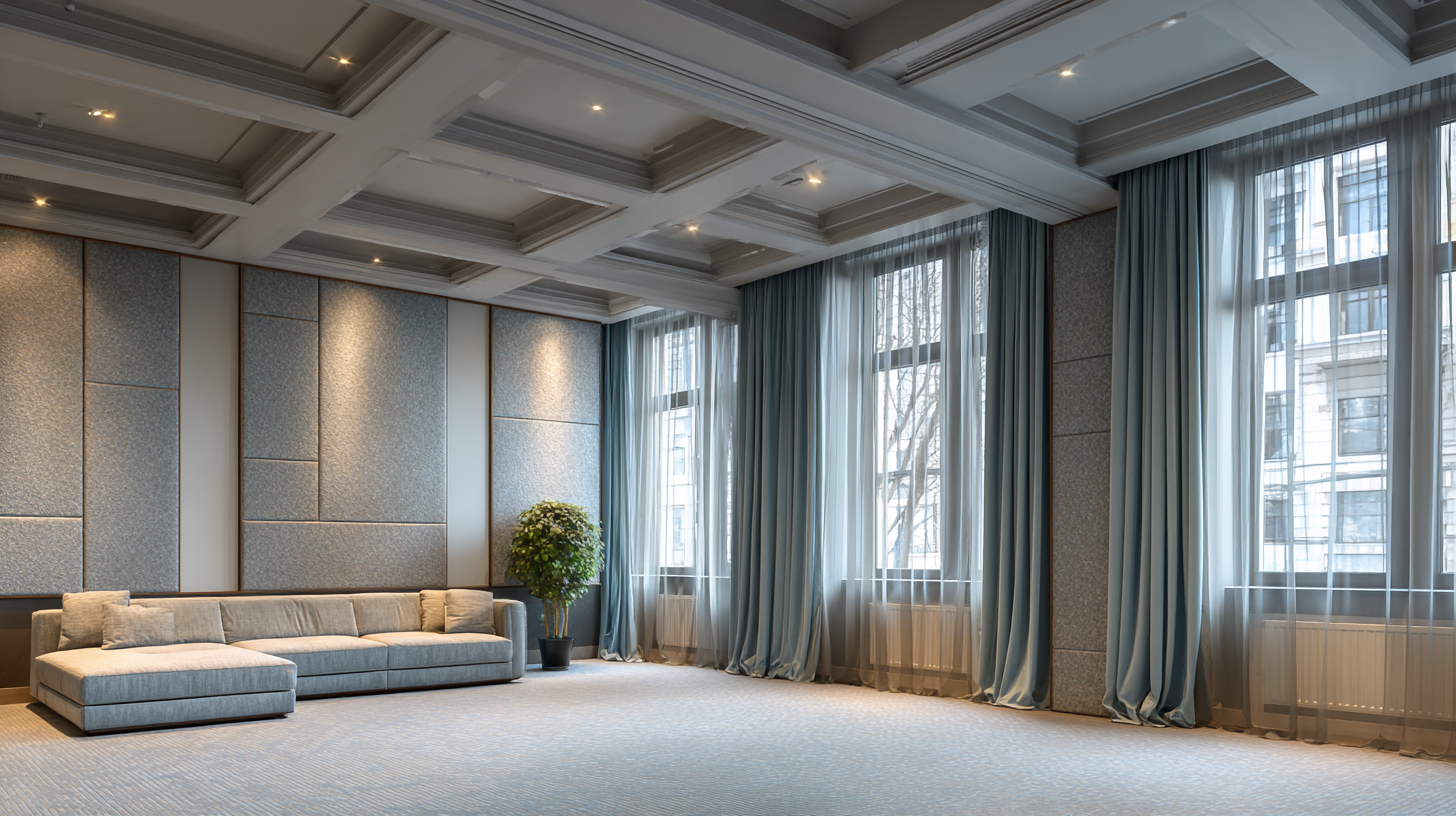
Sound-absorbing materials reduce reverberation, echo, and noise buildup inside a space by converting sound energy into heat rather than reflecting it back into the room. The effectiveness of a material depends on its physical structure, thickness, and the frequencies it is designed to absorb.
Why Some Materials Absorb Sound Better Than Others
When a sound wave reaches a surface, three things can happen: the energy is reflected back into the room, absorbed within the material, or transmitted through it. Hard, dense surfaces such as concrete and glass reflect most of the energy. Soft, porous, and fibrous materials absorb it.
Absorption occurs through molecular friction. As a sound wave penetrates a porous or fibrous material, air molecules are forced through narrow channels and cavities within the structure. The resistance they encounter converts the kinetic energy of the sound wave into heat, which dissipates harmlessly.
Two physical properties determine how well a material absorbs sound: porosity (the density and size of internal air pockets) and thickness. Greater porosity means more surface area for friction. Greater thickness extends absorption to lower frequencies, which have longer wavelengths and require more material depth to dissipate effectively.
A thin, open-weave fabric can show a high NRC rating because it transmits rather than reflects sound, but the energy passes through rather than being absorbed. True absorption requires sufficient material depth and internal structure to dissipate the sound energy within the material itself.
Best Sound-Absorbing Materials - Comparison by NRC
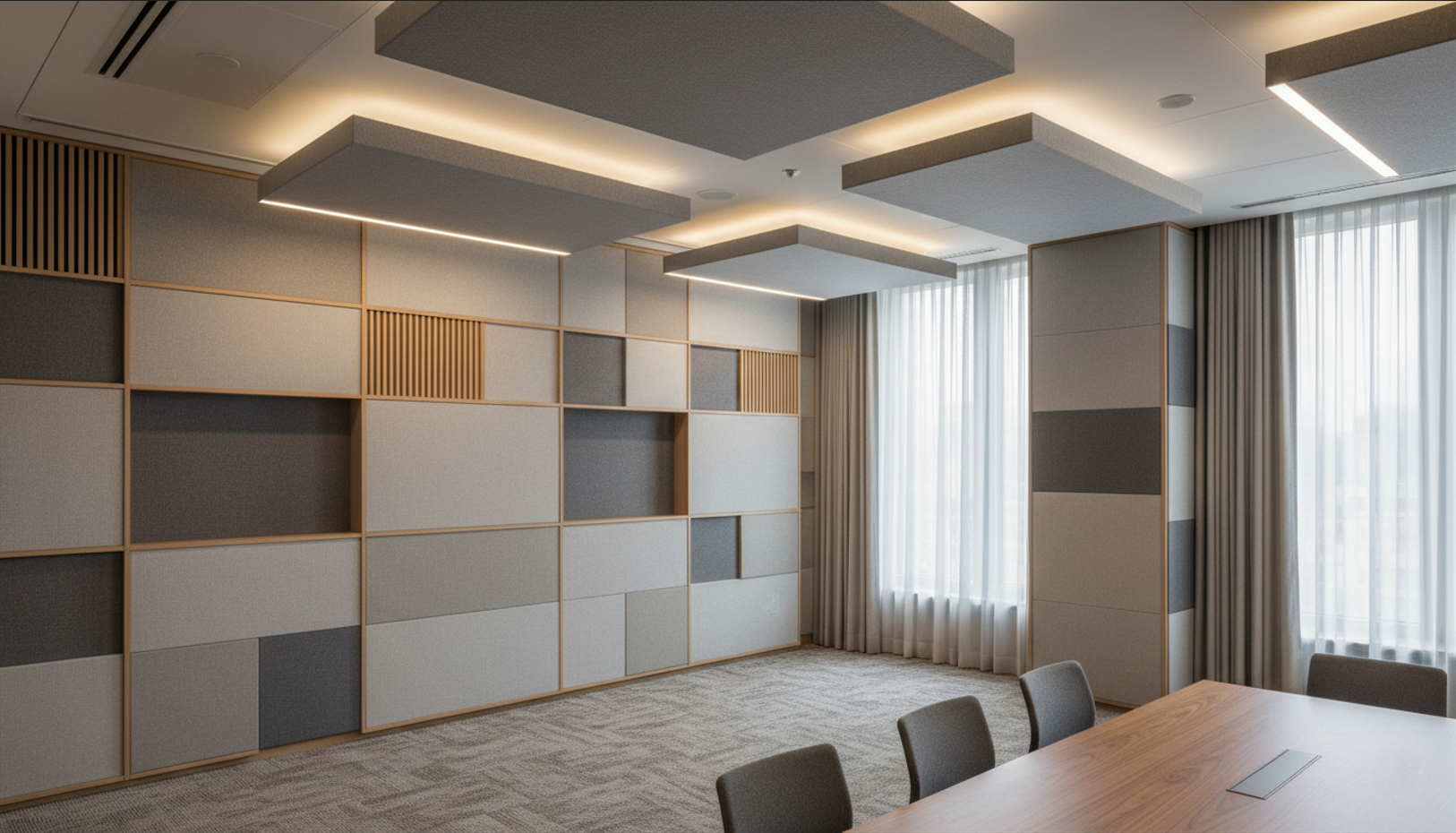
The Noise Reduction Coefficient (NRC) is the standard single-number metric for comparing sound-absorbing materials. It ranges from 0.00 (fully reflective) to 1.00 (fully absorptive) and represents the average absorption across 250 Hz, 500 Hz, 1,000 Hz, and 2,000 Hz.
The table below compares NRC values for the most common sound-absorbing and reflective materials:
|
Material |
Typical NRC |
Primary Frequency Range |
Best Application |
|
Acoustic panel, 2" fiberglass core |
0.95-1.00 |
250 Hz-4 kHz |
Studios, home theaters, offices |
|
Mineral wool board, 2" (OC 703) |
0.95-1.00 |
250 Hz-4 kHz |
Wall panels, ceiling clouds |
|
Acoustic panel, 1" fiberglass core |
0.65-0.85 |
500 Hz-4 kHz |
Offices, conference rooms |
|
Polyester fiber panel (PET), 9mm |
0.80-1.00 |
500 Hz-4 kHz |
Commercial interiors, schools |
|
Suspended acoustic ceiling tile |
0.70-0.90 |
250 Hz-4 kHz |
Open offices, classrooms |
|
Acoustic foam (open-cell, 2") |
0.65-0.80 |
500 Hz-4 kHz |
Studios, vocal booths |
|
Carpet, heavy with thick underpad |
0.35-0.65 |
500 Hz-4 kHz |
Floors in any room type |
|
Acoustic curtain, heavy |
0.40-0.65 |
500 Hz-4 kHz |
Windows, room dividers |
|
Upholstered furniture |
0.35-0.55 |
500 Hz-4 kHz |
Living rooms, lounges |
|
Mass Loaded Vinyl (MLV) |
0.05-0.15 |
All bands (barrier) |
Walls, floors (isolation, not absorption) |
|
Gypsum board (drywall) |
0.05-0.10 |
Mid frequencies |
Structural (not an absorber) |
|
Smooth concrete |
0.01-0.02 |
All bands |
Structural (fully reflective) |
Reading this table: NRC above 0.80 indicates a high-performance absorber. NRC below 0.20 means the material reflects most sound and contributes to reverberation rather than reducing it.
Porous and Fibrous Materials (Highest Absorption)
Porous and fibrous materials are the most effective sound absorbers available. Their internal structure - dense networks of fibers or open-cell cavities - creates maximum surface area for molecular friction, dissipating sound energy efficiently across mid and high frequencies.
Fiberglass acoustic panels are the industry standard for room treatment. A 2-inch panel built on an Owens Corning 703 or 705 core achieves NRC 0.95-1.00 from 250 Hz upward. The compressed glass fibers create a uniform porous matrix that converts sound energy to heat with minimal reflection. Fiberglass panels require fabric wrapping for safe handling, but once installed, they require no maintenance.
Mineral wool boards (rock wool or slag wool) perform identically to fiberglass in acoustic terms and are preferred in applications requiring higher fire resistance or dimensional stability. A 2-inch mineral wool board achieves NRC 0.95-1.00 at mid and high frequencies. Brands such as Rockwool Safe'n'Sound and Owens Corning 703 are the most common panel core materials in the US market.
Polyester fiber panels (PET felt) are made from recycled plastic bottles compressed into rigid or semi-rigid boards. NRC ratings typically range from 0.80 to 1.00, depending on thickness and density. PET panels are lightweight, cut cleanly, carry no fiber hazard, and accept direct printing - making them common in offices, schools, and commercial interiors where aesthetics matter.
Open-cell acoustic foam absorbs sound through the same principle of internal friction, but the cell structure is less dense than mineral wool or fiberglass. Standard 2-inch acoustic foam achieves NRC 0.65-0.80. It is effective at 500 Hz and above but provides limited low-frequency absorption. Acoustic foam is appropriate for vocal booths and small studios where cost and weight are constraints.
All porous and fibrous materials follow the same rule regarding frequency: doubling the thickness roughly extends effective absorption one octave lower. A 1-inch panel absorbs well above 1,000 Hz; a 2-inch panel reaches down to 500 Hz; a 4-inch panel begins to address 250 Hz.
Soft Furnishings and Everyday Materials
Soft furnishings do not replace dedicated acoustic treatment but contribute meaningful absorption, particularly in residential spaces where acoustic panels are not always practical.
Carpet and Underpad
Carpet with a thick underpad is the most effective everyday absorber. A heavy carpet on a dense foam underpad achieves NRC 0.35-0.65 at frequencies from 500 Hz upward. The combination of carpet pile and compressible underpad dissipates significantly more energy than carpet on bare concrete. Carpet is most useful for controlling flutter echo between hard floor and ceiling surfaces.
Heavy Acoustic Curtains
Heavy acoustic curtains achieve NRC 0.40-0.65 at mid and high frequencies. Effectiveness depends on mass and fabric density - lightweight sheer curtains absorb almost nothing. Curtains hung in folds rather than flat increase effective surface area and improve low-mid performance. They are most useful at windows, where hard glass surfaces are otherwise fully reflective.
Upholstered Furniture
Sofas, armchairs, and cushioned seating typically achieve NRC 0.35-0.55. Leather and vinyl coverings reduce absorption compared to fabric upholstery. In a living room or lounge, a fully upholstered sofa can absorb as much sound as a 4-6 square foot acoustic panel at mid frequencies.
Bookshelves and Books
Bookshelves filled with books provide diffusion and moderate absorption simultaneously. The irregular surface of book spines scatters sound in multiple directions, reducing flutter echo, while paper and binding materials absorb some mid-frequency energy. This combination is particularly useful in home offices and listening rooms.
Limitations: Low-Frequency Control
None of these materials absorbs low frequencies below 250 Hz effectively. Bass control requires dedicated bass traps - thick fibrous absorbers placed in room corners, where low-frequency pressure buildup is greatest.
Sound-Absorbing Surfaces by Location
The choice of sound-absorbing material depends not only on NRC but also on the surface being treated and the construction constraints of the space.
Walls
Walls are the primary surface for acoustic panels and fibrous absorbers. Fiberglass or mineral wool panels mounted directly to wall surfaces - or on standoffs with an air gap - provide broadband absorption from 250 Hz upward. The most acoustically critical wall positions are the first reflection points: the side walls and rear wall, where sound from the primary source reaches the listener after a single bounce. Fabric-wrapped panels, PET felt tiles, and hung acoustic baffles are all appropriate wall treatments depending on the installation context.
Ceilings
Ceilings require materials that combine acoustic performance with structural practicality. Suspended acoustic ceiling tiles (NRC 0.70-0.90) are the standard solution for commercial spaces - lightweight, modular, and easy to replace. For higher performance, acoustic ceiling clouds (flat panels suspended horizontally below the structural ceiling) achieve NRC 0.95-1.00 and address both direct ceiling reflections and provide a visual design element. Acoustic baffles - vertical panels hung from the ceiling in parallel rows - increase effective absorptive surface area in open-plan spaces without covering the entire ceiling.
Floors
Floors are treated primarily with carpet and underpad. Hard floors - hardwood, tile, polished concrete - reflect nearly all incident sound and significantly increase reverberation time, particularly at mid and high frequencies. A heavy carpet on a thick foam underpad is the most cost-effective floor treatment available. In spaces where hard floors are required for aesthetic or functional reasons, area rugs over a non-slip pad provide a partial substitute.
Treating All Three Surfaces in Combination
The most effective acoustic treatment addresses walls, ceilings, and floors together. Treating only walls while leaving a hard floor and ceiling untreated will produce uneven results - low-frequency standing waves between floor and ceiling remain unaddressed regardless of wall panel coverage.
What Materials Do NOT Absorb Sound Well
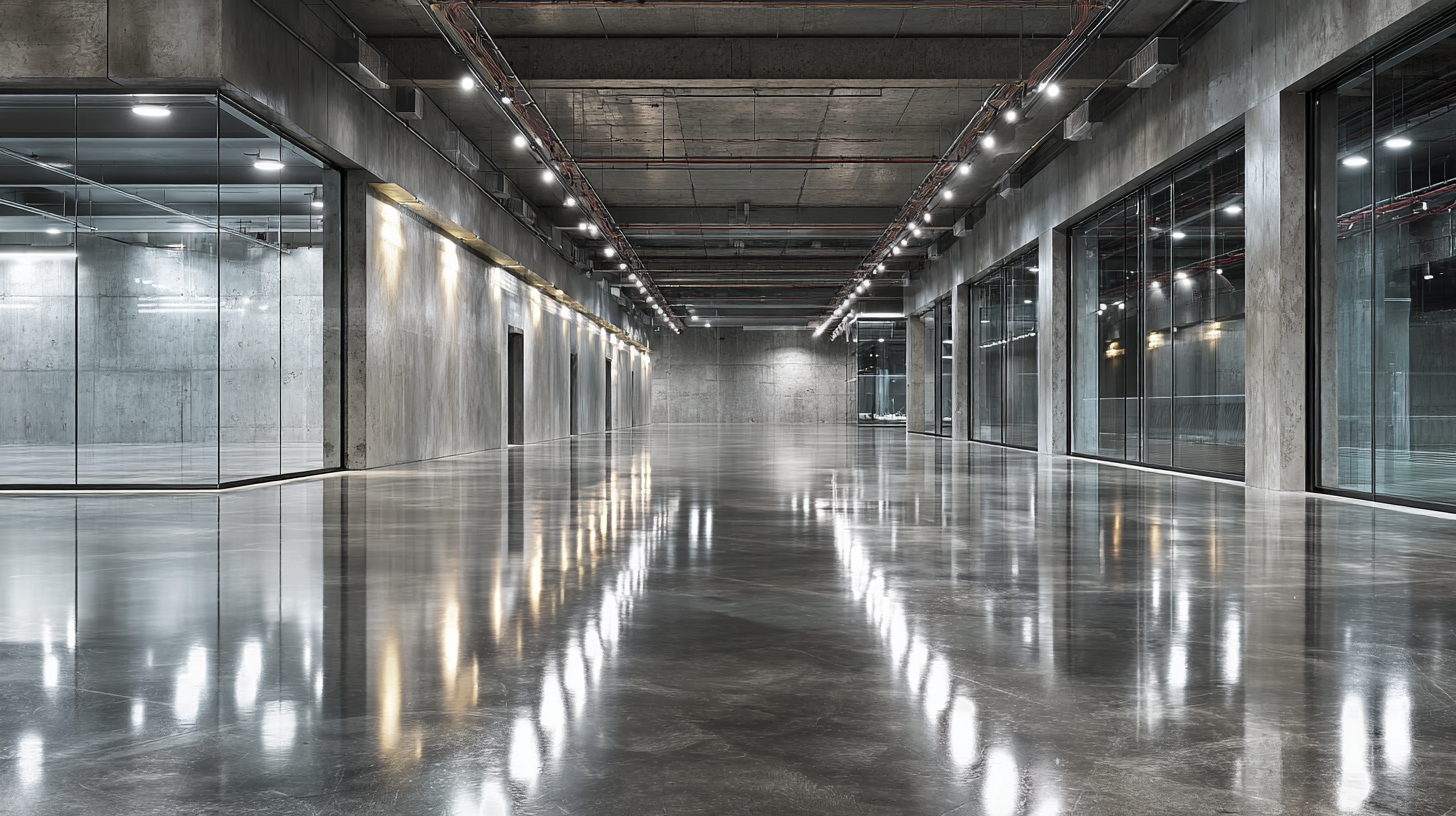
Hard, dense, non-porous materials reflect the majority of incident sound energy. These materials increase reverberation and contribute to echo in any enclosed space.
Smooth concrete and masonry have NRC values of 0.01-0.05 across all frequency bands. Bare concrete walls and floors are among the most reflective surfaces found in buildings. Painting concrete does not meaningfully change its absorption.
Glass (large pane) has an NRC of approximately 0.02-0.06. Windows are among the most reflective surfaces in any room. At low frequencies, glass panes can also act as resonant panels, transmitting rather than absorbing sound.
Gypsum board (drywall) has an NRC of 0.05-0.10. Standard drywall construction, while necessary structurally, does not contribute to room acoustic control. Adding acoustic panels to drywall walls is the standard approach to improving absorption in rooms with typical construction.
Metal surfaces - steel, aluminum, tin - are fully reflective at acoustic frequencies. Industrial spaces with exposed metal ceilings and walls are among the most reverberant environments encountered in practice.
Mass Loaded Vinyl (MLV) is frequently misunderstood. Its NRC is only 0.05-0.15, meaning it absorbs very little sound. MLV is a sound barrier - its function is to add mass to a wall or floor assembly to block sound transmission between spaces, not to reduce reverberation within a room. Using MLV as a room absorber does not work.
A thin sheet of lightweight fabric can show a high NRC rating in laboratory testing because it transmits rather than reflects sound - the energy passes through rather than being absorbed. This does not make it a high-performance absorber in practice, as transmitted energy continues into adjacent spaces or structural cavities.
Choosing the Right Sound-Absorbing Material for Your Space
The right material depends on four factors: the dominant problem frequency, the type of space, the available surface area, and installation constraints. No single material solves all acoustic problems equally.
Problem frequency determines required material thickness. High-frequency echo and speech clarity issues (1,000-4,000 Hz) are resolved with standard 1"-2" acoustic panels. Mid-frequency buildup (250-500 Hz) requires 2"-4" panels or air-gap mounting. Low-frequency bass resonance (below 250 Hz) requires dedicated bass traps - thick fibrous absorbers in corners - or tuned resonant absorbers.
The table below provides material recommendations by space type:
|
Space |
Primary Problem |
Recommended Material |
Target NRC |
|
Recording studio / vocal booth |
Broadband echo, flutter |
2" fiberglass or mineral wool panels + bass traps in corners |
0.95-1.00 |
|
Home theater |
Mid/high reflections, dialogue clarity |
2" acoustic panels on side walls and rear, carpet on floor |
0.90-1.00 |
|
Home office / bedroom |
Echo, reverberation |
1"-2" panels, heavy curtains, carpet |
0.70-0.90 |
|
Open-plan office |
Speech noise, distraction |
Acoustic ceiling tiles or clouds, upholstered furniture, carpet |
0.70-0.90 |
|
Conference room |
Speech clarity, privacy |
2" wall panels on rear wall, acoustic ceiling, carpet |
0.80-0.95 |
|
Classroom |
Reverberation, speech intelligibility |
Suspended ceiling tile, carpet or rubber flooring, rear wall panels |
0.70-0.85 |
Surface area is as important as material NRC. A small area of high-NRC material has less total effect than a larger area of moderate-NRC material. The Sabine equation (RT60 = 0.161 × V / A) quantifies this: total absorption A is the product of surface area multiplied by NRC summed across all surfaces in the room.
For most residential and light commercial applications, a starting point of 25-35% wall coverage with 2-inch acoustic panels, combined with carpet and soft furnishings, brings reverberation time within a comfortable range. High-performance recording environments typically require 40-60% coverage or more across walls and ceiling.
Recent posts


