

Soundproofing an office requires treating each noise pathway separately: doors, walls, windows, floors, ceilings, and HVAC ducts. Each surface has different acoustic weaknesses and requires different materials and techniques. This guide covers every step in the correct sequence - from diagnosing noise sources to selecting materials with verified STC and NRC ratings - so you spend budget where it actually makes a difference.
Why Office Soundproofing Matters

Poor acoustic isolation in an office reduces employee concentration, increases stress levels, and compromises the confidentiality of meetings and calls. Studies in workplace ergonomics consistently identify unwanted noise as one of the top causes of cognitive fatigue and reduced output in open-plan environments.
For offices handling sensitive conversations - legal consultations, HR discussions, therapy sessions, financial advising - acoustic privacy is not optional. In many US states and industries, failure to prevent overhearing of client conversations can create compliance liability under HIPAA, attorney-client privilege rules, or contractual confidentiality obligations.
Even in a standard commercial office, poor soundproofing between a conference room and the open floor sends a signal to clients and employees alike: conversations here are not private.
Soundproofing vs. Sound Absorption - What's the Difference
Soundproofing and sound absorption are two distinct acoustic strategies that are often confused. Both are needed in a well-treated office, but they solve different problems.
What Is Soundproofing?
Soundproofing is the reduction of sound transmission between spaces - blocking sound from entering or leaving a room. It is achieved by adding mass, decoupling surfaces, and sealing air gaps. The performance of soundproofing materials is measured by the Sound Transmission Class (STC) rating: STC 35 means speech is audible and intelligible through the barrier; STC 45 means speech is audible but not intelligible; STC 50+ means conversations are inaudible under normal conditions.
What Is Sound Absorption?
Sound absorption reduces reflections and reverberation inside the room itself. It does not block sound from passing through walls - it only prevents sound from bouncing around the room's interior. Absorption materials are rated by the Noise Reduction Coefficient (NRC) on a scale from 0.0 (no absorption) to 1.0 (full absorption). Acoustic foam panels, fabric-wrapped panels, and carpets are absorption materials, not soundproofing materials.
|
Aspect |
Soundproofing |
Sound Absorption |
|
Goal |
Block sound between rooms |
Reduce echoes inside the room |
|
Key materials |
Mass-loaded vinyl, solid-core doors, gypsum board |
Acoustic foam, fabric panels, carpet |
|
Rating metric |
STC (higher = better blocking) |
NRC (higher = better absorption) |
|
Typical application |
Walls, doors, windows, floors |
Wall panels, ceiling tiles, rugs |
An office that only has absorption panels will still allow conversations to leak through the walls. An office with only heavy walls and no absorption may feel echoey and fatiguing. Effective office soundproofing requires both.
Step 1 - Identify Noise Sources Before You Start
Before purchasing any materials, map all noise pathways in the space. The correct diagnosis determines which surfaces to treat and in what priority order - and prevents spending money on the wrong fix.
Walk through the office and listen for the two main noise types. Airborne noise - speech, music, HVAC - travels through air and passes through walls, doors, and windows when there are gaps or insufficient mass. Impact noise - footsteps, dropped objects, moving chairs - travels through the building structure and appears as vibrations in floors and ceilings.
To identify specific leakage points, perform these checks:
- Door gap test - Hold a piece of paper flat against each door edge. If it slides through easily, the seal is insufficient.
- Light test - In a dark room with lights on in the adjacent space, look for light bleeding around door frames, window frames, or wall penetrations - any visible light gap is also a sound gap.
- Wall tap test - Knock on different sections of a shared wall. Hollow spots indicate a standard stud cavity with no insulation - the most acoustically weak wall type.
- Outlet and switch test - Press your ear near electrical outlets on shared walls. These are flanking paths where sound travels directly through the wall via the box cavity.
- HVAC check - Block the supply vent temporarily and listen to whether the room becomes quieter. HVAC ducts are a common flanking path in multi-office suites.
Document which surfaces are the loudest contributors before spending any budget. In most offices, the door and shared walls account for 70-80% of sound leakage, which is why the next two steps deliver the most impact.
Step 2 - Soundproof Office Doors
Doors are the primary point of sound leakage in most offices because standard interior doors have two critical weaknesses: they are hollow-core (STC ~26-28), and they have visible air gaps at all four edges.
Seal the Perimeter Gap
Apply acoustic weatherstripping (also called door seal) to the top and both sides of the door frame. Compression seals made from EPDM rubber or neoprene are more effective than foam tape, which compresses permanently over time and loses its seal. For a door that requires an STC upgrade of 5-8 points without hardware replacement, properly installed compression gaskets are the most cost-effective first step.
Install a Door Sweep or Automatic Door Bottom
The gap under the door is typically the largest single air gap in the assembly. A standard hollow-core door with a 1/4-inch undercut can lose 10+ STC points from this gap alone.
A door sweep is a strip of rubber or brush material that attaches to the bottom of the door and drags across the floor. It is inexpensive but wears quickly on uneven floors. An automatic door bottom (drop seal) retracts when the door opens and deploys a rubber seal when the door closes - it is more durable and provides a consistent seal regardless of floor irregularities.
Upgrade to a Solid-Core Door
A standard hollow-core door has an STC rating of approximately 26-28, making speech clearly audible on the other side. Replacing it with a solid-core wood door raises the STC to 34-38. A solid-core door with acoustic seals on all four sides (including an automatic door bottom) can achieve STC 42-45, sufficient for most private office applications.
For the highest acoustic performance - law offices, therapy rooms, executive suites - acoustic door assemblies with STC 45-55 are available from manufacturers such as Krieger, VT Industries, and ASSA ABLOY.
Step 3 - Soundproof Office Walls
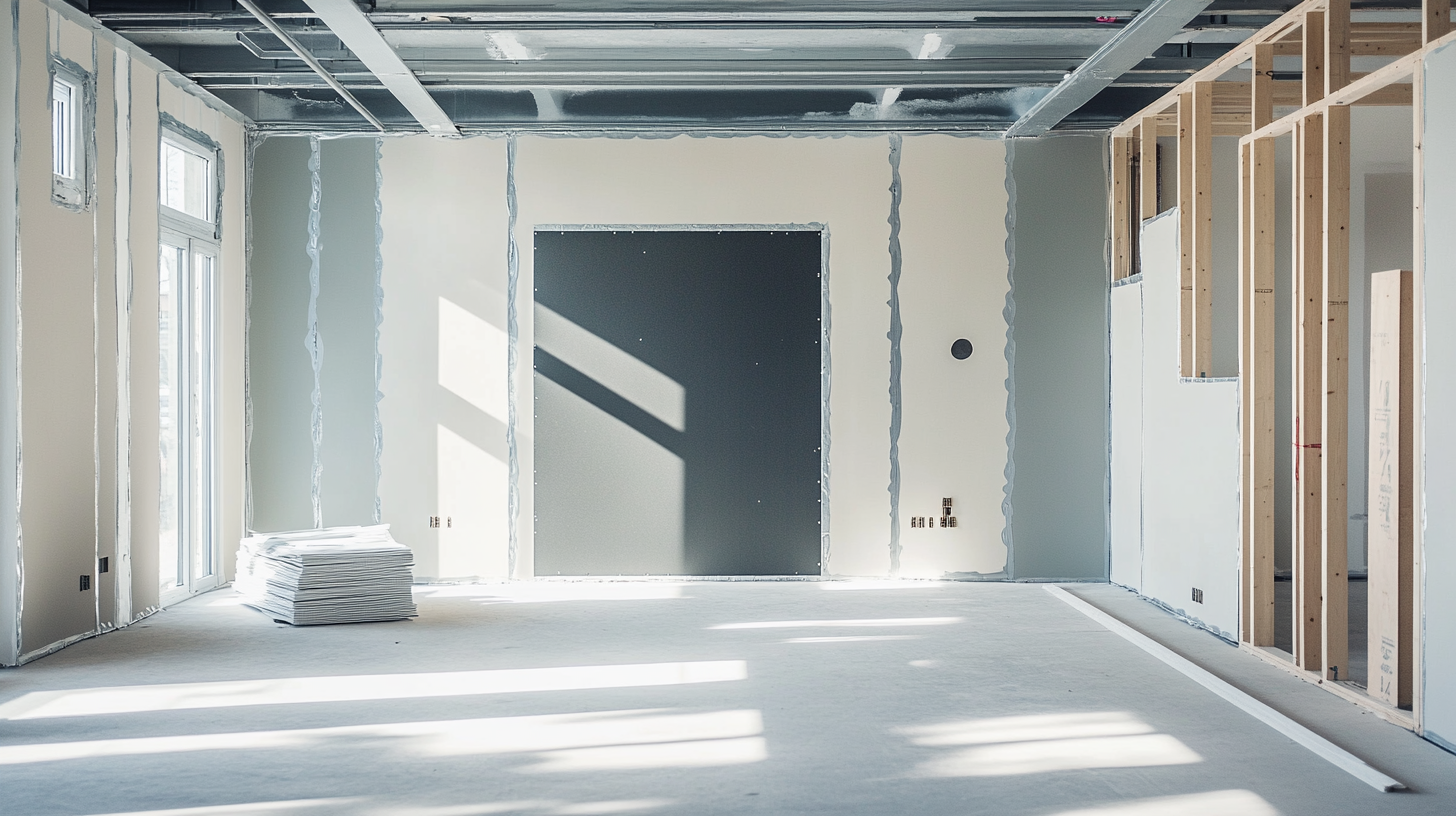
Walls transmit airborne noise through three mechanisms: insufficient mass, rigid structural connections (flanking), and unsealed penetrations. Each requires a different treatment, and they can be applied independently or in combination depending on the target STC.
Add Mass to the Wall
The simplest way to increase wall STC is to add mass. A standard single-layer drywall partition (3.5-inch stud cavity, no insulation) has an STC of approximately 33-35, enough to hear a conversation clearly through. Adding a second layer of 5/8-inch Type X gypsum board raises it to approximately 38-40.
Mass Loaded Vinyl (MLV) is a dense, flexible membrane (typically 1 lb/sq ft) that can be installed beneath drywall or directly on existing surfaces without full demolition. Adding a single layer of MLV plus a second gypsum board layer raises a standard partition to STC 50-52 when combined with acoustic sealant at all edges. In practice, this means a conversation on the other side becomes inaudible under normal office conditions.
Decouple the Wall Structure
Decoupling prevents vibration from transferring through the physical framing of the wall. When both sides of a wall share the same studs, even a heavy wall loses STC through structural transmission - sound bypasses the mass entirely by traveling through the rigid frame.
Resilient channels are horizontal metal strips that attach to existing studs and hold the new gypsum board layer without direct contact. They interrupt the rigid connection and can add 8-12 STC points to an existing wall. RSIC-1 clips (resilient sound isolation clips) are a higher-performing alternative used in critical applications such as recording studios and medical offices.
A double-stud wall - two independent stud rows with an air gap between them - achieves STC 55-65 but requires 4-6 inches of additional floor space.
Seal Acoustic Weak Points
Any unsealed gap in a wall - regardless of how well the surface is treated - creates a flanking path that cancels out the mass and decoupling investment. This is the step most DIY projects skip, and it's why walls that look fully treated still leak sound.
Apply acoustic sealant (such as OSI SC-175 or Tremco Acoustical Sealant) around all wall perimeter joints, at the base of the wall, and around any electrical boxes. Acoustic putty pads installed inside electrical outlet boxes on shared walls prevent sound from transmitting through the cavity. All penetrations - pipes, conduit, cable runs - must be sealed with acoustic sealant or non-hardening caulk.
Step 4 - Soundproof Office Windows
Standard single-pane windows have an STC rating of approximately 27. Double-pane insulated glass (IGU) reaches STC 28-32, depending on glass thickness and gap width - only marginally better against mid- and low-frequency noise. In a street-facing office or a building with noisy neighbors, windows are often the weakest acoustic link after doors.
Seal the Window Frame
Before any glazing upgrade, inspect and reseal the window frame. Gaps between the frame and wall assembly are the most common cause of acoustic underperformance in otherwise adequate windows. Apply silicone acoustic sealant at all frame-to-wall junctions and replace any cracked or deteriorated glazing compound around the glass edge.
Install Secondary Glazing or Acoustic Window Inserts
Secondary glazing (a second independent pane mounted 4-8 inches inside the existing window) creates an air gap large enough to break the vibration coupling between the two panes. This approach can raise a standard double-pane window from STC 28-32 to STC 44-48 without replacing the existing window, making it the highest-performance non-destructive window upgrade available.
Acoustic window inserts (such as Indow Window inserts) are compression-fit acrylic panels that install inside the existing frame without hardware. They add 7-14 STC points depending on the existing window's baseline and are well-suited for rental spaces where permanent modification is not allowed.
Use Heavy Curtains as a Supplementary Layer
Dense, floor-to-ceiling curtains made from tightly woven fabric (at least 15 oz/sq yd) add approximately 4-8 STC points and provide useful NRC improvement inside the room. Curtains are not a substitute for sealed frames or secondary glazing, but they reduce both transmission and interior reflections and are a practical supplement in any setting.
Step 5 - Address Floors and Ceilings
Floors and ceilings primarily transmit impact noise - footsteps, vibrations, and structural sounds that travel through the building frame. Airborne noise also passes through floor/ceiling assemblies, but the solutions differ by noise type.
Reduce Impact Noise Through Floors
Impact noise is measured by the Impact Insulation Class (IIC) rating, where higher values indicate better isolation. A bare concrete slab has an IIC of approximately 25-28; building codes for multi-unit construction typically require an IIC 50+.
Adding a floating floor system - an acoustic underlayment layer beneath a hard floor finish - is the most effective way to increase IIC without raising the floor height significantly. Underlayment products made from recycled rubber or mass-loaded vinyl composites (such as Acoustimat, QuietWalk, or FloorMuffler) add 18-25 IIC points. Wall-to-wall carpet with a dense pad raises IIC by 25-30 points.
For rental offices where floor work isn't possible, area rugs with thick underlays provide meaningful IIC improvement without any installation work.
Improve Ceiling Sound Isolation
Acoustic ceiling tiles (ACT) reduce interior reverberation (NRC) but have a limited effect on sound transmission between floors. For true inter-floor isolation, the ceiling assembly itself must be decoupled from the structure above.
A resilient channel ceiling - the same decoupling principle used in walls - suspends the gypsum board below the joists on resilient channels and adds 8-12 STC points to the assembly. Acoustic ceiling clouds and baffles suspended below the ceiling plane improve NRC ratings without structural work and are practical for open-plan offices.
For offices in multi-story buildings with noise coming from the floor above, the most effective solution combines a decoupled ceiling assembly with mineral wool insulation (not fiberglass batts) packed into the cavity above.
Step 6 - Control HVAC and Mechanical Noise
A shared HVAC system creates a direct flanking path between rooms: sound travels through the air duct network regardless of how well walls and doors are treated. This is one of the most frequently overlooked noise sources in commercial office buildings - and the reason why a well-sealed office can still feel acoustically exposed.
For supply and return ducts, the fix involves three layers. First, install flexible duct connectors where ductwork meets the air handler - these absorb vibration at the source. Second, line the interior of ducts with acoustic duct liner (fiberglass or foam) to absorb sound traveling through the airstream. Third, for critical privacy needs, add duct silencers (sound attenuators) - baffled chambers inserted inline in the duct run that interrupt sound propagation through the system.
Plumbing noise is addressed with pipe insulation wraps and anti-vibration clamps that prevent pipes from transmitting structure-borne vibration into the framing.
Sound masking systems - ceiling-mounted speaker networks emitting a calibrated background signal (shaped pink noise or a speech-masking frequency profile) - raise the ambient noise floor so that speech from adjacent rooms falls below the threshold of intelligibility. Sound masking does not reduce actual noise levels; it reduces the signal-to-noise ratio. Systems from Cambridge Sound Management (Qt), Lencore, and Soft dB are widely deployed in US commercial office environments.
Start Small, Then Build Up

Office soundproofing isn't a single renovation project - it's a stack of independent solutions, each of which delivers measurable results on its own. Even a limited budget, applied to the right surface first, makes a real difference: a properly sealed door blocks more sound than a wall full of acoustic panels on the same shared wall.
Start with the diagnosis and the door. In most offices, that single step is enough to make conversations in a private room inaudible to anyone walking past. If that's not sufficient, each next layer - acoustic panels on shared walls, secondary glazing on windows, underlayment under the floor - adds a predictable number of STC or NRC points at a known cost. That's what makes office soundproofing one of the few building improvements where you can plan the outcome in advance, without guesswork.
Recent posts


