
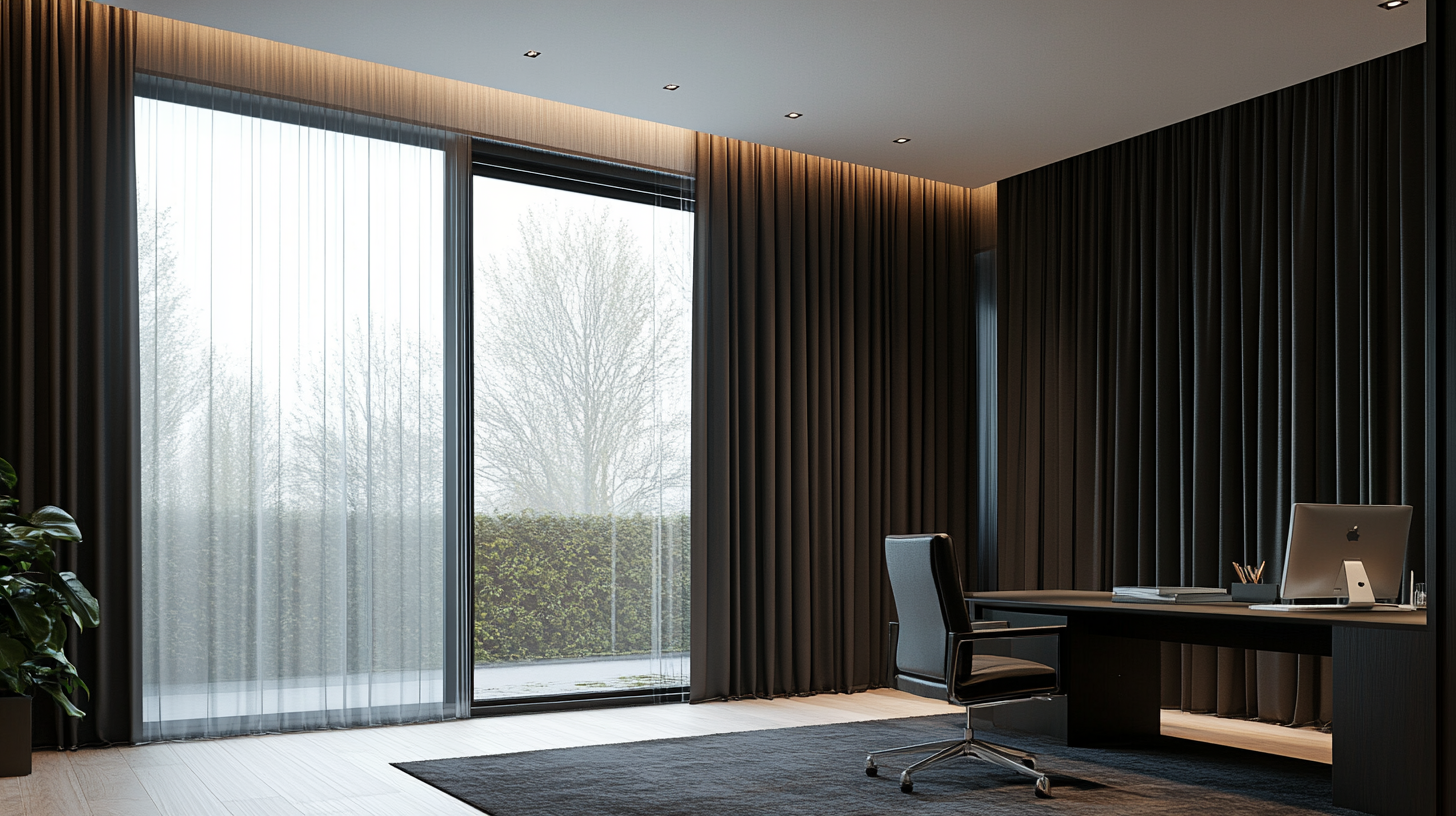
"Soundproof curtains" is a marketing term, not a technical description. Acoustic curtains reduce echoes and reverberation inside a room and take the edge off high-frequency noise coming through windows. They do not block sound the way a wall or a sealed door does. Understanding exactly what they do - and what they can't - determines whether they're the right solution for your noise problem.
The Short Answer
Acoustic curtains work as sound absorbers, not sound blockers. A properly installed acoustic curtain reduces ambient noise by approximately 3-7 dB in the mid- and high-frequency ranges. For low-frequency noise - traffic rumble, bass, HVAC - the reduction is typically under 2 dB, which is barely perceptible.
To put those numbers in context: the human ear perceives a 10 dB drop as roughly half the loudness. A 5 dB reduction is noticeable - the room feels quieter and less harsh - but it does not make a noisy street inaudible. It takes the sharp edge off the problem, not the problem itself.
The term "soundproof" as applied to curtains is a mislabel that leads to disappointed buyers. No curtain available at retail achieves the mass and airtightness required for true sound blocking. What the best acoustic curtains do achieve - echo reduction and moderate high-frequency attenuation - is genuinely useful, but only for the right applications.
Why Fabric Cannot Truly Block Sound

Sound transmission through a barrier is governed by two physical principles: mass and airtightness. Heavier, denser materials resist the pressure waves of sound more effectively. Airtight seals prevent sound from traveling through gaps, which is the path of least resistance for airborne noise.
Fabric fails on both counts. Even the densest acoustic curtain weighs 1-2 lbs per square foot. To put that in perspective, a single layer of drywall - which has an STC rating of only 28, already considered minimal for any acoustic application - weighs 2.2 lbs per square foot and is rigid and sealed at the edges. A curtain hanging freely in front of a window achieves none of the conditions that make drywall work.
Fabric is also porous. Sound waves pass through the fiber gaps in any woven or knitted material regardless of how tightly it is constructed. This is why acoustic curtains absorb sound energy inside the room - the fibers convert some of that energy to heat through friction - but cannot prevent sound from entering through a window assembly.
A curtain also leaves gaps at the top, sides, and bottom where sound travels around the fabric without interacting with it at all. Sound, like air, takes the path of least resistance - and the path around a curtain is always easier than the path through it.
Sound Absorption vs. Sound Blocking - What Curtains Actually Do
Sound absorption and sound blocking are two distinct acoustic mechanisms measured by different metrics. Acoustic curtains affect one of them.
Sound absorption reduces echo, reverberation, and the buildup of reflected sound inside a room. It is measured by the Noise Reduction Coefficient (NRC), rated from 0.0 to 1.0. A quality acoustic curtain achieves NRC 0.5-0.8.
Sound blocking prevents sound from passing through a barrier between spaces. It is measured by the Sound Transmission Class (STC) rating. Acoustic curtains have no meaningful STC rating - they are not tested for transmission blocking because they don't perform that function.
|
Metric |
What It Measures |
Curtains' Performance |
|
NRC |
Sound absorption inside the room |
0.5-0.8 (good) |
|
STC |
Sound blocking between spaces |
Not rated / negligible |
The practical implication: acoustic curtains make a room sound less echoey and slightly quieter inside. They do not prevent a conversation in the next room from being audible, and they do not meaningfully reduce the volume of street noise entering through a window.
How Much Noise Reduction to Realistically Expect
Some manufacturers advertise 15-25 dB reduction. These figures come from laboratory tests where the curtain is sealed to a test aperture under controlled conditions - a setup that bears no resemblance to a real window installation. In practice, those numbers don't transfer.
The realistic noise reduction from quality acoustic curtains in a real-world installation is 3-7 dB across mid and high frequencies (roughly 500 Hz and above). At low frequencies (below 250 Hz), the reduction is 0-2 dB - effectively zero.
This frequency split matters because most intrusive urban noise is low-frequency. Heavy traffic, truck engines, HVAC systems, and bass-heavy music all peak below 250 Hz. Acoustic curtains offer minimal relief from these sources. They perform better against higher-pitched sounds: voices through a window, distant sirens, light traffic.
The 3-7 dB range is also conditional on installation. Curtains that are too narrow, too short, or hung close to the glass with no air gap perform at the lower end. Correctly installed curtains - ceiling-mounted, full-width with side overlap, floor-to-ceiling - reach the upper end. Installation is covered in a later section.
When Acoustic Curtains Are Worth Buying

Acoustic curtains are the right tool in four specific situations.
Echo and reverberation inside the room
A room with hard floors, bare walls, and no soft furnishings accumulates reflected sound that makes speech fatiguing and recordings sound unprofessional. Acoustic curtains reduce reverberation time and improve the perceived acoustics of the space without construction. This is their strongest use case.
Reducing the harshness of high-frequency street noise
Acoustic curtains soften the sharp, high-pitched components of traffic and pedestrian noise. The low rumble remains largely unchanged, but the overall quality of the noise becomes less intrusive. A genuine improvement, even if the dB reduction is modest.
Rental spaces where permanent modifications are prohibited
Acoustic curtains require no drilling beyond a standard curtain rod and can be removed without damage. For renters who cannot seal windows, treat walls, or install secondary glazing, curtains are one of the few practical options available.
Supplementing an existing soundproofing solution
In a room that already has sealed windows and treated walls, acoustic curtains reduce remaining interior reflections and provide incremental improvement on top of the primary barrier. Used as a layer, not as the only solution, they contribute meaningfully.
When Curtains Won't Solve the Problem
Acoustic curtains are not sufficient when the primary noise is low-frequency, when sound is entering through walls rather than windows, or when the required noise reduction exceeds 10 dB.
Low-Frequency Noise
Low-frequency noise - truck and bus traffic, subwoofers, HVAC systems, construction equipment - cannot be meaningfully attenuated by fabric. These frequencies have wavelengths measured in feet, and a curtain weighing a few pounds per square foot has no physical ability to impede them. If the noise that bothers you has a physical rumble or vibration quality, curtains will not help.
Noise Through Walls, Floors, and Ceilings
Sound entering through walls, floors, or ceilings is not addressed by window curtains. A curtain on a window has no effect on noise transmitted through a shared wall with a neighbor, through the floor from the unit above, or through a hollow-core door. If noise enters via those paths, the curtain adds nothing.
When You Need More Than 10 dB Reduction
Situations requiring more than 10 dB reduction - a home studio, a medical office, a bedroom on a major highway - need STC-rated solutions: sealed windows, secondary glazing, treated walls, or solid-core doors with compression seals. Curtains cannot bridge the gap between a noisy environment and a genuinely quiet one.
How to Hang Acoustic Curtains for Best Results
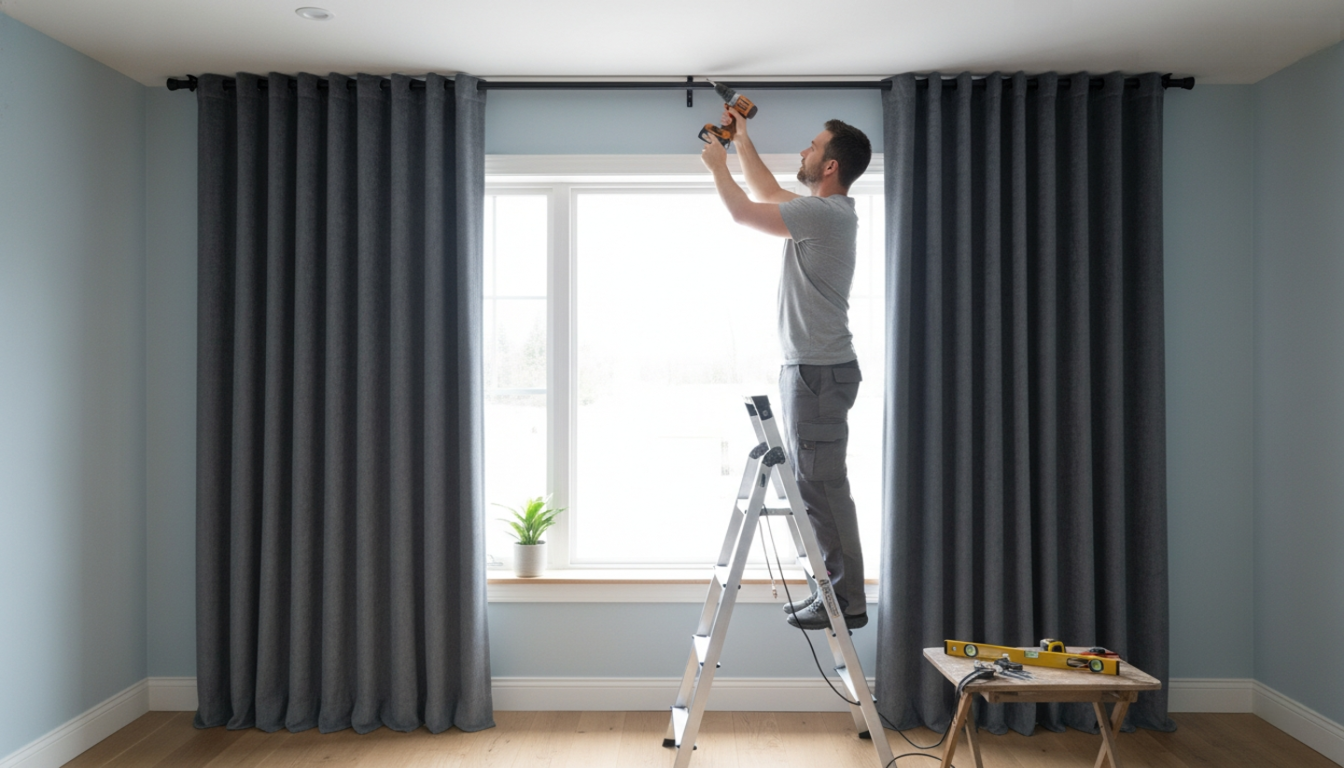
Correct installation adds 2-3 dB to the real-world performance of acoustic curtains. Most of the gap between manufacturer claims and actual results comes from poor installation, not from the material itself.
Mount the Rod at Ceiling Height
Ceiling-mounted curtains cover the wall area above the window - a gap that frame-level installation leaves as an open flanking path for sound. The curtain should run from the ceiling to the floor with no gap at the top or bottom.
Use a Curtain Width of 1.5-2× the Window Width
A curtain exactly as wide as the window leaves the sides open. Extra width allows the curtain to overlap the wall by 6-12 inches on each side when closed, closing the flanking paths around the window frame.
Add a Side Return if Possible
A side return is a short section of rod that angles back toward the wall so the curtain wraps around the sides of the window rather than ending at the edge. This creates a three-sided enclosure that measurably improves performance.
Choose Fabric Heavy Enough to Hang Flat
Minimum useful weight is 1 lb per square foot. A curtain that billows or moves easily in air currents is too light to perform acoustically. Press it flat against the window frame - if it holds position without support, the weight is adequate.
Acoustic Curtains vs. Alternatives at the Same Price
At the $100-$400 price range, where most acoustic curtains are sold, two other options address noise problems more directly for specific use cases.
|
Solution |
Best For |
Price Range |
NRC Effect |
STC Effect |
|
Acoustic curtains |
Echo reduction, high-freq edge on windows |
$80-$300 |
Good (0.5-0.8) |
None |
|
Acoustic wall panels |
Echo and reverberation in any room |
$80-$300/panel |
Excellent (0.7-1.0) |
None |
|
Acoustic window inserts |
Blocking external noise through windows |
$200-$600/window |
Minimal |
+7-14 STC points |
For pure echo reduction, acoustic wall panels outperform curtains at equivalent price points - they offer a higher NRC per square foot and can be placed at specific reflection points rather than only at windows.
For blocking outside noise through a window, an acoustic window insert adds 7-14 STC points to the existing window - a real transmission reduction that curtains cannot replicate.
Acoustic curtains win when both aesthetics and flexibility matter: they look like regular curtains, visually cover the window, and can be opened. For a living room, bedroom, or office where the goal is a quieter-feeling, less echoey space, curtains are the practical, non-permanent choice.
Use Curtains for What They Are, Not What They're Called
Acoustic curtains are a legitimate product with a specific, well-defined function: they reduce echo inside a room and soften the high-frequency components of noise entering through windows. That's a real improvement, and for many spaces it's exactly what's needed.
The problem is the name. "Soundproof" implies total noise blocking, which is physically impossible for any fabric product at any price. Buyers who expect silence get 3-7 dB and feel deceived. Buyers who expect a quieter, less echoey room get exactly that - and are satisfied.
If your goal is to reduce harsh room acoustics or take the edge off street noise in a rental apartment, acoustic curtains are a practical, reversible, and reasonably priced choice. If your goal is acoustic privacy or serious noise reduction, pair them with sealed windows and door gaskets - or skip curtains entirely and start with the higher-STC solutions.
Recent posts


