
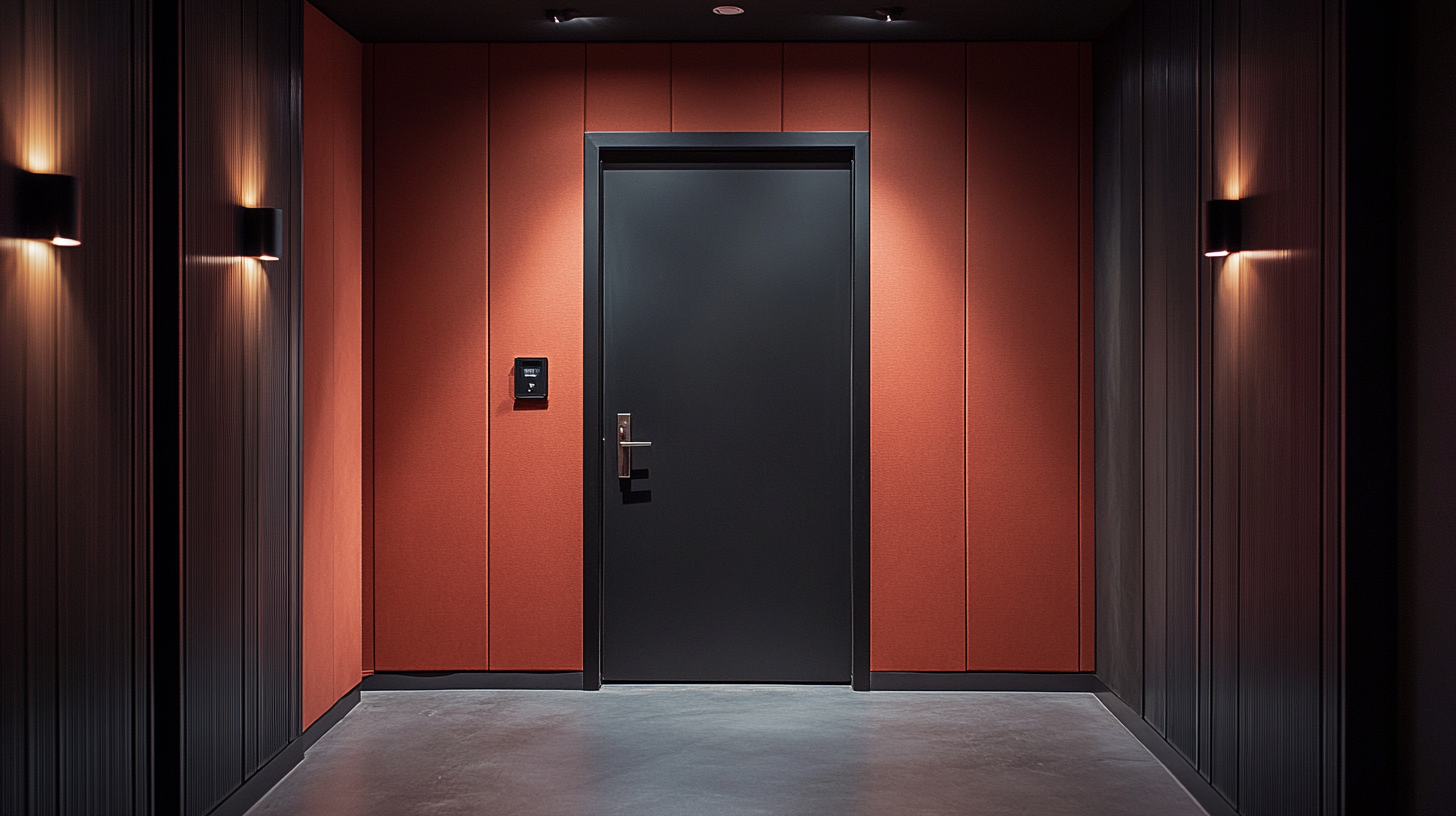
Soundproofing a door requires addressing two separate problems: air gaps around and under the door, and insufficient mass in the door panel itself. Air gaps are responsible for the majority of sound leakage in most doors and should always be fixed first. This guide covers every method in sequence - from a $15 door sweep to a professional acoustic door assembly - so you can stop at whichever step meets your needs.
Why Doors Let Sound Through
Doors are the acoustically weakest point in most walls because they combine two serious vulnerabilities: air gaps and low mass.
Air gaps around the door frame and under the door panel create direct paths for sound to travel without passing through any material at all. A gap as narrow as 1/8 inch under a door can reduce the effective STC of the entire assembly by 10-15 points - meaning a solid-core door rated STC 38 performs at STC 23-28 in practice if the undercut is left unsealed.
Low mass is the second problem. A standard hollow-core interior door - the most common type in US residential and commercial construction - has an STC rating of approximately 26-28. At STC 26, a normal conversation on the other side is clearly audible and fully intelligible.
Fixing air gaps is always the higher-return first step. A sealed hollow-core door consistently outperforms an unsealed solid-core door on acoustic measurements.
How to Assess Your Door Before Buying Anything
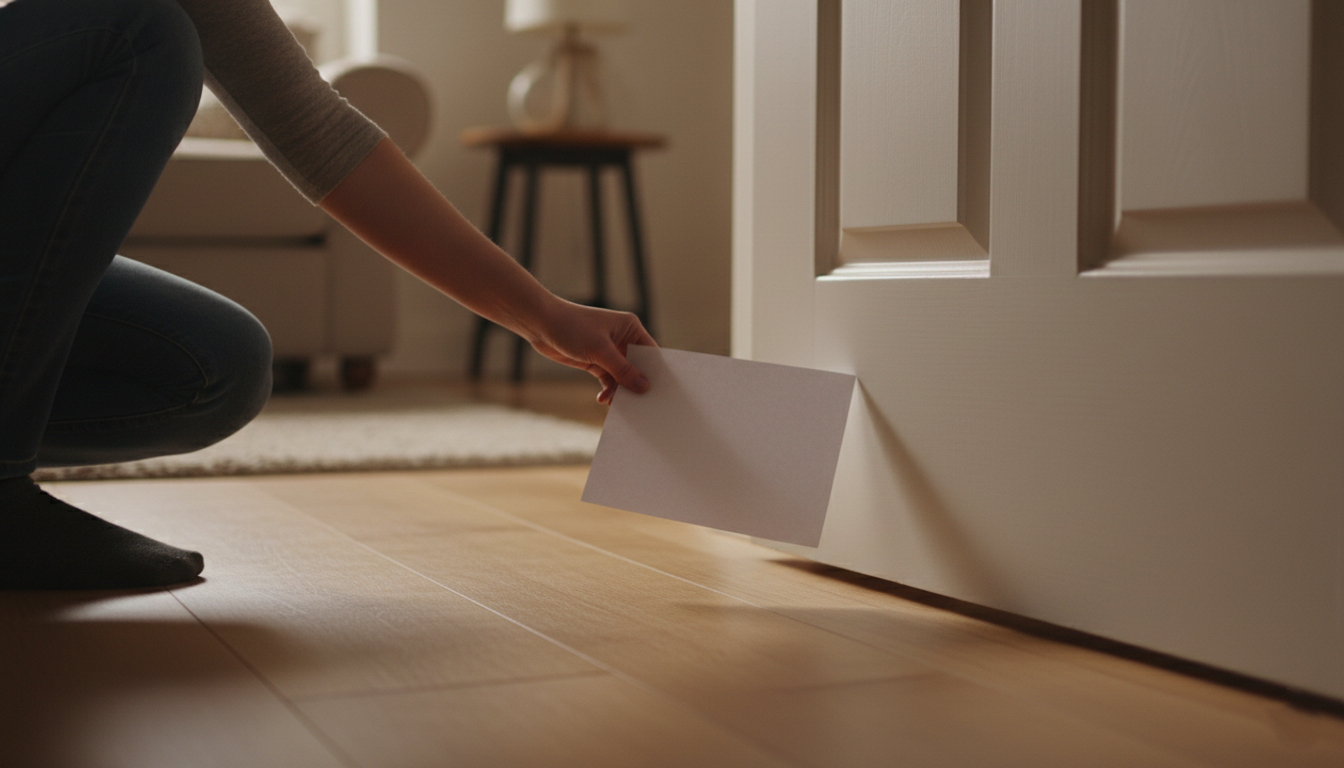
Before purchasing materials, identify whether your door's main problem is gaps, mass, or both. The answer determines which steps to prioritize and how much to spend.
Under-Door Gap Test
Slide a piece of paper under the closed door. If it moves freely with no resistance, the gap is large enough to be the primary leak source and the first thing to fix.
Light Test
Turn off all lights in the room and look for light bleeding around the door frame - top, both sides, and bottom. Any visible light gap is an equivalent sound gap. This test reveals frame perimeter leaks that the paper test misses.
Knock Test
Knock firmly on the center of the door panel. A hollow, resonant sound indicates a hollow-core door (STC 26-28). A dull, dense thud indicates solid-core (STC 34-38). This tells you whether replacing the door is worth considering.
White Noise Test
Play white noise on a speaker on one side of the closed door and listen from the other. Note where the sound seems loudest - under the door, at the frame edges, or through the panel itself. This confirms which fix to prioritize after the other three tests.
How to Soundproof a Door - 5 Steps from Quick Fix to Full Build

Each step builds on the previous one. Start with Step 1, test the result, and continue only if more isolation is needed.
Step 1 - Seal the Gap Under the Door
The gap under the door is the single largest air gap in a standard door assembly. A standard residential undercut of 3/4 to 1 inch is large enough to transmit speech clearly even through an otherwise well-treated wall.
A door sweep is a rubber or brush strip that mounts to the bottom of the door and contacts the floor when closed. Rubber blade sweeps provide a better acoustic seal than brush sweeps. They cost $15-$40 and install in under 20 minutes. The downside: on uneven floors, they wear out within 1-3 years.
An automatic door bottom (drop seal) is the more durable alternative. It retracts when the door opens and deploys a rubber seal only when the door closes - so there's no drag wear regardless of floor type. For offices and high-traffic doors, this is the right choice. Cost: $80-$160.
For maximum performance, pair an automatic door bottom with a floor threshold plate - this creates a compression seal rather than surface contact and eliminates any remaining gap at floor level.
Step 2 - Seal the Perimeter (Top and Sides)
After sealing the underside, the next leak source is the 1/8-inch gap between the door panel and the frame on all three remaining edges.
For most doors, EPDM compression gaskets are the right choice - they mount to the door stop, compress against the door face when it closes, and hold their shape for years. A full perimeter set costs $30-$80. Installed on a solid-core door with a door bottom, they add 5-8 STC points to the assembly.
Foam weatherstrip tape ($5-$12) works as a budget option but compresses permanently within 6-18 months. Use it for temporary applications or low-traffic doors only.
Magnetic seals provide the tightest closure available for non-specialized doors - similar to a refrigerator door. They're used in medical, legal, and studio applications. Cost: $150-$400. Requires precise installation alignment.
One rule applies to all three types: the door must visibly compress the gasket when closing. If the door closes with no resistance, the seal isn't making acoustic contact.
Step 3 - Add Mass to the Door Panel
If sealing all gaps doesn't fully solve the problem, the next step is adding mass to the door panel itself - targeting sound that passes through the door material rather than through gaps.
Mass Loaded Vinyl (MLV) is the standard solution. A 1 lb/sq ft membrane cut to door dimensions and attached with construction adhesive adds approximately 4-6 STC points. Material cost for a standard door: $30-$50.
⚠️ Before applying MLV, check your hinges. A standard residential two-hinge setup handles up to 80-100 lb. MLV adds 20-25 lb to the door. If the door already feels heavy or sags, upgrade to three heavy-duty hinges first.
Acoustic door blankets are the renter-friendly alternative - they hang on over-door hooks with no attachment required and add 3-5 STC points. They can be removed without leaving damage. Cost: $60-$200.
Step 4 - Replace with a Solid-Core Door
Replacing a hollow-core door with a solid-core door is the right move when you want a permanent upgrade, and sealing alone hasn't reached the target STC.
A hollow-core door runs STC 26-28. A solid-core MDF or particleboard-core door reaches STC 34-38 on its own - and STC 42-45 when combined with a full seal assembly. At STC 42-45, speech on the other side is audible as a murmur, but words are not intelligible, which covers most private office, bedroom, and home studio needs.
When buying, check three things:
- Weight: a 1-3/4-inch solid-core door should weigh 60-80 lb
- Thickness: 1-3/4 inch is standard for interior acoustic applications
- STC rating: look for a manufacturer-stated STC if available
Solid-core doors are available at Home Depot, Lowe's, and specialty door suppliers in the $150-$400 range. Plan for three heavy-duty hinges - standard two-hinge setups are not adequate for doors above 60 lb.
Step 5 - Acoustic Door Assemblies (STC 45-55+)
This step is for recording studios, medical exam rooms, law offices, and therapy suites - spaces where STC 45 from a sealed solid-core door isn't sufficient. If that's not your situation, Steps 1-4 are all you need.
A prefabricated acoustic door assembly is a complete engineered unit - door, frame, and sealing hardware tested together to a certified STC rating. Manufacturers, including Krieger, ASSA ABLOY (Overly), and VT Industries, produce assemblies rated STC 45-55 to ASTM E90 standards. Prices range from $1,500 to $8,000 per door.
A sound lock vestibule - two doors installed in series with a 4-8 foot air gap between them - is the standard approach for STC 55+. The air gap prevents direct vibration coupling between the two assemblies, which is what drives performance beyond what any single door can achieve.
Soundproofing a Door Without Permanent Modifications
For renters who cannot drill or make permanent changes, these no-modification options provide real improvement:
|
Problem |
Solution |
Cost |
|
Under-door gap |
Draft stopper (weighted fabric tube) |
$10-$30 |
|
Under-door gap (better) |
Self-adhesive door sweep |
$15-$25 |
|
Panel transmission |
Acoustic door blanket on hooks |
$60-$200 |
|
Perimeter gaps |
Removable foam weatherstrip tape |
$8-$15 |
|
General transmission |
Heavy floor-to-ceiling door curtain |
$50-$180 |
Self-adhesive door sweeps work reliably on hard floors; on carpet, adhesion is less consistent. A draft stopper is the lowest-risk option for any surface.
Start at the Gap, Not the Store
Most soundproofing projects waste money by treating the wrong problem first. A $400 MLV upgrade on a door with an unsealed frame and a 3/4-inch undercut will underperform a $60 sealing kit on the same door - because air gaps bypass mass entirely.
Seal the under-door gap first, then the frame perimeter, then evaluate whether transmission through the panel still needs attention. In most homes and offices, sealed gaps alone make a private conversation genuinely private. If you still need more after that, a solid-core door with a complete seal assembly will perform exactly as expected - because the gaps that would have undermined it are already gone.
Recent posts


