
Echo Reduction Panels

$48.00
$48.00
$105.00
$85.00
$55.00
$79.00
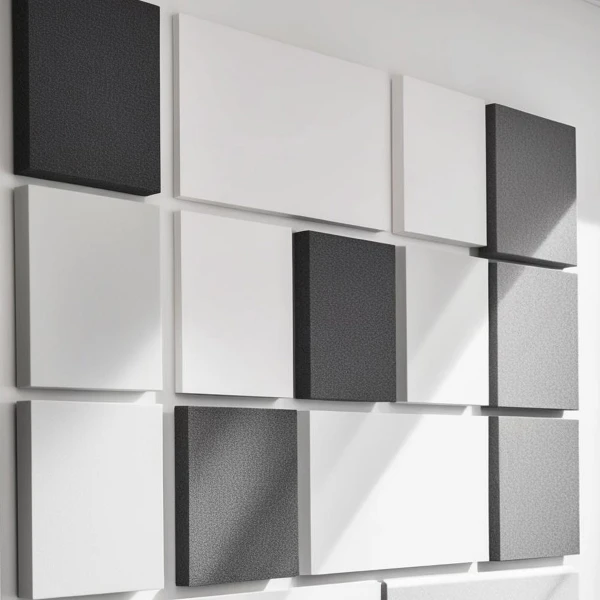
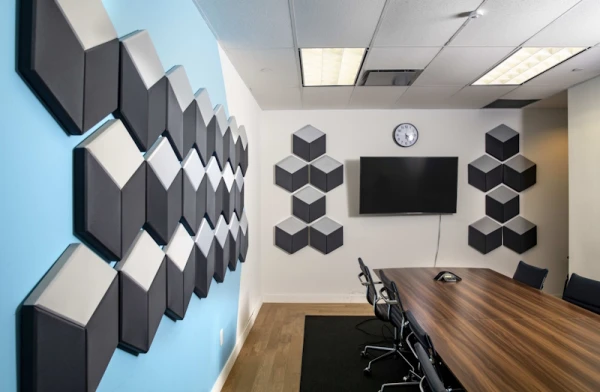
Echo reduction panels absorb the reflections that make a room ring, sound hollow, or turn speech into a blur. Ours are fabric-wrapped fiberglass panels in 1, 2, 3, and 4-inch thickness, for walls and ceilings, in rectangular sizes and decorative shapes. They're rated Class A for fire and handcrafted in the USA.
Echo shows up most in rooms with hard floors, bare walls, and little furniture. Typical examples are a newly finished apartment, a home office used for video calls, a living room with a high ceiling, a gym, or a church. A few well-placed panels on the walls and ceiling make a noticeable difference in rooms like these.
What Causes Echo in a Room
Hard surfaces like drywall, glass, tile, and hardwood reflect almost all the sound that reaches them. What you hear as "echo" usually falls into one of three patterns, and each one points to a slightly different fix.
An echo in the strict sense happens when a reflection arrives late enough to be heard as a separate repeat of the original sound. It's common in large spaces like gyms, lobbies, and sanctuaries, where the walls are far apart.
Reverberation describes the smeared tail of sound that lingers after someone stops talking. Countless reflections overlap, so words run into each other, and the room feels loud and tiring even at normal speaking volume.
Flutter echo comes from two parallel hard surfaces, usually facing walls or a hard floor and ceiling. Sound bounces back and forth between them and produces a fast, buzzy ringing.
A simple test tells them apart. Stand in the middle of the room and clap once. A distinct repeat points to echo, a long fading tail points to reverberation, and a rapid metallic buzz points to flutter echo. In every case, the fix comes down to one step: put absorptive panels on the surfaces doing the reflecting, so less sound comes back.
Echo Reduction Panels vs Other Echo Fixes
Most people try soft furnishings before buying panels, and some of them help. The table compares the common options by what they treat and where they fall short.
|
Fix |
What it treats |
Effect on echo |
Limits |
|
Area rug |
The floor |
Helps with the upper frequencies |
Leaves walls and ceiling bare |
|
Curtains |
Windows and glass walls |
Helps where they hang |
Covers only the window area |
|
Bookshelves and upholstered furniture |
Scattered spots around the room |
Modest |
Depends on layout and how full the shelves are |
|
Foam tiles |
Walls, usually in thin sheets |
Varies widely by product |
Fire rating and durability often unpublished |
|
Fabric-wrapped fiberglass panels |
Walls and ceiling |
Broad, and reaches lower as thickness increases |
Need to be mounted |
A rug and curtains are worth having, but they treat the floor and windows while the walls and ceiling keep reflecting. That's why a room with a new rug can still ring. Acoustic panels to reduce echo go on the surfaces furnishings can't reach. In most rooms, the best result comes from combining them: a rug on the floor, curtains on large windows, and panels on the walls and ceiling.
Where to Place Echo Reduction Panels
Where echo dampening panels go matters as much as how many you buy. Panels work best on the surfaces that send the most sound back toward people, and the right spots depend on which kind of echo the room has.
Parallel Walls
Flutter echo needs two facing hard surfaces, so breaking up one of them stops it. You can treat one of the two parallel walls, or stagger panels on both so that each panel faces a stretch of bare wall across the room. Staggering spreads the treatment and keeps either wall from looking heavily covered.
First Reflection Points
At a desk, in a home theater, or in a listening room, the reflections that matter most are the first ones to reach your ears. To find them, sit in your usual spot and have someone slide a mirror along the side wall. Wherever you can see the speaker, monitor, or the person you're talking to in the mirror, a panel belongs there. For a desk used for video calls, the wall in front of you and the wall beside you are the usual first spots.
The Ceiling
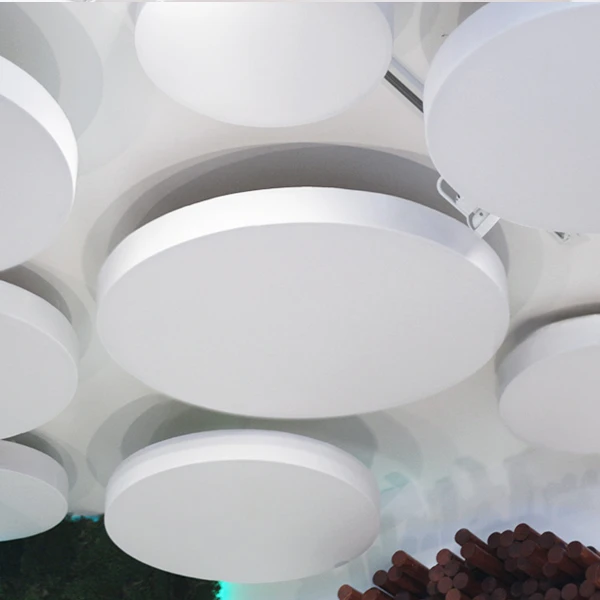
In rooms with high ceilings or hard floors, sound bounces between floor and ceiling as much as between the walls. Panels mounted near the ceiling or hung below it on chains treat that path directly. In gyms, lobbies, and open-plan homes, the ceiling is often where echo control has the most room to work.
Spreading Panels Across the Room
Panels spread across several surfaces control echo better than the same number grouped on one wall. Mount wall panels around ear height for the people using the room, seated or standing, and combine them with ceiling panels in larger spaces. The right amount depends on the room's size and how hard its surfaces are. If you send us the dimensions and a description of the room, we'll suggest a layout.
Choosing Panels for Echo Control
Echo-reducing panels differ mainly in thickness, shape, and fabric. Thickness decides how well a panel handles the voices and music in the room, while shape and fabric decide how the panels fit the space visually.
Thickness
Speech sits mostly in the middle of the frequency range, so performance around 500 and 1,000 Hz tells you how well a panel will clear up conversation. Our panels with an inner frame use Owens Corning 703 fiberglass board. In Owens Corning's data sheet (Pub. No. 10021736-H, tested to ASTM C423 against a solid backing), 1-inch 703 absorbs 0.63 at 500 Hz and 0.88 at 1,000 Hz. At 2 inches, those figures rise to 1.14 and 1.16. These values describe the bare board, and a finished fabric-wrapped panel may perform somewhat differently.
That difference is why we recommend 2-inch panels for most echo problems, especially in larger rooms and on ceilings. A 1-inch panel suits small offices and bedrooms where the goal is clearer speech. In home theaters, music rooms, and gyms, 3 and 4-inch panels extend control into the lower frequencies where a big room tends to boom.
Shapes and Colors
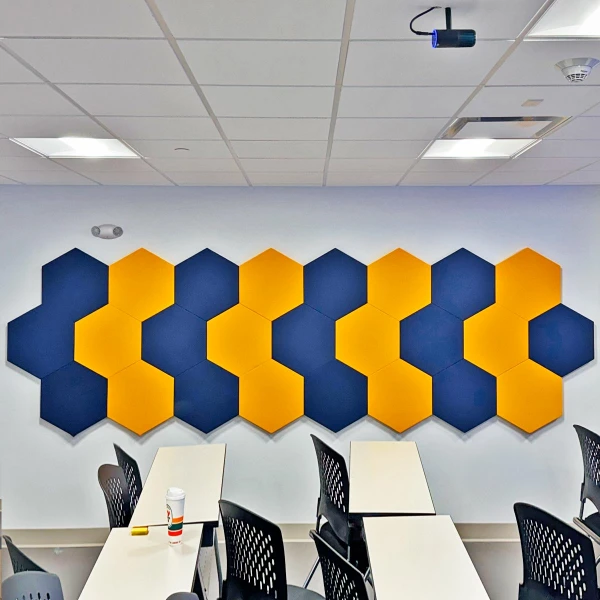
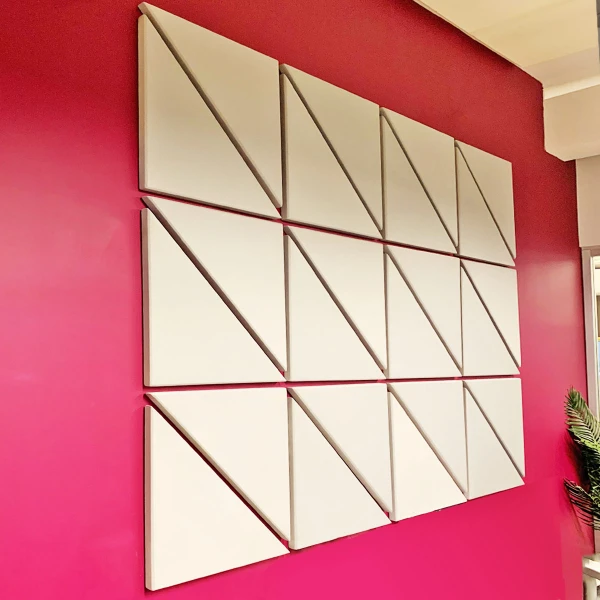
Anti-echo panels don't have to look like office equipment. Besides rectangular sizes from 1'x4' to 3'x4', panels come as hexagons, circles, triangles, and diamonds that can be arranged into patterns on a living room or reception wall. Fabric comes in two collections: Matte, with a smooth surface and 23 colors, and Anchorage, with a woven texture and 20 colors. Matching the fabric to the wall color makes panels blend in, while a contrasting color turns them into a design feature.
Installing Echo Reduction Panels
Every panel ships with its mounting hardware, and installation needs only a drill, a level, a tape measure, and anchors suited to the wall. Use concrete anchors for masonry and drywall anchors for gypsum board, and drive screws straight into wood.
On walls, panels with an inner frame hang on two offset clips, and a wood strip on the back of the panel slides down onto them. Frameless panels press onto impaling clips set a few inches inside the panel's outline, with a dab of adhesive on each clip. Either way, the panel sits close to the wall and can be leveled before it's pressed into place.
On ceilings, panels hang from four chains attached to hooks set 3 inches in from each corner of the panel's footprint. The chains angle slightly toward the center, which keeps the panel steady and level.
Where Echo Reduction Panels Make the Biggest Difference
Echo reduction panels help most where hard finishes meet everyday talking. New apartments and renovated homes with hardwood or tile floors often echo until the furniture arrives, and sometimes long after. A home office is another common case. A microphone picks up every reflection in a bare room, so the other people on a video call hear you as if you're in a stairwell.
Living rooms with high or vaulted ceilings, conference rooms with glass walls, and reception areas all benefit from panels that double as decor. Gyms, sports courts, churches, and lobbies have large volumes and hard surfaces where echo control panels on the walls and ceiling make announcements and conversation easier to understand.
Browse the full range of acoustic panels, or see our special shape panels for decorative layouts. For rooms that are loud as well as echoey, our noise reduction panels cover the same panels from a different angle. Room-specific options include acoustic panels for home office, acoustic panels for gymnasium, and church acoustic panels, and for windows and glass walls, see our acoustic curtains.
Echo sound panels treat the sound inside a room and won't stop noise coming through the walls from next door. If that's the problem, start with our sound isolation products.
Ordering, Shipping, and Returns
Panels ship by FedEx anywhere in the contiguous United States, with shipping calculated at checkout from weight, dimensions, and address. Every package is insured for the full order value, and that coverage is built into the shipping charge.
If a panel arrives damaged, email us within 5 days of delivery with photos, and we'll send a free replacement once the insurance review is done. Finished panels carry a 1-year limited warranty for interior installations that follow our mounting guidelines.
In New York City, pickup and delivery are free on orders over $150. To plan a room, send us its dimensions, a photo, and how it's used, and we'll recommend thickness, placement, and quantity.
FAQs
Frequently Asked Questions. Here are some common questions about Acoustic panels.
/01Will echo reduction panels stop noise from neighbors?
They reduce echo and reverberation inside the room where they're installed. Keeping noise from passing through walls, floors, or ceilings takes sound isolation materials, which work on the structure of the room.
/01Do I need to cover an entire wall?
Full coverage is rarely necessary. Sound panels for echo spread across the walls and ceiling at the main reflection points usually control echo with far less material than covering one wall completely.
/01Will a rug fix the echo in my room?
A rug helps with reflections from the floor, but the walls and ceiling keep reflecting. Most rooms need panels on those surfaces as well.
/01Does foam work as well as fiberglass for echo?
Foam products vary widely, and many are thin and don't publish a fire rating. Fabric-wrapped fiberglass panels come in thicknesses up to 4 inches, and ours are rated Class A for fire according to our technical data sheets.
/01Are echo reduction panels the same as noise reduction panels?
They're the same fabric-wrapped fiberglass panels used for a different goal. Echo reduction focuses on ringing and hollow-sounding rooms, while noise reduction focuses on rooms that get loud when they're full of people.
/01Can I return echo reduction panels?
Stock panels can be returned within 30 days through an RMA, minus the original shipping cost, as long as they haven't been drilled or modified. Custom sizes, custom fabrics, and light-colored panels that show signs of use can't be returned.