
Noise Reduction Panels

$48.00
$48.00
$105.00
$85.00
$55.00
$79.00
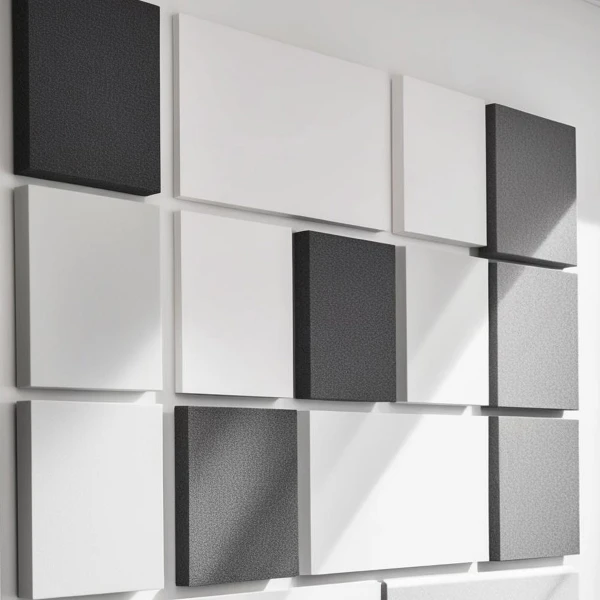
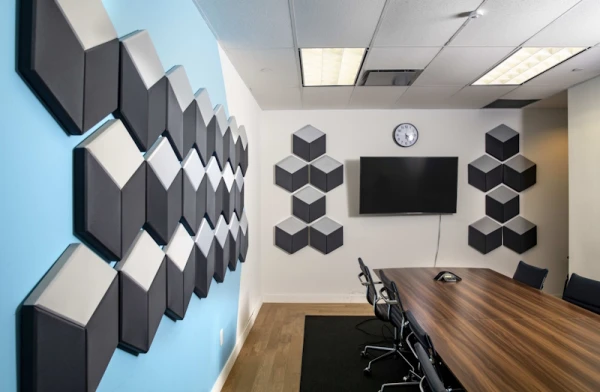
Noise reduction panels lower the noise level inside a room by absorbing the sound that would otherwise bounce off hard walls and ceilings. Ours are fabric-wrapped fiberglass panels in 1, 2, 3, and 4-inch thickness, made for both wall and ceiling installation. They're rated Class A for fire and handcrafted in the USA.
They work on noise generated inside the space: conversation, music, footsteps on a hard floor, the clatter of a busy dining room. Noise coming through the walls from a neighbor or the street needs a different solution, and the comparison below shows which one.
How Noise Reduction Panels Lower Noise in a Room
In a room with drywall, glass, and hard floors, every sound reflects many times before it fades. Those reflections overlap and add up, so the room sounds louder than the sources in it. People then raise their voices to be heard over the background, which pushes the level higher still. Restaurants, open offices, and classrooms are where this loop is easiest to hear.
A noise reduction panel breaks the loop at the reflection stage. Sound passes through the acoustically transparent fabric and into the fiberglass, where most of its energy is absorbed and little of it bounces back. With enough panels on the walls and ceiling, the background level drops, reverberation fades faster, and speech becomes easier to follow without anyone straining.
The panel's job is limited to that room. It reduces what builds up inside the space and doesn't stop sound from traveling through the structure into the next one.
Noise Reduction Panels vs Soundproofing Materials
Noise reduction panels and soundproofing materials solve two different problems. Panels absorb sound inside the room where they hang. Soundproofing materials, often called sound isolation products, keep sound from passing through a wall, floor, ceiling, or door into another space. The table matches common noise problems to the right type of product.
|
The problem |
Do noise reduction panels help? |
What solves it |
|
Echo and a room that sounds harsh or hollow |
Yes |
Panels on walls and ceiling |
|
A restaurant or open office that gets louder as it fills |
Yes |
Panels, usually with ceiling coverage |
|
Voices carrying through the wall from the next room |
No |
Added mass and damping inside the wall, plus sealed gaps |
|
Footsteps and impact noise from the floor above |
No |
A decoupled ceiling on isolation clips |
|
Traffic or street noise |
No |
Heavier walls and better-sealed windows |
|
Sound leaking under or around a door |
No |
Door bottom and perimeter seals |
Noise reduction panels are sometimes sold as noise canceling panels, and you'll see listings for noise canceling wall panels and noise canceling panels for walls. Nothing electronic happens inside them. The fiberglass absorbs sound passively, the same way any fabric-wrapped acoustic panel does.
Some rooms need both approaches. This comes up often in home studios, podcast rooms, and conference rooms for confidential calls. Isolation keeps sound from reaching the neighbors, and panels keep the room itself clear and quiet. In that case, the isolation work goes into the walls, ceiling, and door first, and the panels go up afterward.
How to Choose Noise Reduction Panels
Choosing acoustic panels for noise reduction comes down to four questions: what the panel is made of, how thick it is, where it mounts, and how many the room needs. The material and thickness decide how well each panel absorbs, while placement and quantity decide how much the room changes.
Fiberglass or Foam
Many noise-reducing wall panels sold online are thin foam tiles with adhesive backing. They're light and cheap, but foam varies widely in density, fire performance, and durability, and many products don't publish a fire rating at all. Foam can also discolor and break down with age, especially near windows.
Fiberglass noise reduction panels use rigid fiberglass board, 3 to 6 pounds per cubic foot in our frameless panels. Our technical data sheets rate the finished panels Class A for fire, which matters in offices, classrooms, and any commercial space. The fabric covering also makes them look like a finished part of the room.
Panel Thickness
Thickness sets how far down the frequency range a panel absorbs. Our panels with an inner frame use Owens Corning 703 fiberglass board, and Owens Corning publishes the absorption of that board on its own. Its data sheet (Pub. No. 10021736-H) reports tests to ASTM C423 with the board placed against a solid backing. Unfaced 703 is rated NRC 0.70 at 1 inch, 1.00 at 2 inches, and 1.15 at both 3 and 4 inches. Owens Corning tested the bare board, so a finished fabric-wrapped panel may perform somewhat differently. The figures still show the pattern clearly.
The same data sheet shows where the extra thickness helps most. At 125 Hz, the lowest band tested, absorption climbs from 0.05 at 1 inch to 0.56 at 4 inches. A 1-inch panel handles speech well, which is why it's common in offices and classrooms. We recommend 2 inches for ceilings and larger rooms, and 3 or 4 inches suits home theaters and music spaces where low-frequency noise builds up.
Wall or Ceiling Placement
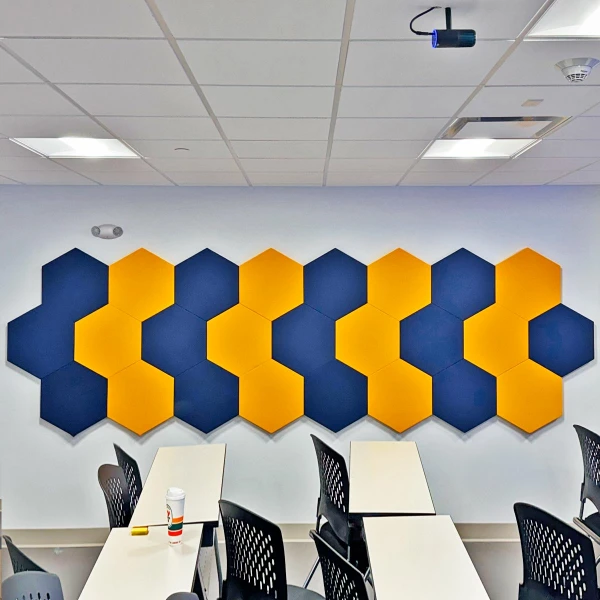
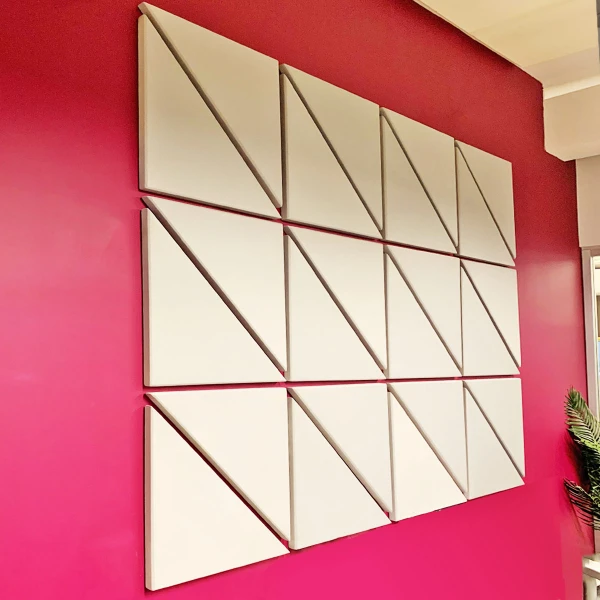
Noise reduction panels for walls are easy to reach and to place exactly where reflections start. Typical spots are the walls nearest a conference table or the wall behind a row of desks. Wall panels for noise reduction also work as part of the room's design, since the fabric comes in many colors.
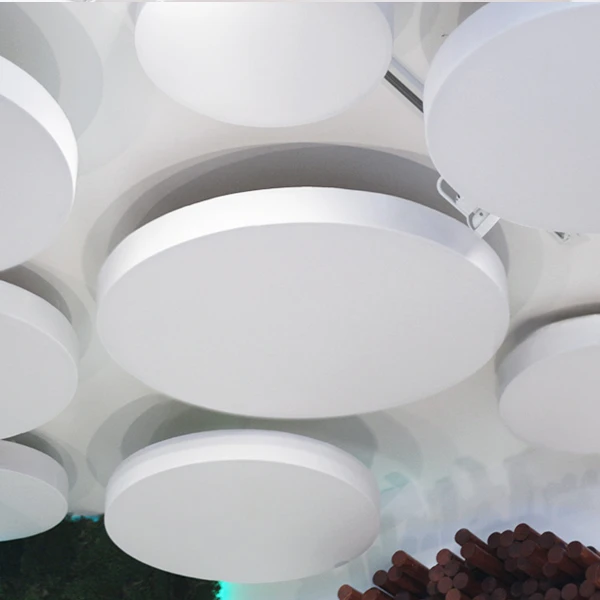
The ceiling is usually the largest hard surface in the room, and in open offices and restaurants it's often the most effective place to start. Noise reduction ceiling panels can mount close to the ceiling or hang below it on chains. Hanging noise reduction panels absorb sound on both faces, and our frameless panels have an open back for exactly that reason.
How Many Panels You Need
The right quantity depends on the size of the room, how hard its surfaces are, and how quiet it needs to be. A carpeted bedroom with soft furniture needs far fewer panels than a dining room with tile floors, glass walls, and a concrete ceiling. Rooms built for listening, like home theaters and studios, need more coverage than rooms that only need to be comfortable.
Start with the surfaces that reflect the most sound toward people: the ceiling over a seating area and the walls closest to where people talk. If you send us the room's dimensions, its main surfaces, and how it's used, we'll recommend a panel count and layout.
How to Install Noise Reduction Panels
Noise reduction wall panels and ceiling panels install with the hardware included in the box, on drywall, plaster, concrete, or wood. Pick anchors that match the surface: concrete anchors for masonry and drywall anchors for gypsum board, while wood takes screws directly. Pilot holes are drilled with a 3/16-inch bit.
Panels with an inner frame hang on two offset clips set 3 inches below the top of the panel's outline and 4 inches in from each side. The wood strip on the back of the panel slides down onto the clips. Frameless panels press onto impaling clips placed at least 3 to 4 inches inside the panel's edge, with a small amount of adhesive on each clip.
Noise-reducing ceiling panels of both types hang from four chains. Ceiling hooks go 3 inches in from each corner of the panel's footprint, so the chains angle slightly toward the center. The panel's own hooks or anchors then connect to the chains.
Where Noise Reduction Panels Make the Biggest Difference
Noise reduction panels pay off most in rooms full of people and hard surfaces. Office noise reduction panels are a standard fix in open-plan workspaces. Ceiling noise reduction panels and a few wall panels near desk clusters keep conversations from merging into one constant hum. In conference rooms, panels near the table make video calls clearer for everyone on the line.
Restaurants and bars use them to stop the dining room from getting louder as each table raises its voice. Classrooms, gyms, and churches have large volumes and hard surfaces where speech gets lost without treatment. At home, a few noise-reducing panels for walls make a home office, a living room with hard floors, or a home theater noticeably calmer.
Browse the full range of acoustic panels or our sound-absorbing panels collection. For specific rooms, see acoustic panels for conference rooms, acoustic panels for restaurants, acoustic panels for classrooms, and acoustic panels for home theater.
If the noise is coming from outside the room, start with sound isolation products. For impact noise from the floor above, see sound isolation clips for ceilings, and for sound leaking around a door, see our acoustic door seals.
Ordering, Shipping, and Returns
Panels ship by FedEx anywhere in the contiguous United States, with shipping calculated at checkout from weight, dimensions, and address. Every package is insured for the full order value, and that coverage is built into the shipping charge.
If a panel arrives damaged, email us within 5 days of delivery with photos, and we'll send a free replacement once the insurance review is done. Finished panels carry a 1-year limited warranty for interior installations that follow our mounting guidelines.
In New York City, pickup and delivery are free on orders over $150. For larger projects, send us the room dimensions and how the space is used, and we'll help you choose thickness, placement, and quantity before you order.
FAQs
Frequently Asked Questions. Here are some common questions about Acoustic panels.
/01Do noise reduction panels block noise from neighbors?
They reduce noise inside the room where they're installed, and they won't stop sound coming through a shared wall or ceiling. Blocking noise between spaces takes sound isolation materials such as mass-loaded vinyl, damping compound, isolation clips, and door seals.
/01Are noise reduction panels the same as sound absorbing panels?
Yes, they're the same fabric-wrapped fiberglass panels. "Noise reduction" describes the goal, a quieter room, while "sound absorbing" describes how the panel works. You'll find the full range on our sound-absorbing panels page.
/01Are noise canceling panels different?
Panels sold as noise canceling work by absorption, with nothing electronic inside. The name borrows from noise canceling headphones, which use a different technology altogether.
/01Are fiberglass panels better than foam for noise reduction?
Fiberglass board is denser and more consistent than most foam, and our panels are rated Class A for fire according to our technical data sheets. Foam products vary widely, and many don't publish fire ratings, which matters in any commercial space.
/01How many noise reduction panels do I need?
It depends on the room's size, its surfaces, and how quiet it needs to be. Send us the dimensions and a description of the room, and we'll recommend a panel count and layout.
/01Can I use noise reduction panels outdoors?
Our panels are made for interior use only. Installing them outdoors exposes the fiberglass and fabric to moisture and voids the warranty.
/01Can I return noise reduction panels?
Stock panels can be returned within 30 days through an RMA, minus the original shipping cost, as long as they haven't been drilled or modified. Custom sizes, custom fabrics, and light-colored panels that show signs of use can't be returned.