
Acoustic Ceiling Clouds
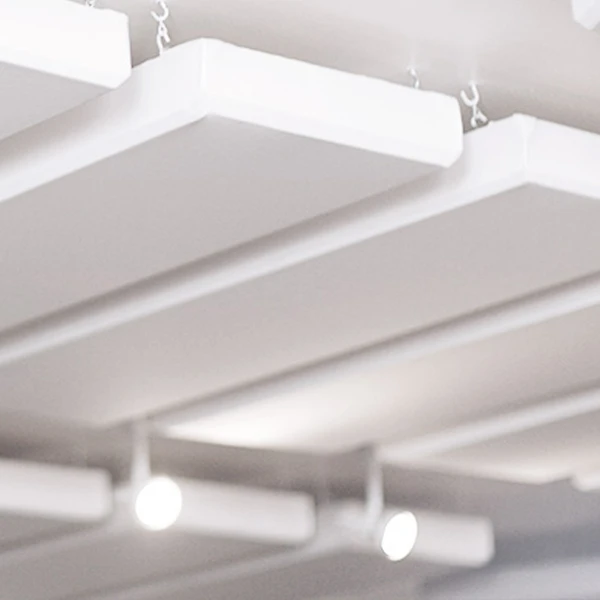
$48.00
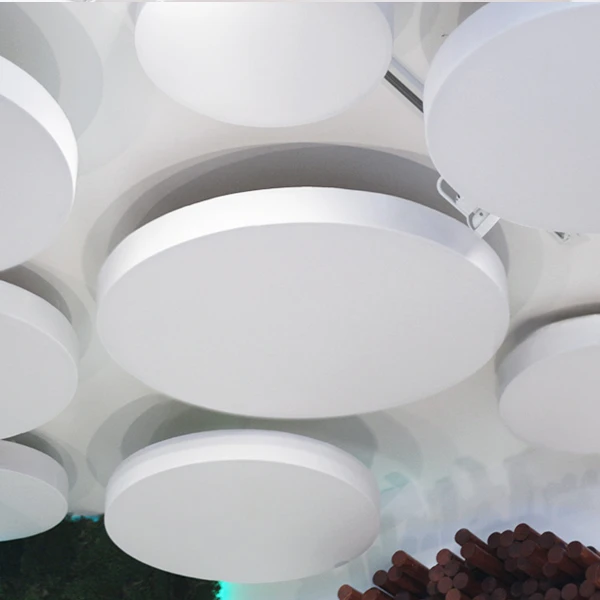
$105.00
Acoustic ceiling clouds are sound-absorbing panels suspended horizontally below the ceiling on chain or wire. The suspension is what separates a cloud from ordinary ceiling treatment: hanging in open air, the panel absorbs sound with both faces instead of one. Sound Pro Solutions builds its cloud range on fabric-wrapped panels with rigid fiberglass cores, available as squares and rectangles, large formats up to 4'x8', and shaped acoustic ceiling clouds in hexagon, circle, diamond, and triangle outlines.
Every panel in the range carries ceiling suspension options directly on its product card, alongside fabric choices and full absorption data. This page covers how suspended acoustic ceiling clouds work, which formats fit which rooms, and how to choose thickness and coverage.
How Ceiling Clouds Work
The air gap does the extra work. A cloud hung below the ceiling leaves its rear face exposed, and because our panels use an open-back construction, sound is absorbed both on the way up and again as it reflects off the ceiling deck and passes back through. One suspended panel puts two absorbing faces into the room where a flat-mounted panel offers one.
The ceiling itself is usually the best place to spend that efficiency. It's the largest uninterrupted surface in almost any room, free of the doors, windows, and furniture that fragment wall space, and it sits directly above the conversations, desks, and tables producing the sound. Suspended ceiling clouds treat that surface without construction: no grid, no demolition, just anchors and hanging hardware.
Clouds earn their place over wall panels in three situations. Rooms where glass, shelving, or artwork occupy the walls leave the ceiling as the only treatable surface. Tall spaces such as lofts and converted industrial buildings put so much air volume overhead that wall treatment alone can't reach the reverberation. And zoned rooms, a dining area, a desk cluster, a conference table, benefit from ceiling clouds for noise control placed exactly above the zone that needs quiet.
Cloud Formats
Three format families cover the range, all built on the same fiberglass core and fabric system. The differences are size, structure, and the compositions they make possible.
|
Format |
Sizes |
Thicknesses |
Suited for |
|
Square & rectangular (frameless) |
1'x4' to 3'x4' |
1"–2" |
Grids, rows, zone coverage |
|
Large-format (inner-frame) |
up to 4'x8' |
1"–4" |
Single statement clouds, big rooms |
|
Shaped (hexagon, circle, diamond, triangle) |
12" to 24" |
varies by shape |
Clusters and floating compositions |
Square and Rectangular Clouds
Frameless panels from 1'x4' to 3'x4' form the workhorse tier of ceiling cloud panels. At 2 lbs for a 2'x2' unit, they hang on light hardware, arrange into grids or staggered rows, and scale coverage panel by panel as a space grows.
Large-Format Clouds
Inner-frame panels reach 4'x8' with core thickness up to 4", and the internal wood frame is what makes that size workable overhead: it holds the panel's geometry flat across the span. One large cloud centered over a conference table or a restaurant's private dining room delivers concentrated absorption with a single, deliberate design gesture.
Shaped Clouds
Hexagons in three sizes, circles in two, diamonds, and triangles turn suspension into composition. Shaped panels weigh as little as 0.5 lbs each, so a floating cluster of a dozen pieces stays trivial for the ceiling structure while reading as an intentional design feature rather than acoustic equipment.
How to Choose Clouds for Your Space
Three decisions size a cloud project: thickness, total coverage, and drop height.
Thickness follows the guidance published on our product cards: 2" panels are the recommendation for ceiling use, with 1" reserved for walls. The extra inch extends absorption into the lower speech frequencies that large rooms accumulate. Studios and music rooms can specify 3"–4" cores on formats that offer them, where full-range absorption matters more than profile.
Coverage is a share of the ceiling area rather than a fixed count, and the right share depends on room volume, surface materials, and how the space is used. Rather than publish a one-size formula, we review dimensions and use during a consultation and return a panel count and layout; the request costs nothing and prevents both under-treatment and wasted panels.
Drop height tunes the rear face. A cloud hung close to the deck behaves nearly like a mounted panel, while a deeper drop opens the gap that lets the open back contribute fully. Ceiling height, sightlines, and lighting usually set the practical range, and we can advise on the trade-off for a specific room.
Suspension and Hardware
Each product card lists its hanging options as a hardware selection at checkout. Frameless and shaped panels hang on chain with insulation anchors or on wire with insulation anchors; wire suspended acoustic ceiling clouds read as nearly floating, while chain gives a more visible, industrial line. Inner-frame panels use chain-and-hook or wire-and-hook sets matched to the frame, and frameless panels add a snap-on anchor option that serves both wall and ceiling.
Panel weight keeps the structural demands modest. With most units between 0.5 and 2 lbs, anchoring goes into the deck or joists with light hardware rather than engineered supports. Hanging is realistic for one or two people on a ladder; for large formats, high ceilings, or commercial volumes, a professional installer of your choosing is the sensible route.
Materials
Every cloud in the range wraps a rigid fiberglass core, Whispertone or Owens Corning 703, in 100% acoustically transparent polyester. Owens Corning publishes octave-band absorption data for the 703 core measured per ASTM C423, with an NRC of 1.00 at 2" thickness, and full absorption tables appear on each product page. The core arrives completely encapsulated in fabric, so no fiber surface is exposed in the room, overhead or anywhere else.
Fabric options run across two collections, smooth Matte and textured Anchorage, in more than twenty stock colors from white through charcoal, navy, and black. Custom fabrics are available by request for projects matching a brand palette or interior scheme. Panels are produced to order, so fabric, edge profile, thickness, and hardware are chosen per piece rather than picked from a fixed stock unit.
Professional Applications
Acoustic ceiling clouds in modern office design solve the open-plan problem at its source: conversations rise, and clouds catch them above the desks before they spread across the floor. Rows of rectangular clouds over work zones and a large-format cloud over the conference table have become standard specifications, in part because they treat sound without touching the walls that glass partitions have claimed.
Restaurant acoustic ceiling clouds break the volume race, the cycle where diners speak louder to beat the noise and raise it further. Clouds above the dining floor cut the reverberant build-up while the shaped formats double as interior design, which is why hospitality projects lean on hexagon and circle clusters.
Ceiling clouds for apartments and lofts answer the exposed-ceiling problem: beautiful concrete and beams, brutal acoustics. A few suspended panels restore conversation-friendly sound without covering the architecture that made the space worth renting. A studio ceiling cloud above the mix position handles the strongest early reflection in the room, and 3"–4" cores extend that control down into the low mids.
Coverage Areas
Sound Pro Solutions ships acoustic ceiling clouds from Long Island City across the continental United States via FedEx, with every shipment insured for the full order value. Customers in Manhattan, Brooklyn, Queens, and the tri-state area can pick up at our facility or use free pickup and delivery within NYC on orders over $150.
For a coverage calculation, a thickness recommendation, or help choosing between formats, call +1-888-661-7233 or write to requests@soundprosolutions.com, Monday through Friday, 8:00–16:00 EST.
FAQs
Frequently Asked Questions. Here are some common questions about Acoustic panels.
/01What is a cloud sound dampening panel?
It's a sound-absorbing panel suspended horizontally below the ceiling on chain or wire, commonly called an acoustic cloud. The suspension exposes both faces of the panel, so acoustical ceiling clouds absorb more per unit than the same panel mounted flat.
/01Acoustic ceiling clouds or baffles: which should I choose?
Clouds hang horizontally and suit rooms where treatment should stay visually quiet and absorb reflections from below and above. Baffles hang vertically in rows and appear mostly in very large commercial volumes. For offices, restaurants, studios, and homes, clouds cover the need in nearly all cases.
/01How are clouds different from drop-in ceiling tiles?
Tiles sit in a grid or mount flat to the deck and absorb with one face; clouds suspend in open air and absorb with two. Tiles integrate into an existing suspended ceiling system, which we cover under acoustic ceiling tiles and panels, while clouds need no grid at all.
/01How many clouds does my room need?
It depends on room volume, surface materials, and use, so coverage is calculated per project rather than by a universal rule. Send us your room dimensions and how the space is used, and we'll return a recommended count and layout at no charge.
/01Will ceiling clouds block noise from upstairs neighbors?
No. Clouds absorb sound inside your room; stopping sound that travels through the ceiling structure requires isolation products such as clips, channels, and damping compound from our sound isolation range. The two are often combined in apartment projects.
/01Is a fiberglass core safe hanging overhead?
Yes. The core is fully wrapped in polyester fabric with no exposed fiber, panels weigh as little as 0.5 lbs, and each card's hanging hardware is matched to its format. Suspended use is a standard, card-listed configuration, and interior installation keeps the 1-year limited warranty on finished panels in force.