
Fiberglass Acoustic Panels
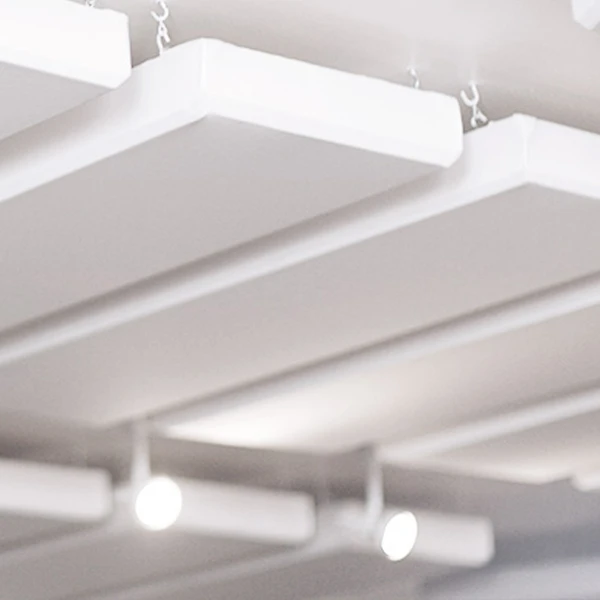
$48.00
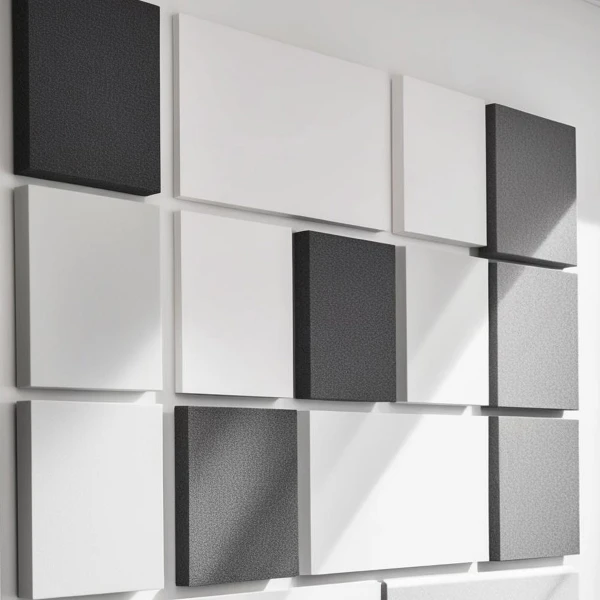
$48.00
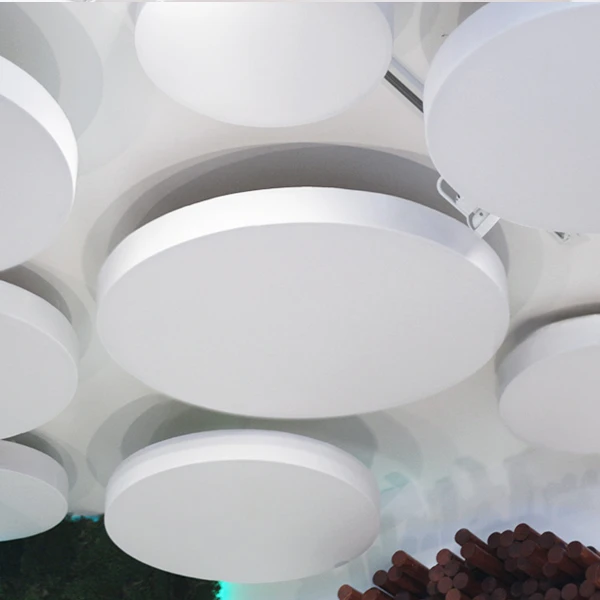
$105.00
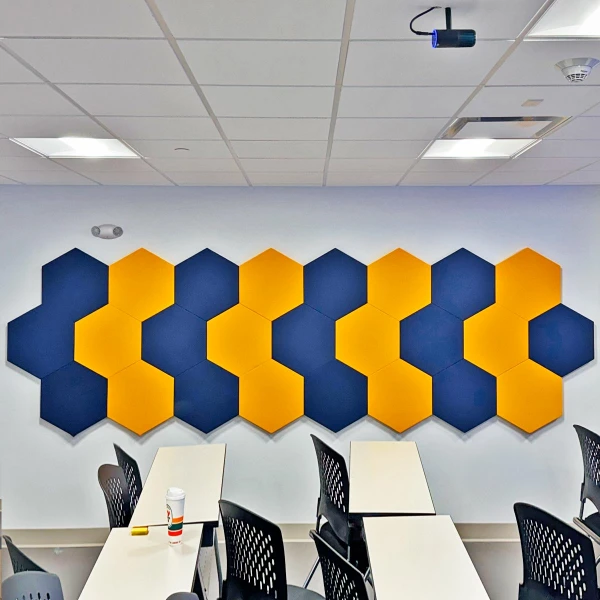
$85.00
$55.00
$79.00
Fiberglass acoustic panels are finished sound-absorbing panels built on a rigid core of compressed glass fiber and wrapped in acoustically transparent fabric. Every panel in this category uses Whispertone or Owens Corning 703 as its core, the material most studios and architects specify when they want absorption backed by published test data. The lineup includes framed and frameless rectangles, plus circles, triangles, diamonds, and hexagons, so the same core performance is available in whatever format a wall or ceiling calls for.
The fiberglass inside these panels carries the industry's best-documented absorption ratings. Owens Corning publishes octave-band coefficients for 703 measured per ASTM C423, and full absorption tables for each panel appear on the product pages.
Why Spaces Need Fiberglass Acoustic Panels
Hard surfaces reflect sound. In a room with bare drywall, glass, and concrete, speech and music bounce between surfaces for a second or longer before decaying, and the overlapping reflections blur words and smear detail. Absorption shortens that decay: as sound pushes air through the core's fiber structure, acoustic energy converts to trace amounts of heat and never returns to the room.
Rigid fiberglass does this work more efficiently per inch than foam. Owens Corning's published data rates a 2" thickness of 703 at NRC 1.00, meaning it absorbs roughly as much energy across the speech band as strikes it. Foam of equal thickness needs far more coverage to approach that figure, and foam sags and discolors with age, while a resin-bonded core holds its shape and its numbers.
Acoustic fiberglass panels solve one specific problem: sound quality inside the room. Blocking sound transfer between rooms takes mass, decoupling, and sealing, and those products live in our sound isolation categories. The two families often combine in the same project.
Types of Fiberglass Acoustic Panels
Construction and shape divide the category. All six panels share the same core material and fabric options, so choosing between them comes down to durability requirements, mounting method, and the look you're after.
Inner-Frame Panels
The Acoustic Panel with Inner Frame surrounds its 703 core with a rigid internal frame that protects edges and holds geometry over years of service. It mounts on offset clips and suits high-traffic locations, offices, corridors, and any wall where panels risk contact.
Frameless Panels
The frameless panel skips the internal structure. Fabric wraps a Whispertone/703 core straight to the edge, which reduces weight, creates a clean fabric surface with no visible border, and lets one person install it on impaling clips.
Special Shape Panels
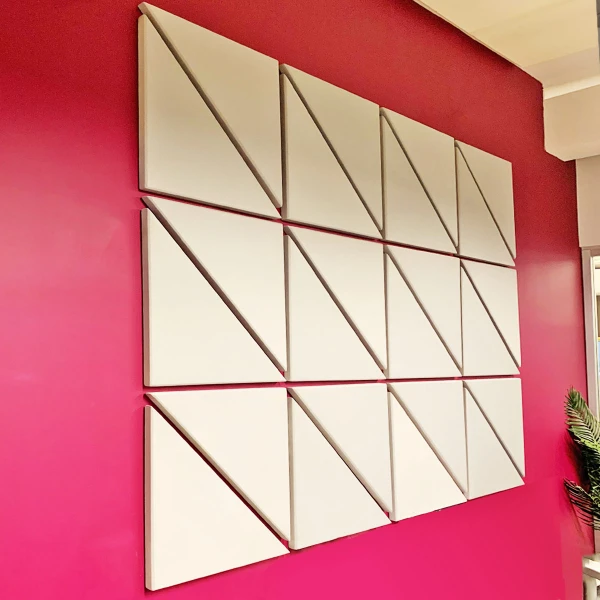
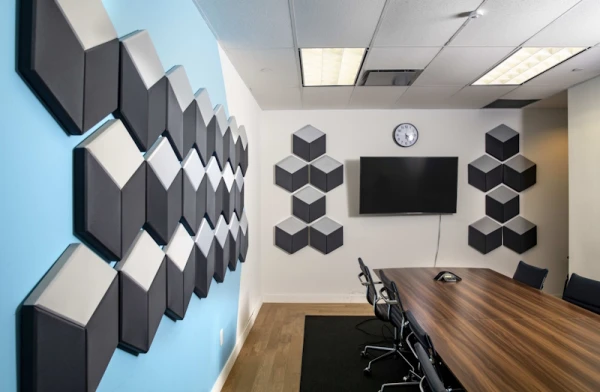
Four shaped formats turn treatment into a design element: a 14" circle on Z-clips, a 12"x12" triangle, a 12"x18" diamond, and a 12" hexagon. Grouped into clusters or scattered across a wall, they absorb with the same fiberglass core while doubling as graphic composition. Smaller formats need more units to cover the same area, which our team can calculate for your room.
How to Choose Thickness
Thickness sets the lowest frequency a panel absorbs effectively, so match it to the deepest problem sound in the room. The table below shows Owens Corning's published figures for the unfaced 703 core, measured per ASTM C423 with Type A mounting.
|
Core thickness |
Published NRC (OC 703) |
Frequency coverage |
Typical use |
|
1" |
0.70 |
Mid and high frequencies |
Offices, conference rooms, speech clarity |
|
2" |
1.00 |
Extends into low-mids |
Ceiling mounting, general rooms, home theaters |
|
3" |
1.15 |
Reaches 250 Hz and below |
Control rooms, mixing spaces |
|
4" |
1.15 |
Strongest low-frequency reach |
Studios, full-range music rooms |
Available thickness options vary by panel and are listed on each product card. A practical shortcut for most rooms: 1" handles echo and speech intelligibility on walls, 2" earns its space overhead and in music rooms, and 3"–4" belongs where low frequencies are the complaint.
Materials and Construction
Each panel pairs a compressed glass-fiber core with a 100% polyester wrap that lets sound pass through to the absorbing material behind it. The fabric comes in two collections, smooth Matte and textured Anchorage, across more than twenty stock colors, and custom fabrics are available by request for projects that need to match an interior or a brand palette.
Two edge profiles finish the panels. Square edges give crisp geometry for grids and tight layouts; beveled edges soften the profile for residential and hospitality settings. The profiles perform identically, so the choice is visual.
The open back is the construction detail worth knowing about. With no sealed rear face, a panel suspended from the ceiling absorbs on both sides, which raises the total absorption each unit contributes compared with the same panel mounted flat.
These fabric-wrapped fiberglass acoustic panels arrive finished and ready to hang, with the shedding-prone fiber fully enclosed, so no additional covering or site fabrication is involved.
Mounting for Walls and Ceilings
Fiberglass acoustic wall panels install on impaling clips, offset clips, Z-clips, or construction adhesive, depending on the model. Clip systems keep panels removable and forgiving of slightly uneven surfaces; adhesive suits light 1" panels on flat painted drywall where no visible hardware is wanted.
For overhead treatment, fiberglass acoustic ceiling panels hang on chain or wire with insulation anchors at any drop height. Suspended mounting exposes the open back, engages both faces of the core, and treats the one surface in the room that furniture and doors never occupy. Rooms with glass walls or full shelving often get better results from the ceiling than from the few wall areas left available.
Most installations are within reach of one person with basic tools, and each product card lists mounting hardware options.
Professional Applications
Recording studios and podcast rooms place panels at first reflection points beside and above the listening position, then treat the rear wall to flatten decay across the band. Thicker cores matter most here, since music production surfaces problems below the range office treatment ever meets.
Offices and conference rooms rely on 1"–2" panels to lift speech intelligibility and drop the background chatter that makes open plans exhausting. Restaurants and public venues use shaped panels to control the rising-volume effect of a full dining room without looking like a treated space.
Home theaters follow studio logic at a smaller scale: side-wall reflection control decides most of the perceived quality, and ceiling clouds handle rooms where wall space belongs to screens and seating. Across all of these, the published core data lets a designer predict results before a single panel ships.
The parent sound-absorbing panels category collects the full finished-panel range, including wood and specialty options beyond fiberglass.
Advantages of Fiberglass Acoustic Panels
The case for fiberglass rests on documentation. Owens Corning publishes octave-band absorption data for the 703 core, measured per ASTM C423, which means coverage for a room can be planned on numbers instead of estimates. Few core materials on the market come with that depth of test history behind them.
The published figures also translate into practical efficiency. With an NRC of 1.00 at just 2" of core thickness, fiberglass reaches its targets with fewer panels and shallower profiles than foam-based treatment, leaving more wall surface free and keeping projects within budget. That performance holds over time: resin-bonded cores resist sagging and keep their edges, while the polyester wrap shrugs off fading and stains through years of service.
Construction adds a bonus that raw absorption specs don't capture. The open back turns every ceiling-hung panel into a double-faced absorber, so suspended installations pull more performance out of each unit than flat mounting can. And since framed, frameless, and all four shaped formats carry the same core, a project can mix formats freely without introducing performance gaps between them.
Finished panels in this category are covered by a 1-year limited warranty for interior installation.
Coverage Areas
Sound Pro Solutions ships fiberglass acoustic panels from our Long Island City facility across the continental United States via FedEx, and insures every shipment for the full order value. Customers in Manhattan, Brooklyn, Queens, and the wider tri-state area can pick up orders at our facility or use free pickup and delivery within NYC on orders over $150.
Architects, contractors, and homeowners anywhere in the country can reach us for remote consultations on thickness, coverage, and layout before ordering. Call +1-888-661-7233 or write to requests@soundprosolutions.com, Monday through Friday, 8:00–16:00 EST.
FAQs
Frequently Asked Questions. Here are some common questions about Acoustic panels.
/01Do fiberglass acoustic panels soundproof a room?
No. Fiberglass acoustic insulation panels absorb sound inside a room, shortening reverberation and cutting echo. Keeping sound from passing through a wall requires mass-loaded vinyl, damping compound, isolation clips, and sealing, all covered in our sound isolation categories.
/01What core material is inside these panels?
Every panel in this category uses a rigid compressed glass-fiber core, specified as Whispertone or Owens Corning 703 on the product cards. Owens Corning 703 has served as the reference absorption material in US acoustic treatment for decades, with test data published by the manufacturer.
/01Which thickness should I pick?
Match thickness to the lowest problem frequency. For speech and echo on walls, 1" covers the need; 2" suits ceilings, home theaters, and music rooms; 3"–4" targets studios and rooms with bass complaints. Available thicknesses are listed per product.
/01Is the fiberglass safe once installed?
Yes. The core arrives fully enclosed in polyester fabric, so no fibers are exposed in normal use. Panels install and stay in service without any contact with the raw material.
/01Can rigid fiberglass acoustic panels hang from the ceiling?
Yes, on chain or wire with insulation anchors, at any drop height. Suspended panels absorb on both faces thanks to the open-back construction, which makes ceiling clouds one of the most efficient placements per panel.
/01Can I match panels to my interior colors?
The stock range covers more than twenty fabric colors in two textures, and custom fabrics are available by request. Note that panels made with custom fabrics are produced to order.