
Fabric-Wrapped Acoustic Panels
$48.00
$48.00
$105.00
$79.00
$55.00
$85.00
A fabric-wrapped acoustic panel is a rigid, high-density fiberglass core covered in acoustically transparent fabric and mounted on a wall or ceiling to reduce echo and reverberation inside a room. Sound passes through the fabric without reflecting off it, enters the porous fiberglass, and loses energy as it moves through the fiber.
Sound Pro Solutions supplies six fabric-wrapped panels: framed and frameless 2'x2' squares plus circle, triangle, diamond, and hexagon formats. Stock configurations are 1" thick in matte white polyester. Thicknesses up to 4", non-standard dimensions, Pantone-matched fabrics, and customer-supplied material are produced to order.
Why Spaces Need Fabric-Wrapped Acoustic Panels
Hard surfaces send sound back into the room, and those reflections reach the listener a few milliseconds behind the direct sound. The overlap blurs consonants and muddies music. Drywall, glass, concrete, and tile all reflect efficiently, so any room finished in those materials accumulates reverberation regardless of what happens inside it.
The symptoms differ by room. Restaurant guests raise their voices over the reflected conversation, which in turn raises the reflected level again, and the room grows louder as the evening goes on. In open-plan offices, speech from three desks away stays intelligible enough to interrupt concentration. In a control room, reflections off the side walls and the console bridge color everything the engineer hears, and mixes made there translate poorly elsewhere.
Absorption fixes reflections inside a space. It will not stop a neighbor's television, footsteps from the apartment above, or street noise through a window, because transmission between spaces depends on the mass and construction of the barrier. Those problems call for sound isolation products built into the assembly: mass-loaded vinyl, Green Glue, isolation clips, and door seals.
Types of Fabric-Wrapped Acoustic Panels
The category is divided by construction (framed or frameless) and by format (rectangular or shaped). All six products share the same fiberglass core and polyester covering, so the choice comes down to durability, mounting method, and how the panel should look on the wall.
Framed Fabric-Wrapped Panels
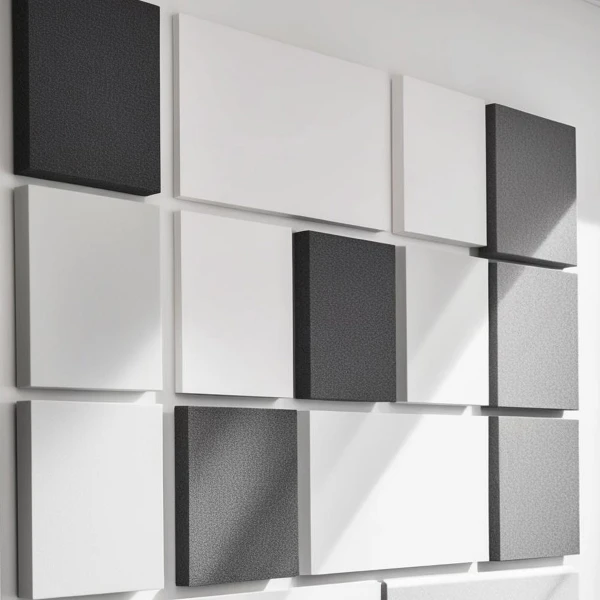
The Acoustic Panel with Inner Frame is built around an internal frame that runs the full perimeter and carries the fabric tension. Stock configuration: 2'x2', 1" thick, square edge, matte white, Core 703 fiberglass, offset clips.
The frame holds the edge geometry over years of handling, which matters in corridors, classrooms, and any location where people brush against the wall. Framed panels also take custom printing and non-standard shapes more readily, since the frame gives the fabric something rigid to pull against. The full range sits in Inner-Frame Panels.
Frameless Fabric-Wrapped Panels
The Acoustic Panel Frameless has no internal skeleton. Fabric wraps around the compressed fiberglass block and folds over the edges, so the panel reads as a single continuous surface with no visible border. Stock configuration: 2'x2', 1" thick, Whispertone 703 core, impaling clips.
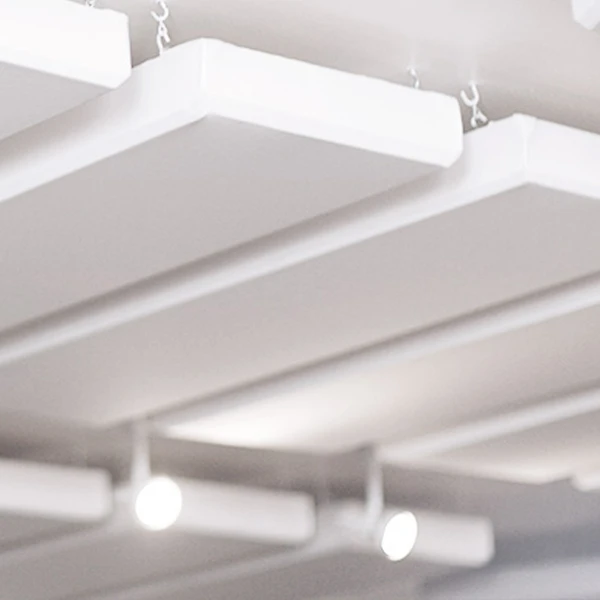
Weight is the practical difference. A frameless panel goes up with one person and puts less load on the suspension hardware, which is why ceiling clouds usually specify frameless panels. The back of the panel stays open, and that has acoustic consequences covered further down. See Frameless Panels for the full range.
Shaped Fabric-Wrapped Panels
Four non-rectangular formats use the same core and fabric as the square panels:
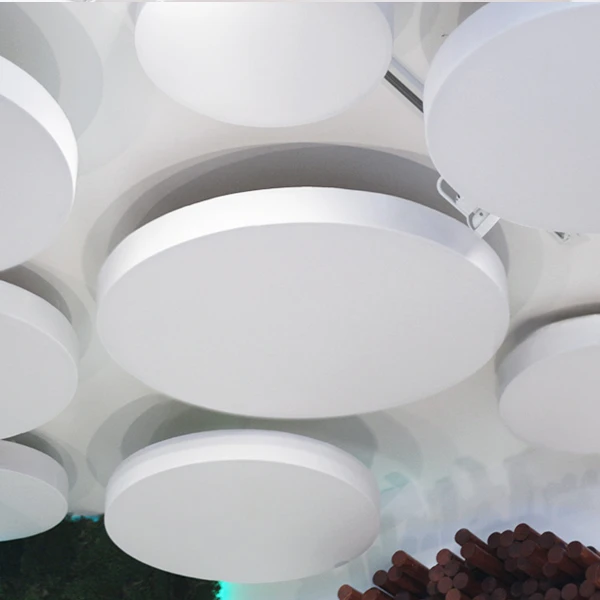
- Circle Acoustic Panel, 14", framed, Z-clips
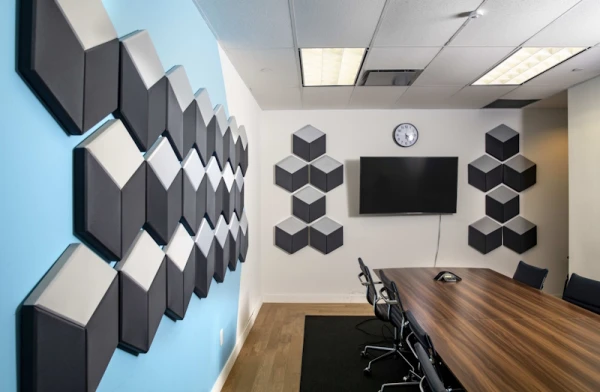
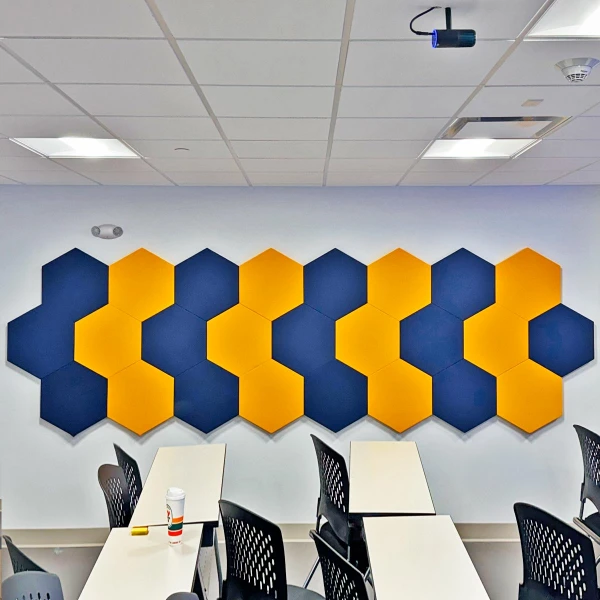
- Hexagon Acoustic Panel, 12"
- Diamond Acoustic Panel, 12"x18"
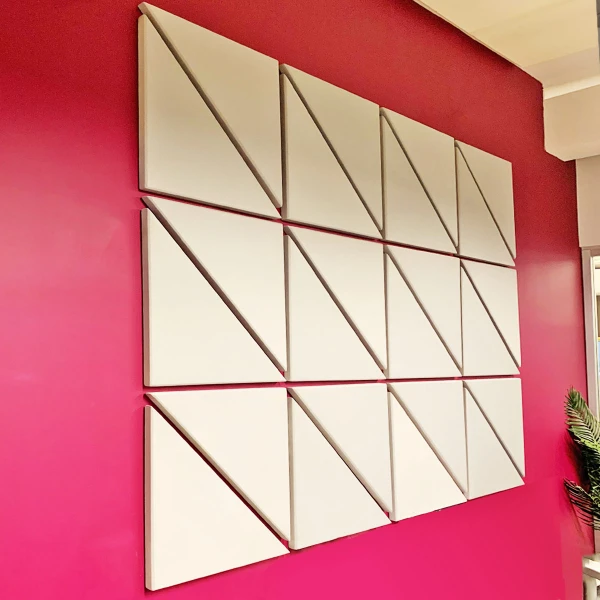
- Triangle Acoustic Panel, 12"x12"
Smaller footprints let you build a composition instead of hanging a grid: staggered hexagon clusters, triangles fanned across a corner, mixed colors in one field. Coverage still comes from total treated area, so a wall of 12" hexagons needs more units than the same wall in 2'x2' squares. All shapes are listed under Special Shape Panels.
Custom Sizes and Custom Fabrics
Made-to-order production covers dimensions, thickness, and covering. Panels can be sized to a specific wall rather than trimmed to fit one, built at 2", 3", or 4" thick, and wrapped in a fabric matched to a Pantone reference or supplied by the customer.
Send wall dimensions, ceiling height, and the intended use of the room, and we can work through panel count, thickness, and layout with you.
Materials and Construction of Fabric-Wrapped Acoustic Panels
The core determines how the panel performs acoustically, the fabric determines how it looks and wears, and the edge profile and mounting hardware determine how it sits on the surface. Each element is covered below.
High-Density Fiberglass Cores
Every fabric-wrapped panel in the catalog uses compressed high-density fiberglass board, named on the product cards as Core 703 and Whispertone 703. Owens Corning 703 is the reference material for fabric-wrapped absorbers in North American specification work.
Rigid fiberglass board maintains its dimensions, resists sagging within the fabric, and withstands humidity without breaking down. Open-cell acoustic foam of comparable thickness starts crumbling at the edges, discolors under UV, and loses shape where it is compressed by the mounting. A fiberglass panel installed correctly still measures the same ten years later.
Acoustically Transparent Polyester Fabric
The covering is 100% polyester woven openly enough for sound to pass into the core. Dense decorative upholstery reflects part of the energy back into the room, which is why furniture fabric makes a poor panel covering even when the core underneath is identical.
Two stock collections are available: Matte, a smooth flat weave, and Anchorage, a textured weave with visible surface structure. Both resist staining and hold color without fading under normal interior lighting. Custom fabrics are matched to Pantone references for brand palettes, and customer-supplied material is accepted for projects where panels have to match existing textiles. Both options are produced to order for the specific project.
Panel Thickness and Frequency Range
Absorption depends on the panel thickness relative to the sound's wavelength. High frequencies have short wavelengths and get absorbed by a thin panel; low frequencies have wavelengths measured in feet and pass through thin material almost untouched.
|
Thickness |
Frequencies handled |
Typical spaces |
Notes |
|
1" |
Speech range and above |
Offices, classrooms, living rooms, conference rooms |
The most-ordered thickness; standard for wall mounting |
|
2" |
Speech range plus additional low-mid |
Ceilings, open-plan areas, restaurants |
Recommended for ceiling installations and clouds |
|
3"–4" |
Full range, including low frequencies |
Recording studios, mixing rooms, home theaters |
Chosen where music content requires low-frequency control |
In rooms with heavy bass content, thicker panels placed in corners handle more low-frequency energy than the same panels spread across flat walls, because pressure builds at wall junctions.
Square and Beveled Edge Profiles
Two edge profiles are available, and they perform identically. The choice is visual.
Square edges produce a crisp rectangular block, which suits grid layouts, ceiling systems, and rooms with strict geometry. Beveled edges taper toward the face, softening the outline against the wall, and read better in residential rooms and hospitality interiors where the panels should not announce themselves.
Open-Back Construction
Frameless panels leave the back of the fiberglass exposed rather than closing it off behind a frame. Mounted flat against a wall, that makes little difference. Suspended from the ceiling on chain or wire, it means both faces of the panel are open to the room and absorbing.
Ceiling clouds take advantage of this. A suspended frameless panel absorbs sound arriving from above and below, so overhead treatment often delivers more per panel than the same units mounted flat on a wall.
Mounting Hardware
Panels ship with hardware matched to their construction:
- Impaling clips for frameless panels on drywall, plaster, wood, or concrete. Clips fasten to the wall, the panel presses onto the spikes, and it lifts off when needed.
- Z-clips for framed panels, including the circle format. An interlocking pair of aluminum profiles holds the panel flat and allows it to be removed.
- Offset clips for the inner-frame panel, giving a small standoff from the wall surface.
- Construction adhesive for lightweight 1" panels on flat painted drywall, with no visible hardware.
- Chain and wire suspension for ceiling clouds at any drop height.
Confirm the mounting method and the layout before drilling anything, since a panel modified for one mounting system will not accept a different one cleanly.
Professional Applications for Fabric-Wrapped Acoustic Panels
Configuration follows from what the room does. The five settings below account for most installations and indicate the thickness and construction that suit each.
Recording Studios and Podcast Rooms
Treatment starts at the first reflection points, the spots on the side walls and ceiling where sound from the monitors reaches the listening position after one bounce. Panels 3" or 4" thick handle the wider frequency range that music production requires, and corner placement addresses low-frequency buildup. Dark fabrics keep camera-facing walls neutral for video work.
Offices and Conference Rooms
Speech intelligibility and background noise drive most workplace orders. Glass-walled meeting rooms are the difficult case, since glass reflects almost everything and there is rarely wall area available, which pushes treatment onto the ceiling. Suspended clouds above the table work well here, and Pantone-matched fabric lets the panels carry brand color instead of reading as equipment.
Restaurants, Bars, and Hospitality
Dining rooms built from tile, glass, and exposed concrete run into a feedback loop: guests speak louder to overcome reflected noise, which raises the reflected level, which pushes voices higher again. Ceiling coverage breaks the cycle most effectively, and shaped panels in mixed colors let the treatment function as part of the interior scheme.
Home Theaters and Media Rooms
Side wall reflections between the speakers and the seating position blur dialogue and shift the stereo image. Panels at the first reflection points, plus treatment on the rear wall, tighten both. Beveled edges and fabric chosen to match the room keep the installation from looking like studio equipment in a family space.
Schools, Auditoriums, and Houses of Worship
Large volumes with hard finishes hold reverberation long enough to overlap consecutive syllables, which is why announcements in a gymnasium turn to noise. Framed panels are the safer specification at reachable height in these buildings, since they survive contact better than frameless. Higher elevations and ceilings can use either construction.
Advantages of Fabric-Wrapped Acoustic Panels
Fabric-wrapped construction remains the default for room treatment across residential and commercial projects. The reasons are practical.
Broadband Absorption from a Rigid Core
High-density fiberglass absorbs across the speech range and, at greater thicknesses, well into the low end. The material keeps its acoustic behavior over time, unlike foam, whose performance drifts as the cell structure degrades.
Acoustic Treatment That Reads as Interior Finish
Two stock weave collections with color options, plus Pantone matching, and four geometric formats mean the panels can be specified to disappear into a room or to become its visual anchor. Nothing about the finished installation looks like equipment.
One Product Line for Walls and Ceilings
The same panels mount flat to walls or ceilings, or are suspended as clouds, using hardware from the same range. A single specification covers a whole room, and the ceiling option matters in spaces where wall area is committed to glass, windows, or cabinetry.
Made-to-Order Sizing
Panels are produced to the project's dimensions rather than cut from a standard blank. That matters for alcoves, sloped ceilings, and wall sections between windows, where standard sizes leave awkward gaps or force compromises in coverage.
Installs on Finished Surfaces
Treatment is applied to existing walls and ceilings using clips, adhesive, or suspension hardware. No demolition, no drywall work, no repainting. A finished office or a completed home theater can be treated in an afternoon and untreated later without leaving structural damage.
Sound Pro Solutions Coverage Areas
Sound Pro Solutions supplies fabric-wrapped acoustic panels nationwide from its facility in Long Island City, New York, with local pickup and delivery for the NYC metro area.
New York City and the Tri-State Area
Customers in Manhattan, Brooklyn, Queens, the Bronx, Staten Island, and the surrounding tri-state region qualify for free pickup and delivery in NYC on orders over $150. Local customers can schedule a consultation, and for larger projects, we can look at the space on site before you specify quantities. We supply the panels and the specification guidance; installation is handled by you or your contractor.
Nationwide Shipping
Orders ship via FedEx throughout the continental United States, and every package is insured for the full order value with the insurance included in the shipping cost. Ship-out speed is listed on each product page, since stock and made-to-order items differ. Consultations by phone or email cover panel count, thickness selection, fabric matching, and layout planning for projects outside the local area.
Finished acoustic panels carry a one-year limited warranty for interior installation. If a shipment arrives damaged, notify us by email within 5 days with photographs, and we handle the FedEx claim and arrange a replacement at no cost once the insurance review is complete.
FAQs
Frequently Asked Questions. Here are some common questions about Acoustic panels.
/01Do fabric-wrapped acoustic panels block noise from neighbors?
No. They absorb reflections inside the room where they are installed. Noise transmitted through a shared wall, ceiling, or floor requires isolation materials built into the assembly, such as mass-loaded vinyl, Green Glue, or isolation clips.
/01Should I choose framed or frameless panels?
Framed panels hold their edge geometry under handling, which suits corridors, classrooms, and walls at contact height. Frameless panels weigh less, can be installed by one person, and leave the back open, which makes them the usual choice for suspended ceiling clouds.
/01What thickness do I need for a recording studio?
Three or four inches for rooms handling full-range music, with the thicker panels concentrated in corners where low-frequency energy accumulates. One inch is sufficient for voice-only recording and podcast rooms, where the working range is speech.
/01How many panels does my room need?
Panel count depends on room dimensions, ceiling height, surface materials, and the room's use. Send those details, and we can work through coverage and layout with you.
/01Can panels be wrapped in my own fabric?
Yes. We accept customer-supplied material and also match custom fabrics to Pantone references. Both are produced to order, so fabric selection is settled before production starts.
/01How do I clean fabric-wrapped panels?
Vacuum with a soft brush attachment, working across the surface rather than pressing into it. Light stains lift with a damp cloth and minimal moisture. Avoid saturating the fabric, since water reaching the fiberglass takes a long time to dry.
/01Can these panels be installed on a ceiling?
Yes, flat-mounted or suspended. Two-inch panels are the usual ceiling specification, and frameless panels suspended on chain or wire absorb from both faces because the back of the panel stays open.