
Auditorium Acoustic Panels

$48.00
$48.00
$225.00

$38.00
$79.00
$55.00
$85.00
Sound Pro Solutions supplies certified auditorium acoustic panels for architects, acoustic engineers, school administrators, contractors, and performing arts facility managers working on large-volume acoustic treatment projects. Our panels control reverberation time, improve speech intelligibility, and deliver the sound clarity that auditorium audiences require - built to NRC 0.85+ and Class A fire rating standards, available in large-format wall and ceiling configurations, with nationwide shipping and free pickup and delivery in New York City.
Acoustic Challenges in Auditorium Spaces
Auditoriums are acoustically more demanding than any other commercial space. Large volumes, high ceilings, hard parallel surfaces, and the absence of soft furnishings produce reverberation times that make speech difficult to follow and musical performances hard to resolve clearly. Adding amplification or upgrading audio equipment doesn't fix this - it only amplifies the problem along with the signal.
RT60 - the time it takes for sound to decay by 60 decibels after the source stops - is the key acoustic parameter for auditorium design. When RT60 is too long, syllables blur together and the audience loses the thread of spoken content. When it's too short, music sounds dry and lacks presence. Acoustic treatment brings RT60 within the target range for the type of use the space is designed for.
The three acoustic problems common to untreated auditoriums:
- Excessive reverberation - sustained reflections from hard wall and ceiling surfaces that reduce speech intelligibility and compromise sound definition across the seating area
- Rear wall echo - delayed reflections from the back wall that return toward the stage and audience, creating a distinct secondary signal that confuses both performers and listeners
- Uneven sound distribution - flutter echo between parallel side walls and standing waves in corners that create acoustic dead zones and hot spots across different seating positions
Treating all three requires a combined wall, ceiling, and rear wall approach - not panels on one surface alone.
Auditorium Acoustic Panels - Our Collection
Every panel in this collection is built on a certified fiberglass core - Owens Corning 703 or 705 - with NRC ratings between 0.85 and 1.0 and full compliance with Class A fire rating requirements under ASTM E84. Available in large-format sizes up to 96×48 in for efficient coverage of extended wall sections, and in ceiling-suspended configurations for overhead reverberation control in high-volume spaces. All products carry full technical documentation including NRC data sheets and ASTM E84 fire classification, available on each product page.
Wall Panels
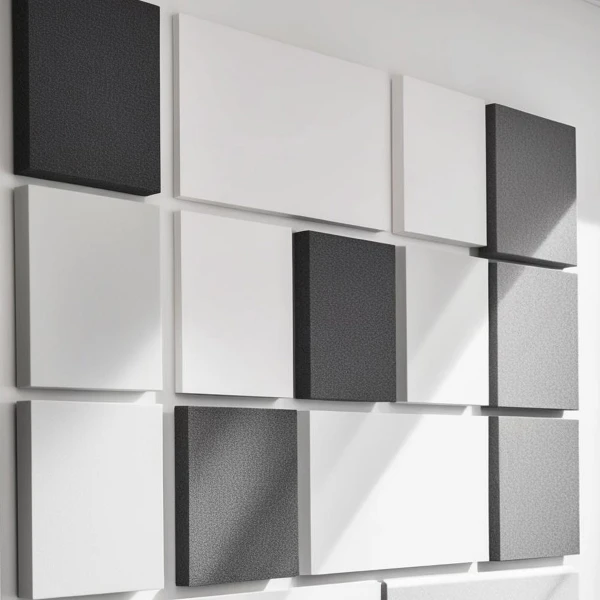
The Acoustic Panel with Inner Frame is the standard choice for auditorium side wall and rear wall treatment. Fabric-wrapped fiberglass on a rigid inner frame with offset clip mounting hardware, available in sizes from 12×12 in through 96×48 in. The large-format options are particularly efficient for covering the extended wall sections typical of school and performing arts auditoriums - fewer individual units per square foot of coverage means faster installation and lower hardware cost on large projects. The clip system allows panels to be repositioned without wall damage, which is useful during phased renovation projects where layout decisions may change between phases.
The Frameless Acoustic Panel is specified for performing arts venues and institutional auditoriums where a flush, architecturally clean wall finish is a design requirement. With no visible frame, the panel integrates directly into the wall surface without exposed hardware - the right choice for spaces where the acoustic treatment needs to disappear into the interior rather than read as a separate installation. Performance is identical to the framed version: same certified fiberglass core, same NRC rating, same Class A fire classification.
Ceiling Treatment
Acoustic Ceiling Baffles are the primary solution for overhead reverberation control in auditoriums with high ceilings, exposed structural elements, or open ceiling configurations where horizontal clouds cannot be effectively mounted. Suspended vertically from the ceiling structure, baffles add significant absorption area without requiring modification to the ceiling surface itself. They are the standard approach for large-volume spaces - school auditoriums, performing arts halls, multipurpose venues - where wall treatment alone is insufficient to bring RT60 within the target range. Available in multiple sizes and fabric finishes to match the visual requirements of the space.
Design and Architecture
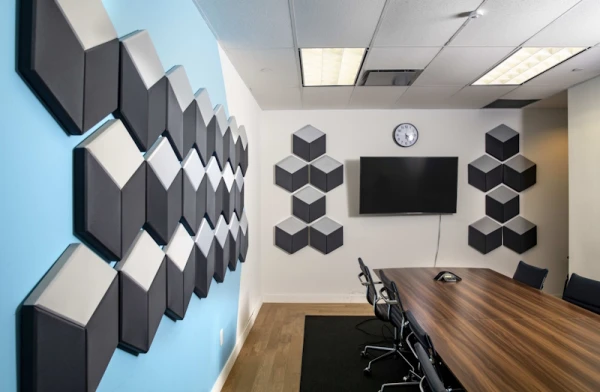
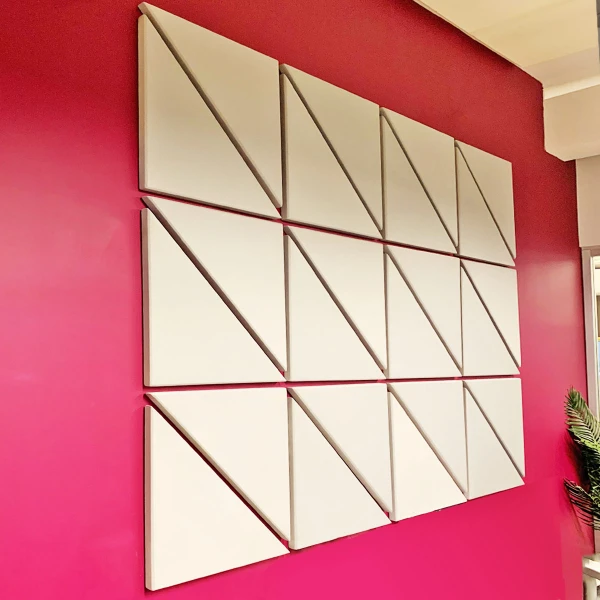
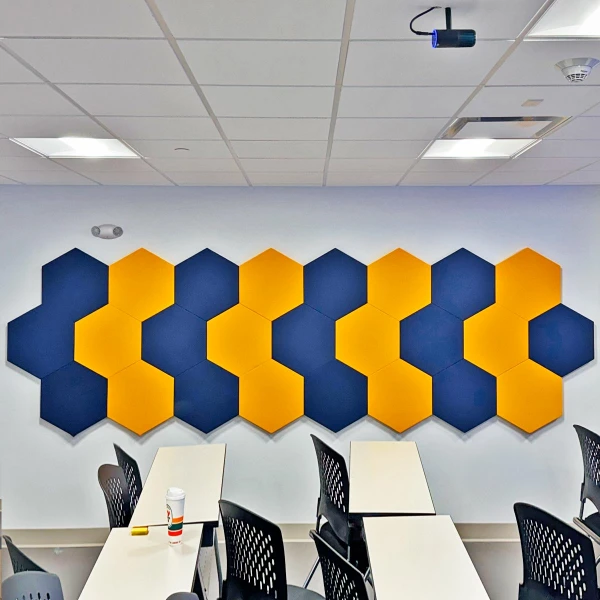
Special Shape Panels are specified for performing arts centers, theater-style auditoriums, and institutional spaces where standard rectangular formats won't accommodate the geometry of the room or the requirements of the design brief. Custom-cut and hexagonal formats allow full acoustic coverage of curved walls, angled surfaces, splayed side walls, and architecturally complex configurations that a rectangular grid installation would leave partially untreated. Acoustic absorption performance remains consistent regardless of panel geometry.
All products are in stock. Filter by size, format, or mounting type to identify the right specification for your project. For large-volume orders, contact us to discuss project pricing and delivery scheduling.
How to Choose Acoustic Panels for an Auditorium
Four parameters determine the right product specification for an auditorium acoustic treatment: target RT60, NRC rating, fire classification, and panel thickness relative to the low-frequency content of the space.
Target RT60 is the starting point for any auditorium specification. Speech-primary spaces - school auditoriums, lecture halls, presentation rooms - typically target RT60 in the 0.8-1.2 second range. Music venues and performing arts centers generally target 1.4-1.8 seconds to preserve the natural decay that music requires. The gap between your existing RT60 and the target determines how much absorption surface area you need, which directly drives the panel count and format selection.
NRC 0.85 or higher is the appropriate minimum for auditorium wall panels. Large volumes require panels that absorb the substantial majority of incident sound to produce a meaningful shift in reverberation time. Panels rated below this threshold add coverage area without delivering proportional acoustic improvement in large spaces.
Class A fire rating under ASTM E84 is required by building codes for all acoustic materials installed in public assembly occupancies, which include school auditoriums, performing arts centers, houses of worship, and multipurpose halls. Fire rating documentation is available on every product page.
Panel thickness affects low-frequency absorption. Standard 1-inch panels perform well across mid and high frequencies. In auditoriums with significant low-frequency content - music performance, amplified speech, organ - 2-inch panels extend absorption into lower frequencies and are the appropriate specification for those applications.
Acoustic Treatment by Auditorium Type
Acoustic requirements vary considerably depending on how the auditorium is used. The same panel and coverage approach that works for a school assembly hall will underperform in a performing arts center and over-dampen a church auditorium optimized for choral music. Matching the treatment to the use type is as important as the product specification itself.
School Auditorium
The primary acoustic goal is speech intelligibility - students, teachers, and presenters need to be clearly understood from every seat. Target RT60 for school auditoriums typically falls in the 0.6-1.0 second range. Side wall panels and rear wall treatment are the first priorities, with ceiling baffles added in larger halls where overhead reverberation contributes meaningfully to overall decay time.
Performing Arts Center
Performing arts venues require a balance between speech clarity and musical presence - RT60 in the 1.2-1.6 second range is typical for multipurpose performance spaces. Panel placement and coverage need to be calculated carefully to avoid over-damping the natural decay that live performance requires. Frameless panels and architecturally integrated formats are often specified here because the visual quality of the space is part of the facility's identity.
Church Auditorium
Church acoustics typically need to serve both spoken word and music, which creates competing requirements. Contemporary worship spaces with amplified music often target shorter RT60 values closer to a speech auditorium. Traditional spaces designed for choral and organ music may target longer decay times. The right specification depends on the primary use - contact us if you need help identifying the appropriate treatment approach for your specific application.
Multipurpose Hall
Multipurpose auditoriums used for both performance and presentation face the most complex specification challenge. Where the acoustic use genuinely varies, the treatment strategy needs to account for both use cases - typically through careful placement rather than maximum coverage, and by leaving some wall surfaces untreated to retain natural acoustic flexibility.
Where to Place Acoustic Panels in an Auditorium
Auditoriums have four distinct treatment zones, each addressing a different component of the acoustic problem. Side walls and the rear wall are first priorities in most spaces. Ceiling treatment and corner bass control are added based on room volume, ceiling height, and the severity of low-frequency buildup.
Side walls are the highest-priority treatment zone in most auditoriums. Lateral reflections between parallel side walls create flutter echo and contribute the largest share of reverberation energy in a typical rectangular hall. Large-format wall panels distributed across both side walls produce the most significant reduction in RT60 per unit of coverage.
Rear wall treatment prevents delayed echo from returning toward the stage. Without treatment, sound from the front of the hall reaches the rear wall and reflects back across the full length of the auditorium - creating a secondary signal that degrades both speech clarity and musical definition. The rear wall is typically treated to near-full coverage for this reason.
Ceiling baffles address overhead reverberation in halls where ceiling height or structural conditions prevent wall-only treatment from achieving the target RT60. Baffles suspended from the ceiling structure add absorption area above the seating zone without requiring modification to the ceiling surface itself.
Corner bass treatment with thicker panels or bass traps addresses low-frequency buildup at room boundaries - a significant issue in large rectangular auditoriums where bass frequencies accumulate in corners and create uneven energy distribution across the seating area.
|
Zone |
Recommended Product |
Primary Acoustic Effect |
|
Side walls |
Acoustic Panel with Inner Frame / Frameless Panel |
Reduces lateral reflections, flutter echo |
|
Rear wall |
Acoustic Panel with Inner Frame / Frameless Panel |
Prevents delayed rear wall echo |
|
High ceiling |
Acoustic Ceiling Baffles |
Controls overhead reverberation |
|
Corners |
Bass Traps / 2-inch panels |
Absorbs low-frequency buildup |
|
Curved / irregular walls |
Special Shape Panels |
Full-surface coverage on non-standard geometry |
Large-Scale Auditorium Projects - Specification and Bulk Supply
Auditorium acoustic treatment is a specified procurement, not a standard retail purchase. The project requires coverage calculations tied to a target RT60, format selection matched to each treatment zone, fire rating documentation for code compliance, and delivery coordination with a construction or renovation schedule.
Sound Pro Solutions supports the full scope of auditorium projects. For specification support, share your room dimensions, ceiling height, existing surface materials, and the target use type - our team can provide coverage recommendations and product specifications before you place an order.
Bulk pricing is available for qualifying order volumes. Auditorium projects routinely involve large panel counts across multiple sizes and formats - contact us with your project scope and we'll provide pricing appropriate to the scale of the job.
Fire rating and technical documentation - NRC data sheets and ASTM E84 Class A certification - are available for every product in our catalog. These can be provided in the format required for permit submissions or specification packages.
Working on an auditorium project? Contact us for specification support and project pricing.
Why Sound Pro Solutions
Sound Pro Solutions supplies certified acoustic materials to architects, engineers, and contractors across the United States. NRC ratings and ASTM E84 fire classification data are published on every product page, so specifiers can confirm technical compliance without requesting documentation separately - a practical requirement when preparing specification packages for institutional and public assembly projects.
All panels we stock meet the technical requirements that apply to public assembly occupancies. Class A fire classification is published at the product level, which matters when coordinating with building inspectors, submitting permit documentation, or responding to specification review from a school district or facilities department.
Our experience spans commercial, institutional, and performing arts acoustic applications across a wide range of project scales - from single-room school auditorium retrofits to full acoustic treatment of performing arts centers. That range of project experience informs the products we carry, the formats we stock in large sizes, and the specification guidance we provide when a project has both acoustic performance targets and architectural constraints to satisfy.
Orders ship nationwide with reliable delivery to construction and renovation project sites across the US. For contractors and facility teams based in New York City, free pickup and delivery is available with no minimum order requirement.
Every order is covered by our standard return policy. Our support team is available for specification assistance, product selection, and installation guidance from the initial project inquiry through to delivery - and after, if questions come up on site during installation.
FAQs
Frequently Asked Questions. Here are some common questions about Acoustic panels.
/01What NRC rating do I need for auditorium acoustic panels?
NRC 0.85 or higher is the appropriate minimum. Large volumes require panels that absorb the substantial majority of incident sound to produce a meaningful reduction in reverberation time - panels rated below this threshold underperform in high-volume spaces. All panels in our auditorium collection meet or exceed this threshold.
/01What RT60 should I target for my auditorium?
Speech-primary spaces - school auditoriums, lecture halls, assembly rooms - typically target RT60 in the 0.8-1.2 second range. Performing arts centers and music venues target 1.4-1.6 seconds to preserve natural decay while maintaining speech clarity. The gap between your current and target RT60 determines how much absorption surface area the project requires.
/01How many panels do I need for an auditorium?
There's no universal formula - panel count depends on room volume, ceiling height, current RT60, and target use type. Contact us with your room dimensions and we'll provide a coverage recommendation before you order.
/01Do auditorium acoustic panels need to be fire-rated?
Yes. Building codes require a Class A fire rating under ASTM E84 for acoustic materials in all public assembly occupancies - school auditoriums, performing arts centers, houses of worship, and multipurpose halls. Every panel in our collection carries a Class A classification, with documentation available on each product page.
/01Should I use 1-inch or 2-inch acoustic panels for an auditorium?
1-inch panels are effective for speech-primary auditoriums. 2-inch panels extend absorption into lower frequencies and are the right choice for music performance venues or spaces with amplified bass content.
/01Do auditoriums need ceiling treatment in addition to wall acoustic panels?
In larger halls with high ceilings or significant overhead volume, ceiling baffles are needed alongside wall panels to reach the target RT60. For auditoriums over approximately 5,000 cubic feet, a combined wall and ceiling approach is typically required.
/01Can you support large-scale auditorium acoustic panel projects with specification and bulk pricing?
Yes. We provide coverage recommendations, technical documentation for permit submissions, and bulk pricing for qualifying order volumes. Contact us with your project scope to get started.
/01Do you ship auditorium acoustic panels outside of New York?
Yes, we ship nationwide. Free pickup and delivery are available in New York City. For large projects requiring delivery coordination with a construction schedule, contact us in advance.